Chaotic Balls (and other animations) - Numberphile
TL;DR
Mathematical animations demonstrate chaos theory and show how even simple systems can exhibit chaotic behavior.
Transcript
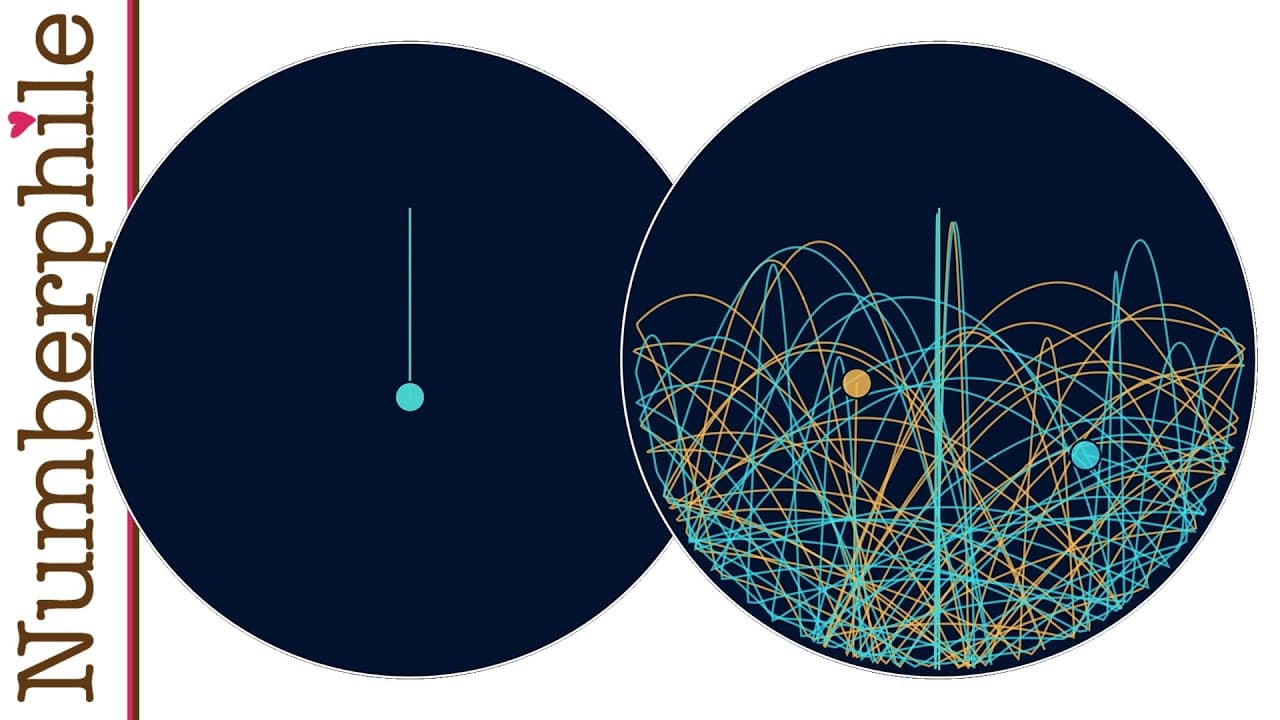
Hi I'm Matt Henderson and I like making mathematical animations; and recently I got a bit into making animations that demonstrate chaos theory. So today I wanted to show a few chaos theory animations. This one is Bouncing Balls and it's a very simple system that demonstrates chaos theory. So what we have is actually two balls - you'll start to see... Read More
Key Insights
- 🚱 Chaos theory examines systems with sensitive dependence on initial conditions and complex, non-linear dynamics.
- 🎱 Simple systems can exhibit chaotic behavior, as demonstrated by the bouncing balls and curved pool table animations.
- 🎱 Billiards problems explore the transition from non-chaotic to chaotic behavior through the introduction of obstacles.
- 🌍 Chaos theory has practical applications in understanding real-world systems and the impact of small uncertainties.
Install to Summarize YouTube Videos and Get Transcripts
Explore YouTube Video Summarizer or Get YouTube Transcript Extractor
Questions & Answers
Q: What is chaos theory?
Chaos theory studies the behavior of dynamic systems that are sensitive to initial conditions, meaning small changes in the starting conditions can result in dramatically different outcomes over time.
Q: Why does the sensitivity to initial conditions in chaos theory matter?
Sensitivity to initial conditions is significant because it means that even small uncertainties in measurement or imprecisions in modeling can lead to drastically different predictions or outcomes in chaotic systems.
Q: What makes a system chaotic?
A system is considered chaotic when it exhibits sensitive dependence on initial conditions, has a nonlinear relationship between its components, and shows a complex behavior that appears random.
Q: How do the animations illustrate chaos theory?
The animations visually demonstrate how simple systems, like bouncing balls or a pool table with curved walls, can lead to chaotic behavior due to the sensitivity to initial conditions and the nonlinear interactions between the system's components.
Q: What is the significance of the billiards problems?
Billiards problems explore the behavior of particles bouncing off specific shapes, such as circles or squares, and help illustrate the transition from non-chaotic behavior to chaos by introducing obstacles that disrupt the system's dynamics.
Q: Why is chaos theory relevant in real-world scenarios?
Chaos theory's relevance lies in understanding how small perturbations or errors can accumulate and lead to unpredictable outcomes. In real-world scenarios, it emphasizes the importance of considering the sensitivity to initial conditions, especially when dealing with complex systems.
Q: What is an attractor?
An attractor is a subspace within a system's state space where points or trajectories tend to converge or settle over time. In chaotic systems, attractors come in various shapes, such as the butterfly-shaped Lorenz attractor.
Q: How does the water wheel animation relate to the Lorenz attractor?
The water wheel animation models the movement of its center of mass, which exhibits chaotic behavior similar to the Lorenz attractor's signature butterfly wing shape. Both systems involve non-linear dynamics that lead to complex and unpredictable outcomes.
Summary & Key Takeaways
-
The first animation, "Bouncing Balls," shows how two balls diverge into different chaotic paths due to the high sensitivity to initial conditions.
-
The second animation compares a pool table with straight edges to one with slightly curved walls, highlighting the subtle change that can make a system chaotic.
-
The third animation features a water wheel with buckets that collect and leak water, demonstrating chaotic behavior in the movement of the wheel's center of mass.
Read in Other Languages (beta)
Share This Summary 📚
Summarize YouTube Videos and Get Video Transcripts with 1-Click
Try YouTube Summary with ChatGPT & Claude or YouTube Transcript Generator
Explore More Summaries from Numberphile 📚




Summarize YouTube Videos and Get Video Transcripts with 1-Click
Try YouTube Summary with ChatGPT & Claude or YouTube Transcript Generator