20. The Prisoner's Dilemma
TL;DR
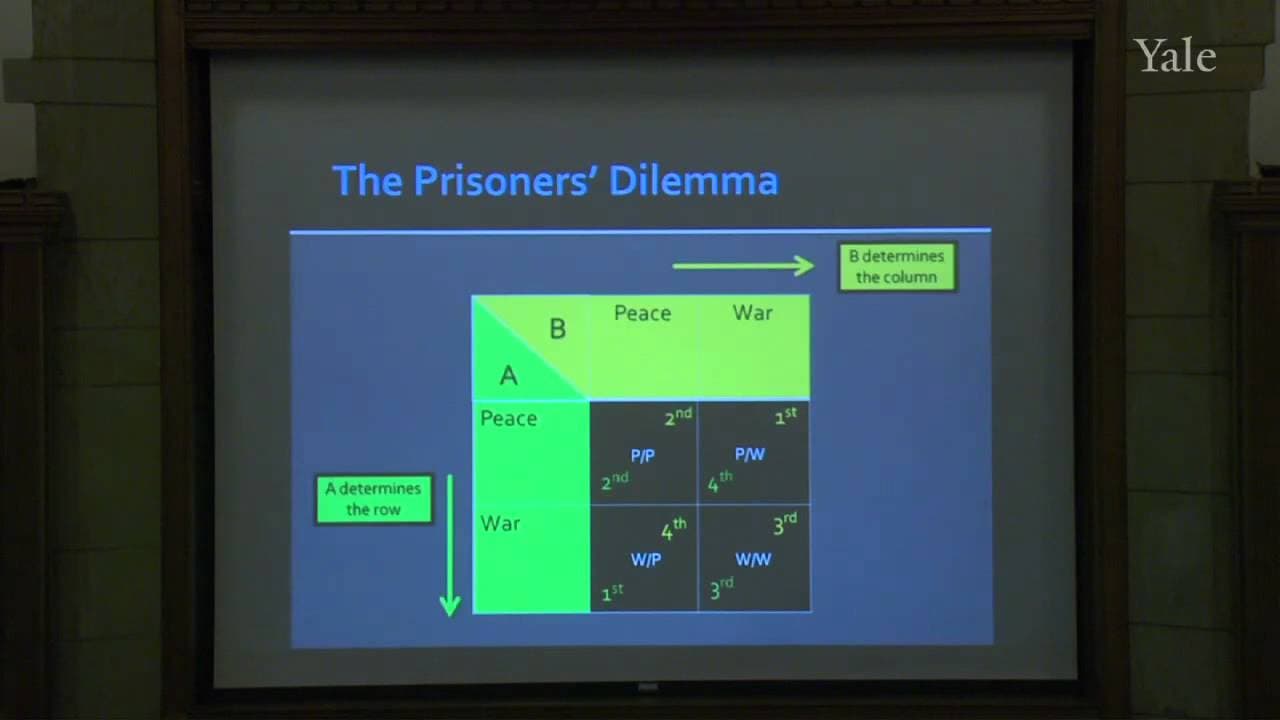
Game theory, specifically the Prisoners' Dilemma, is used to examine the structure of social behavior, cooperation, and the need for enforcement mechanisms to achieve desired outcomes.
Transcript
So, what I want to talk about today in lecture is a game theoretic notion known as The Prisoners' Dilemma, which can be used to characterize a structure that is brought out both in Book Two of Plato's Republic and in chapter 13 of Hobbes' Leviathan. And the purpose of introducing you to this way of thinking about questions is exactly what we have b... Read More
Key Insights
- 🥺 The Prisoners' Dilemma reflects the challenges of achieving cooperation in scenarios where individual self-interest may lead to suboptimal outcomes.
- 💄 Glaucon's argument in Plato's Republic aligns with the rational decision-making process in the Prisoners' Dilemma.
- 🛟 Various incentives and penalties can be employed to encourage cooperative behavior in the Prisoners' Dilemma and real-life scenarios.
- 🤳 The concept of the Tragedy of the Commons showcases the depletion of shared resources due to individual self-interest.
Install to Summarize YouTube Videos and Get Transcripts
Explore YouTube Video Summarizer or Get YouTube Transcript Extractor
Questions & Answers
Q: What is the Prisoners' Dilemma?
The Prisoners' Dilemma is a game theoretic scenario where two individuals have the choice to either cooperate or defect, leading to varying outcomes based on their choices and the other person's choice.
Q: How does Glaucon's argument in Plato's Republic relate to the Prisoners' Dilemma?
Glaucon's argument presents the idea that individuals value justice not because it is inherently good, but because they are too weak to act unjustly without facing consequences. This reflects the rational decision-making process in the Prisoners' Dilemma.
Q: What is the importance of the Prisoners' Dilemma in understanding social cooperation?
The Prisoners' Dilemma highlights the challenge of achieving cooperation in situations where individual self-interest may lead to suboptimal outcomes. It shows the need for mechanisms, such as incentives and penalties, to encourage cooperative behavior.
Q: How can the structure of the Prisoners' Dilemma be applied to real-life scenarios?
The Prisoners' Dilemma can be used to analyze various situations, such as business collaborations, international relations, and even personal decision-making. Understanding the incentives and potential outcomes can help in devising strategies to increase cooperation.
Summary & Key Takeaways
-
The lecture discusses the Prisoners' Dilemma and its presence in Plato's Republic and Hobbes' Leviathan, highlighting the concept of cooperation and the rationality of choosing to cooperate.
-
The lecture explores the nature of justice and social coordination, presenting examples such as the two shepherds and the state of nature.
-
The lecture introduces the Prisoners' Dilemma game and its matrix representation, showcasing the different possible outcomes and the importance of cooperation.
Read in Other Languages (beta)
Share This Summary 📚
Summarize YouTube Videos and Get Video Transcripts with 1-Click
Try YouTube Summary with ChatGPT & Claude or YouTube Transcript Generator
Explore More Summaries from YaleCourses 📚




Summarize YouTube Videos and Get Video Transcripts with 1-Click
Try YouTube Summary with ChatGPT & Claude or YouTube Transcript Generator