What Are the Main Types of Computer Architecture?
TL;DR
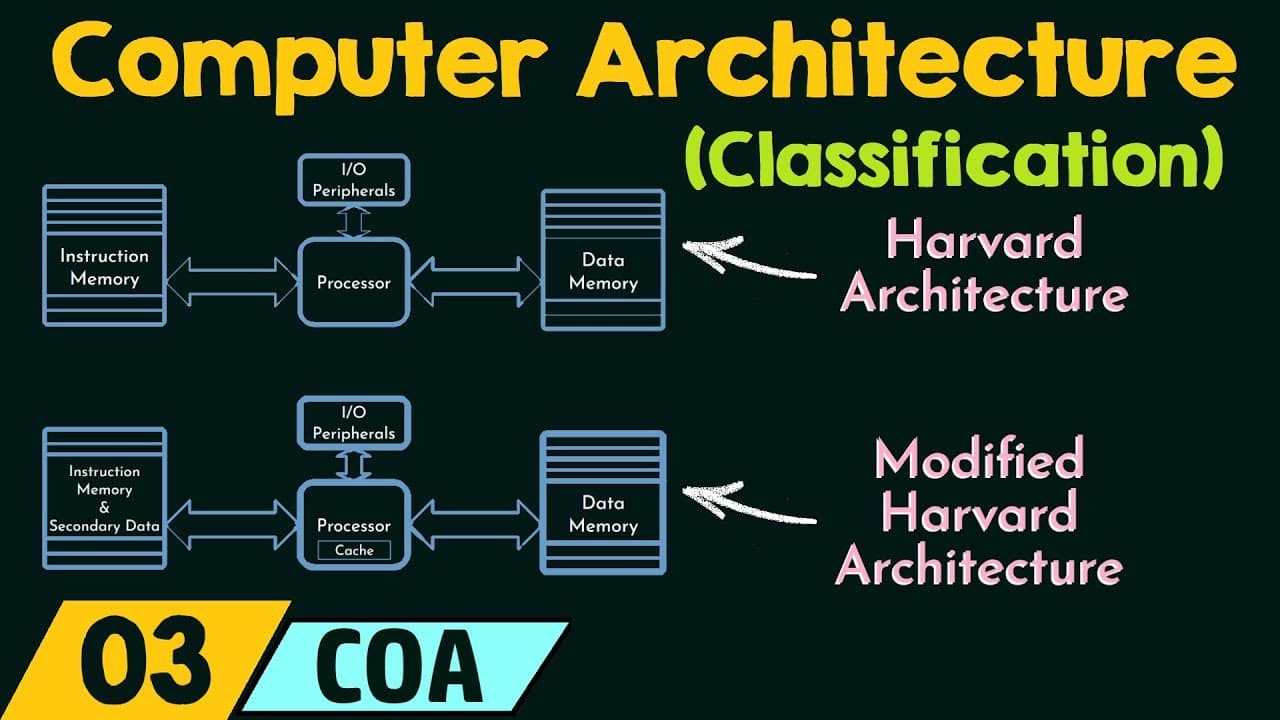
Computer architecture is primarily classified into Von Neumann and Harvard architectures. Von Neumann architecture employs a single memory path for instructions and data, while Harvard architecture uses separate memory units, enabling simultaneous access and enhanced performance. A modified Harvard approach further optimises processing with caching, combining elements of both architectures.
Transcript
well hello everyone welcome to the session and as promised in this particular lecture we are going to dive right into various classifications of computer architecture so without any further ado let's get to learning now coming to computer architecture's classifications there are various models among them we will be learning about two most popular a... Read More
Key Insights
- ✨ Computer architecture can be classified into two categories: von Neumann architecture and non-von Neumann architecture. Von Neumann machines have a CPU, main memory, and I/O system, and execute instructions sequentially.
- 🔬 Harvard architecture, proposed by Harvard University, uses two different memory units and pioneered parallelism. It solves the von Neumann bottleneck by allowing the processor to simultaneously read instructions and operate on data.
- 🔁 Modified Harvard architecture combines features of both Harvard and Princeton architectures. It relaxes the strict division of instruction and data memory, using caching for faster execution from the cache and a von Neumann machine when accessing from the backing memory.
- ⚙️ Computer architectures can also be classified based on characteristics such as the number of processors, programs they can execute, and memory structures being used.
- 🔢 SISD (Single Instruction Stream Single Data Stream) architecture, like von Neumann architecture, has a single CPU that executes one instruction and fetches/stores one item of data at a time.
- ➰ SIMD (Single Instruction Stream Multiple Data Stream) architecture, such as a processor array, has a control unit that executes a single instruction stream across multiple ALUs, operating on different sets of data items in lock steps.
- 🔀 MISD (Multiple Instruction Streams Single Data Stream) architecture theoretically executes multiple programs simultaneously on the same data items, although it hasn't found practical implementation.
- 🌐 MIMD (Multiple Instruction Streams Multiple Data Streams) architecture, also known as multiprocessors, consists of independent processors executing different sets of instructions on their own data, enabling multiple instruction and data streams.
- 📚 Flynn's taxonomy, proposed by Michael J. Flynn in 1966, has been widely used as a tool in modern processor design and functionality. It helps classify and understand the different types of computer architectures.
Install to Summarize YouTube Videos and Get Transcripts
Explore YouTube Video Summarizer or Get YouTube Transcript Extractor
Questions & Answers
Q: What are the key differences between Von Neumann and Harvard architectures?
Von Neumann architecture stores instructions and data in the same memory unit, while Harvard architecture uses separate memory units for instructions and data. This difference allows Harvard architecture to perform simultaneous instruction fetching and data access, making it faster than Von Neumann architecture.
Q: What is the purpose of caching in modified Harvard architecture?
Caching in modified Harvard architecture allows the processor to act as a pure Harvard architecture when executing instructions from the cache, but switch to acting like a pure Von Neumann machine when accessing data from the backing memory. This modification improves processing speed.
Q: What is the significance of Flynn's taxonomy in computer architecture design?
Flynn's taxonomy, proposed by Michael J. Flynn in 1966, classifies computer architectures based on the number of instruction streams and data streams they can handle. This classification has been used as a tool in the design of modern processors and their functionalities.
Q: How does SIMD architecture differ from SISD architecture?
SIMD (Single Instruction Stream Multiple Data Stream) architecture has multiple ALUs that execute the same operation on different sets of data items, while SISD (Single Instruction Stream Single Data Stream) architecture executes one instruction at a time and fetches/stores one item of data at a time.
Answer: SIMP architecture allows for parallel processing by having multiple ALUs operate on different sets of data, while SISD architecture operates sequentially on one instruction and one data item at a time. This distinction in parallelism makes SIMD machines faster in certain applications compared to SISD machines.
Summary & Key Takeaways
-
Von Neumann Architecture: It consists of a CPU, main memory, and I/O system, and executes instructions sequentially.
-
Harvard Architecture: It uses separate memory units for instructions and data, allowing for simultaneous instruction fetching and data access.
-
Modified Harvard Architecture: It combines elements of both Von Neumann and Harvard architectures, utilizing caching for faster processing.
Read in Other Languages (beta)
Share This Summary 📚
Summarize YouTube Videos and Get Video Transcripts with 1-Click
Try YouTube Summary with ChatGPT & Claude or YouTube Transcript Generator
Explore More Summaries from Neso Academy 📚






Summarize YouTube Videos and Get Video Transcripts with 1-Click
Try YouTube Summary with ChatGPT & Claude or YouTube Transcript Generator