Products
Features
YouTube Video Summarizer
Summarize YouTube videos
Web & PDF Highlighter
Highlight web pages & PDFs
Chat with PDF
Ask any PDF questions with AI
Ask AI Clone
Chat with your highlights & memories
Audio Transcriber
Transcribe audio files to text
Glasp Reader
Read and highlight articles
Kindle Highlight Export
Export your Kindle highlights
Idea Hatch
Hatch ideas from your highlights
Integrations
Obsidian Plugin
Notion Integration
Pocket Integration
Instapaper Integration
Medium Integration
Readwise Integration
Snipd Integration
Hypothesis Integration
Apps & Extensions
Chrome Extension
Safari Extension
Edge Add-ons
Firefox Add-ons
iOS App
Android App
Discover
Discover
Ideas
Discover new ideas and insights
Articles
Curated articles and insights
Books
Book recommendations by great minds
Posts
Essays and notes from readers
Quotes
Inspiring quotes collection
Videos
Curated videos and summaries
Explore Glasp
Glasp Newsletter
Weekly insights and updates
Glasp Talk
Interview series with great minds
Glasp Blog
Latest news and articles
Glasp Use Cases
Learn how others use Glasp
Build & Support
Glasp API
Access Glasp's API for developers
MCP Connector
Connect Glasp to Claude & ChatGPT
Community
Glasp Reddit Community
Students
Student discount and benefits
FAQs
Frequently Asked Questions
AboutPricing
DashboardLog inSign up

Eureka Sequences - Numberphile
247.7K views
•
April 13, 2021
by
Numberphile
YouTube video player
Eureka Sequences - Numberphile

TL;DR

Numberphile delves into two deceptively simple number sequences and reveals unexpected patterns hidden within them.

Transcript

I want to show you two sequences that if you're only given a few terms they are really hard. They both appeared in Eureka, in this magazine, in their puzzle section. The first one I can do without cheating and it goes like this: 3, 4, 6, 8, nine, ten - no - eleven, no, twelve? Yeah 12. Thirteen? Fourteen - I've already given you more than the Eurek... Read More

Key Insights

  • #️⃣ Number sequences can be deceptively simple yet hide complex patterns.
  • 🪜 Subtracting or adding specific numbers can transform a sequence into a completely different pattern.
  • 🔨 The OEIS is a useful tool for exploring existing number sequences and their explanations.
  • 💍 Brilliant offers engaging courses and challenges that help improve understanding in mathematics and science.
  • #️⃣ Discovering patterns in number sequences requires creativity and a willingness to explore different possibilities.
  • #️⃣ Consecutive prime numbers can often reveal hidden patterns in number sequences.
  • #️⃣ The sequence of prime numbers is of great interest and importance in mathematics.

Install to Summarize YouTube Videos and Get Transcripts

Explore YouTube Video Summarizer or Get YouTube Transcript Extractor

Questions & Answers

Q: How does subtracting 1 reveal the true pattern in the first sequence?

Subtracting 1 from each term in the first sequence transforms it into the sequence of prime numbers, which increases by one, then two, then four, and so on.

Q: What is the pattern in the second sequence?

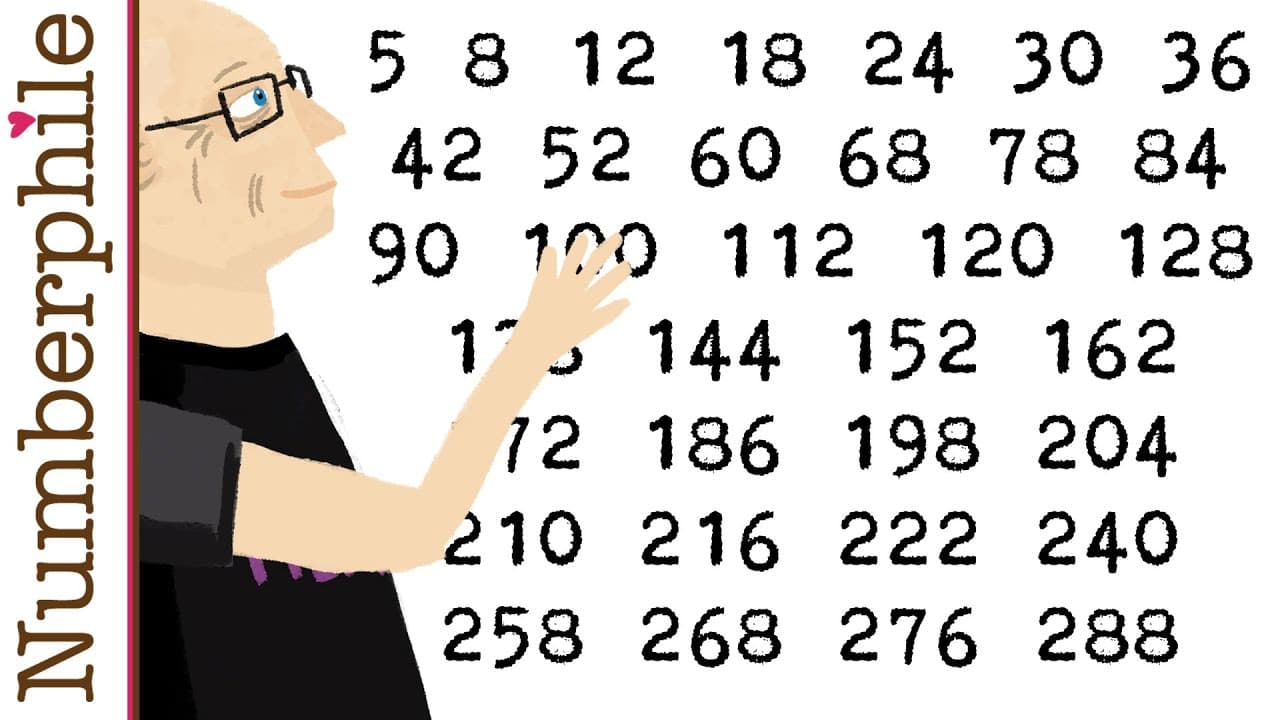
The second sequence, 5, 8, 12, 18, 24, is actually the sums of two consecutive prime numbers. So, 2 + 3 = 5, 3 + 5 = 8, and so on.

Q: What should one do when faced with similar number sequence puzzles?

When encountering number sequence puzzles, it is helpful to excuse yourself and find resources like the OEIS (On-Line Encyclopedia of Integer Sequences) to explore existing patterns and solutions.

Q: What is the benefit of using Brilliant for learning about numbers and other subjects?

Brilliant is a valuable resource offering quizzes, puzzles, and courses that enhance knowledge in mathematics and science, making learning enjoyable and impactful.

Summary & Key Takeaways

  • The first sequence starts with 3, 4, 6, 8 and seems to follow a pattern, but subtracting 1 reveals it is actually the sequence of prime numbers.

  • The second sequence is 5, 8, 12, 18, 24, which appears to be multiples of 6, but it is actually the sums of two consecutive prime numbers.


Read in Other Languages (beta)

English

Share This Summary 📚

Summarize YouTube Videos and Get Video Transcripts with 1-Click

Download browser extensions on:

Try YouTube Summary with ChatGPT & Claude or YouTube Transcript Generator

Explore More Summaries from Numberphile 📚

Brown Numbers - Numberphile thumbnail
Brown Numbers - Numberphile
Numberphile
Statistics, Storks, and Babies - Numberphile thumbnail
Statistics, Storks, and Babies - Numberphile
Numberphile
Mile of Pi - Numberphile thumbnail
Mile of Pi - Numberphile
Numberphile
What Is Pascal's Triangle and Its Mathematical Patterns? thumbnail
What Is Pascal's Triangle and Its Mathematical Patterns?
Numberphile
What Is the 10,958 Problem in Mathematics? thumbnail
What Is the 10,958 Problem in Mathematics?
Numberphile
29 and Leap Years - Numberphile thumbnail
29 and Leap Years - Numberphile
Numberphile

Summarize YouTube Videos and Get Video Transcripts with 1-Click

Download browser extensions on:

Try YouTube Summary with ChatGPT & Claude or YouTube Transcript Generator

Apps & Extensions

  • Chrome Extension
  • Safari Extension
  • Edge Add-ons
  • Firefox Add-ons
  • iOS App
  • Android App

Key Features

  • YouTube Video Summarizer
  • Web & PDF Summarizer
  • Web & PDF Highlighter
  • Chat with PDF
  • Ask AI Clone
  • Audio Transcriber
  • Glasp Reader
  • Kindle Highlight Export
  • Idea Hatch

Integrations

  • Obsidian Plugin
  • Notion Integration
  • Pocket Integration
  • Instapaper Integration
  • Medium Integration
  • Readwise Integration
  • Snipd Integration
  • Hypothesis Integration

More Features

  • APIs
  • MCP Connector
  • Blog & Post
  • Embed Links
  • Image Highlight
  • Personality Test
  • Quote Shots

Company

  • About us
  • Blog
  • Community
  • FAQs
  • Job Board
  • Newsletter
  • Pricing
Terms

•

Privacy

•

Guidelines

© 2026 Glasp Inc. All rights reserved.