Recursive Least Squares Algorithm - Adaptive Filters - Advanced Digital Signal Processing
TL;DR
This video discusses the recursive least squares algorithm for designing adaptive filters, which is more practical and useful than the gradient descent algorithm in certain applications.
Transcript
hello friends and welcome to this video we are with the sixth chapter adaptive filters learning the subject advanced digital signal processing so for the adaptive filters we have basically the two parts after introduction to the adaptive filtering system identification one is the design of finite impulse response type of the adaptive filters and th... Read More
Key Insights
- 🎮 The video introduces the recursive least squares algorithm as a practical and popular method for designing adaptive filters.
- 💁 The algorithm is more suitable when statistical information about the input and desired output is unknown.
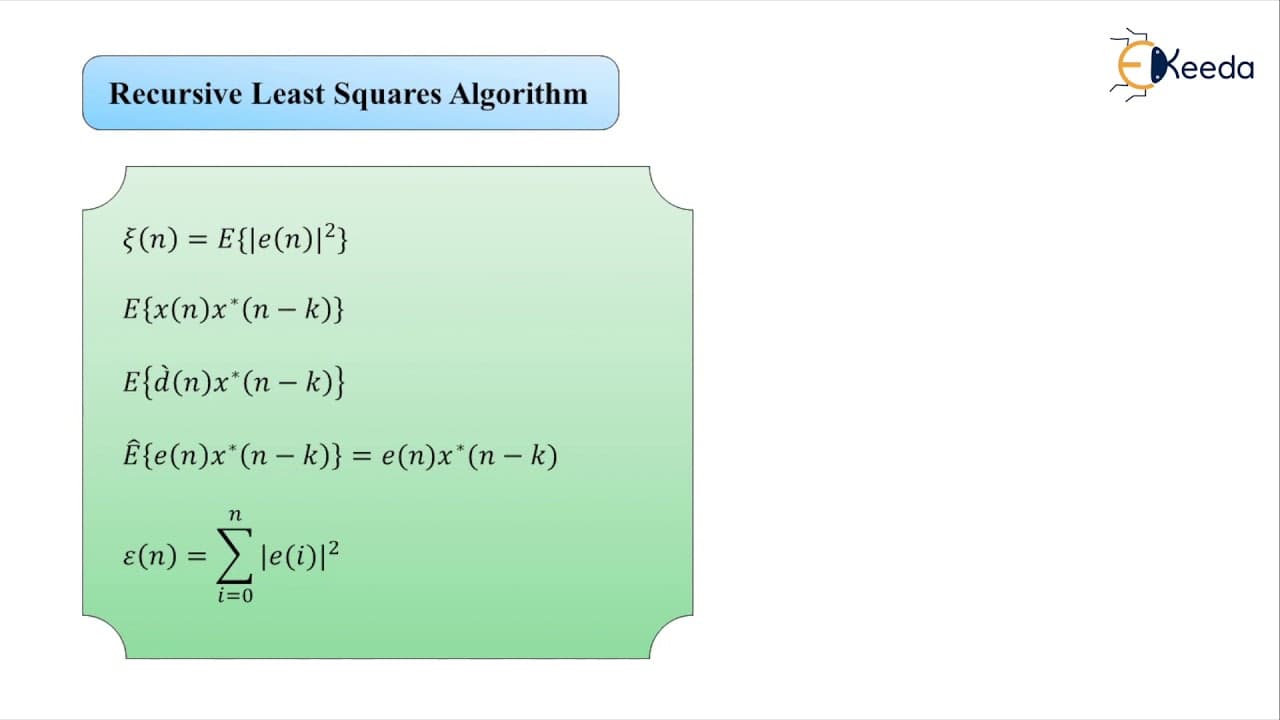
- 💻 The least squares error is used in the algorithm and can be computed directly from available data.
- ❎ The filter coefficients obtained through least square error minimization are specific to the given data, unlike those obtained through mean square error minimization.
- 🎨 The algorithm addresses the limitations of the least mean squares algorithm for recursive filter design.
- 🎮 The video hints at the discussion of the exponentially weighted recursive least squares algorithm in the next video.
- 📡 The recursive least squares algorithm is categorized as an advanced digital signal processing technique.
Install to Summarize YouTube Videos and Get Transcripts
Explore YouTube Video Summarizer or Get YouTube Transcript Extractor
Questions & Answers
Q: What are the two parts of adaptive filters discussed in the video?
The two parts are the design of finite impulse response (FIR) adaptive filters and the design of infinite impulse response (IIR) adaptive filters.
Q: What are the limitations of the least mean squares (LMS) algorithm when applied to recursive filter design?
The LMS algorithm may not provide a sufficient rate of convergence or small excess mean square error in certain applications.
Q: What is the least squares error and how is it computed?
The least squares error is denoted by the Greek symbol epsilon of n and is computed as the sum of the squared errors for each sample. It can be evaluated directly from the input and desired signals.
Q: How do the filter coefficients obtained from least square error minimization differ from those obtained through mean square error minimization?
The filter coefficients obtained from least square error minimization depend explicitly on the specific values of the desired and input signals, while those obtained through mean square error minimization depend only on their ensemble averages.
Summary & Key Takeaways
-
The video explains that for the design of finite impulse response or infinite impulse response filters, the gradient descent algorithm is often used for mean square error minimization.
-
However, if the statistical information regarding the input and desired output is unknown, alternative methods like the least squares error can be used.
-
The least squares error can be computed directly from the available data and does not require prior knowledge of statistical matrices.
Read in Other Languages (beta)
Share This Summary 📚
Summarize YouTube Videos and Get Video Transcripts with 1-Click
Try YouTube Summary with ChatGPT & Claude or YouTube Transcript Generator
Explore More Summaries from Ekeeda 📚





Summarize YouTube Videos and Get Video Transcripts with 1-Click
Try YouTube Summary with ChatGPT & Claude or YouTube Transcript Generator