How Do Ion Engines Work in Space Exploration?
TL;DR
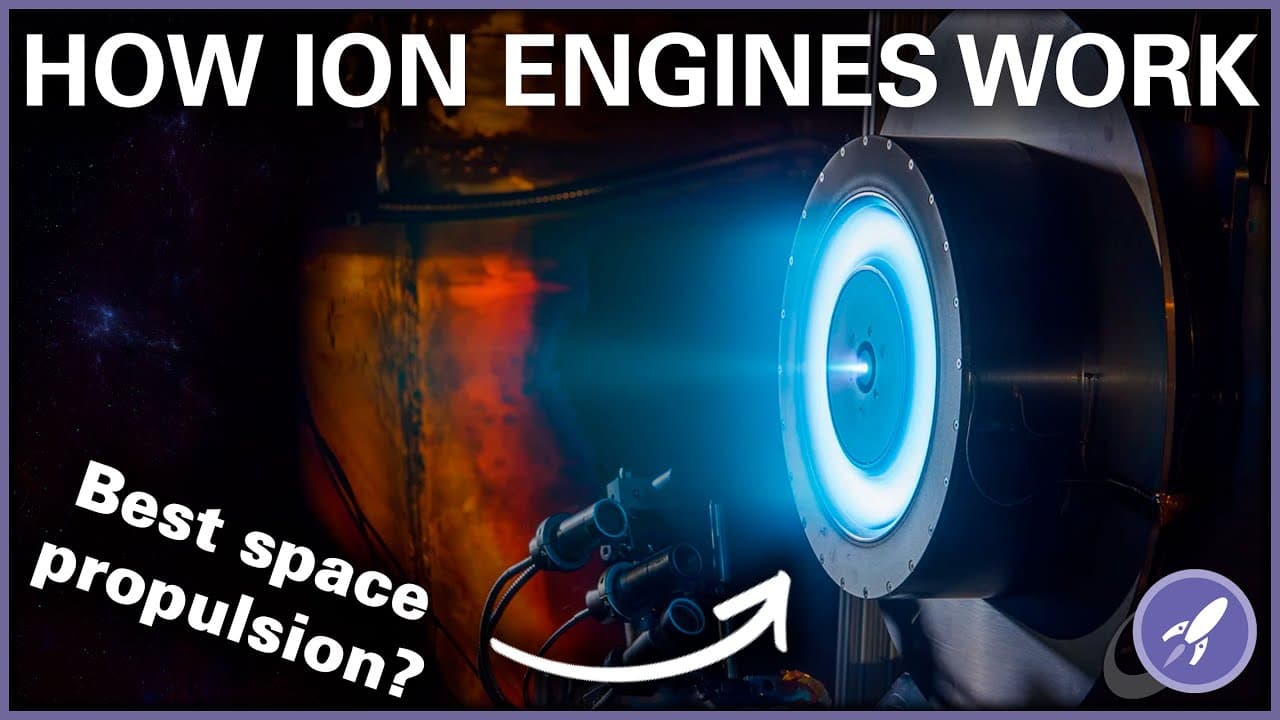
Ion engines operate by using electromagnetic fields to accelerate ions, achieving fuel efficiency of up to 90%. Unlike chemical rockets, which burn fuel quickly, ion engines can provide continuous thrust for long durations, making them ideal for deep space missions like NASA's Deep Space 1. Their unique technology allows for precise maneuvers and potential applications in future missions to Mars and beyond.
Transcript
People always ask me why we’re stuck with chemical rockets. Seriously, exploding a bunch of hydrogen or kerosene is the best we can do? Good news, there are other, exotic science fiction-sounding propulsion systems out there which use electromagnetic fields to accelerate atoms, allowing their spacecraft to accelerate for months at a time. I’m talki... Read More
Key Insights
- 😑 Ion engines offer a more efficient and long-lasting alternative to chemical rockets.
- 👻 They have already been successfully used in various space missions, allowing for extended duration and precise maneuvers.
- 😑 Ion engines have a fuel efficiency of 90%, compared to 35% for chemical rockets.
- 👾 NASA and other space agencies are continuously researching and improving ion engine technology for future space exploration.
- 🎟️ The potential applications of ion engines extend beyond Earth, with possibilities for missions to Mars, Venus, Titan, and other atmospheric planets and moons.
- 🇲🇭 Scaling up ion engines for higher thrust, such as with the X3 hall thruster, could greatly reduce flight times for human astronauts to Mars.
Install to Summarize YouTube Videos and Get Transcripts
Explore YouTube Video Summarizer or Get YouTube Transcript Extractor
Questions & Answers
Q: How do ion thrusters work?
Ion thrusters work by emitting positively charged ions, which are accelerated into space at tremendous speeds using a magnetic field. These ions are created by generating a plasma inside the spacecraft and bombarding neutral propellant atoms with electrons.
Q: How does the efficiency of ion engines compare to chemical rockets?
Ion engines have a fuel efficiency of 90%, while chemical rockets only have a fuel efficiency of about 35%. This higher efficiency allows ion engines to operate for longer durations without running out of fuel.
Q: What are some successful missions that have used ion engines?
NASA's Deep Space 1 mission, Dawn mission, and ESA's Smart 1 spacecraft and Japanese Hayabusa spacecraft have all used ion engines. These missions have allowed for close observations of asteroids, comets, and even Mars.
Q: Can ion engines be scaled up for more powerful thrust?
Yes, ion engines can be scaled up. NASA is currently testing a high thrust version of ion engines known as the X3 hall thruster, which can produce 5.4 newtons of force. This could potentially reduce flight times to Mars to just a few months for human astronauts.
Summary & Key Takeaways
-
Ion engines use electromagnetic fields to accelerate atoms, allowing spacecraft to accelerate for months at a time and perform long-duration missions.
-
Compared to chemical rockets, ion engines are much more efficient, with a fuel efficiency of 90% compared to 35% for chemical rockets.
-
NASA and other space agencies have successfully used ion engines in missions like Deep Space 1, Dawn, Smart 1, and Hayabusa.
Read in Other Languages (beta)
Share This Summary 📚
Summarize YouTube Videos and Get Video Transcripts with 1-Click
Try YouTube Summary with ChatGPT & Claude or YouTube Transcript Generator
Explore More Summaries from Fraser Cain 📚


Summarize YouTube Videos and Get Video Transcripts with 1-Click
Try YouTube Summary with ChatGPT & Claude or YouTube Transcript Generator