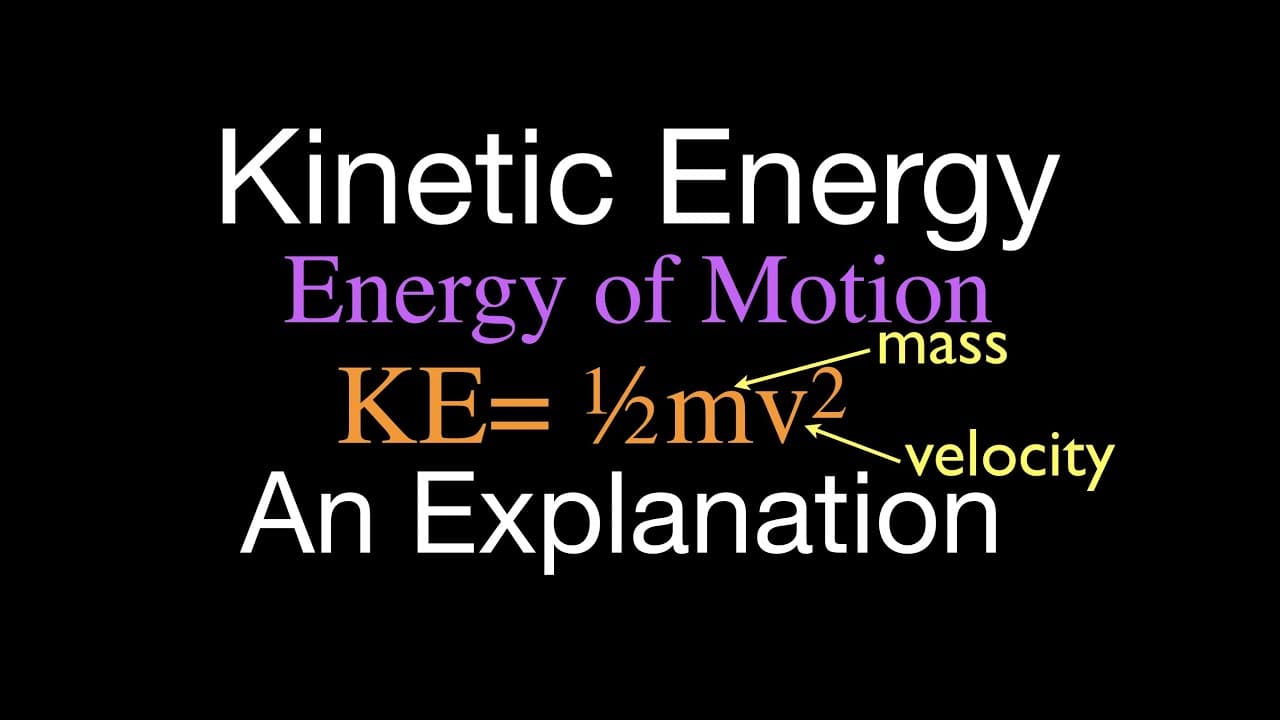
Energy, Work, & Power, (1 of 31) Kinetic Energy, An Explanation
TL;DR
Kinetic energy is the energy of motion and is directly proportional to an object's mass and the square of its velocity.
Transcript
okay in today's video we are going to go over kinetic energy and here we have our definition of kinetic energy now an object that is in motion and that's what kinetic means in motion object that is in motion has the ability to do work that is it has the ability to apply a force over a distance and therefore we say it has energy the energy that an o... Read More
Key Insights
- ❓ Kinetic energy is the energy possessed by an object in motion.
- 🥰 The formula to calculate kinetic energy is K = 1/2 mv^2, where m is the mass and v is the velocity.
- 💆 Kinetic energy is directly proportional to both mass and the square of velocity.
- 💆 Increasing the mass or velocity will increase the kinetic energy.
- ✋ The relationship between velocity and kinetic energy has practical implications, such as stopping distances in driving.
- 🙏 Doubling the velocity will result in a four-fold increase in kinetic energy, while tripling the velocity will lead to a nine-fold increase.
- 💦 Kinetic energy is measured in Joules, the unit for energy and work.
Install to Summarize YouTube Videos and Get Transcripts
Explore YouTube Video Summarizer or Get YouTube Transcript Extractor
Questions & Answers
Q: What is kinetic energy?
Kinetic energy is the energy that an object has due to its motion. It is the ability to do work and is calculated using the equation K = 1/2 mv^2.
Q: How is kinetic energy related to mass?
Kinetic energy is directly proportional to mass. If the mass is doubled, the kinetic energy will also double. If the mass is decreased, the kinetic energy will decrease accordingly.
Q: How is kinetic energy related to velocity?
Kinetic energy is directly proportional to the square of velocity. If the velocity is doubled, the kinetic energy will increase by a factor of four. If the velocity is tripled, the kinetic energy will increase by a factor of nine.
Q: What practical applications does the relationship between velocity and kinetic energy have?
The relationship between velocity and kinetic energy shows that every time the velocity is doubled, it will take four times the distance to stop. Similarly, tripling the velocity will require nine times the distance to stop. This is important to consider when driving a car or any moving object.
Summary & Key Takeaways
-
Kinetic energy is the energy that an object in motion possesses.
-
The equation to calculate kinetic energy is K = 1/2 mv^2, where m represents mass and v represents velocity.
-
Kinetic energy is directly proportional to mass and the square of velocity.
Read in Other Languages (beta)
Share This Summary 📚
Summarize YouTube Videos and Get Video Transcripts with 1-Click
Try YouTube Summary with ChatGPT & Claude or YouTube Transcript Generator
Explore More Summaries from Step by Step Science 📚
Summarize YouTube Videos and Get Video Transcripts with 1-Click
Try YouTube Summary with ChatGPT & Claude or YouTube Transcript Generator