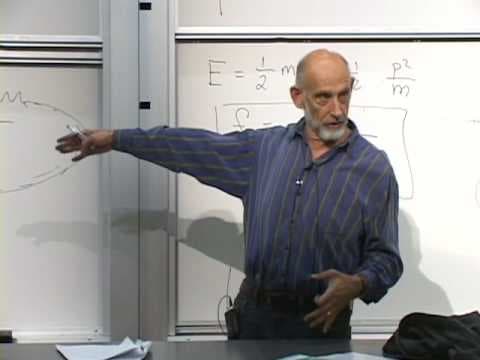
Lecture 4 | Quantum Entanglements, Part 1 (Stanford)

Transcript
this program is brought to you by Stanford University please visit us at stanford.edu uh we won't get to Bells theorem but that's okay we can do that next week I hope we get to entanglement all right but we were in the midst of still entanglement has to do with what happens the simplest case of it is when you have two electrons with their spins for... Read More
Install to Summarize YouTube Videos and Get Transcripts
Explore YouTube Video Summarizer or Get YouTube Transcript Extractor
Summary
In this video, the speaker discusses the concept of entanglement and quantum states in the context of spin systems. They explore the measurement of spin along different axes and the probabilities associated with different outcomes. The speaker also introduces the idea of eigenvectors and their role in measurements. They demonstrate the dependence of probabilities on the angle between two axes and the rotational symmetry of the system. Finally, they explain that the simultaneous measurement of certain quantities is not possible unless the corresponding matrices commute.
Questions & Answers
Q: What is entanglement and how does it relate to quantum states?
Entanglement refers to the phenomenon that occurs when two or more quantum systems become correlated in such a way that the state of one system cannot be described independently of the state of the other system. This means that the quantum states of the individual systems cannot be separated and must be described together as a whole.
Q: What is the difference between measuring spin along an arbitrary axis and measuring it along a specific axis?
When measuring spin along a specific axis, we are interested in the component of spin along that axis. This can be represented by a unit vector that has components corresponding to the three dimensions (x, y, z) in space. However, when measuring spin along an arbitrary axis, we need to calculate the dot product of the spin vector with the unit vector representing the arbitrary axis.
Q: How do we calculate the probability of obtaining a certain spin outcome when measuring along an arbitrary axis?
To calculate the probability, we first need to find the eigenvector of the spin operator corresponding to the desired outcome. We then take the inner product of the prepared state (with its spin aligned along the initial axis) and the final outcome state (with its spin aligned along the measurement axis). The result is the probability amplitude, which can be squared to give the probability of obtaining that specific spin outcome.
Q: Can we measure spin along multiple axes simultaneously?
No, it is not possible to measure spin along multiple axes simultaneously unless the matrices corresponding to the spin operators commute. This means that they have the same set of eigenvectors. In such cases, all the eigenvectors are simultaneous eigenvectors, allowing for simultaneous measurements.
Q: What is the relationship between rotational symmetry and the measurement of spin along different axes?
The measurement of spin along different axes is invariant under rotational symmetry. This means that if the experiment is rotated, the probabilities and outcomes of the measurements remain the same. The answer to a measurement only depends on the angle between the initial and measurement axes, not their specific orientation in space.
Q: Is there an equation that represents the probability of obtaining a certain spin outcome based on the angle between the initial and measurement axes?
Yes, the probability of obtaining a certain spin outcome can be represented by the formula: 1 + cos(theta) / 2, where theta is the angle between the initial and measurement axes. This formula holds true as long as the matrices corresponding to the spin operators do not commute.
Takeaways
In this video, we explored the measurement of spin along different axes and the probabilities associated with different outcomes. We learned that the simultaneous measurement of spin particles along multiple axes is only possible if the corresponding matrices commute. Additionally, we discovered that rotational symmetry plays a crucial role in the measurement outcomes, as the probabilities depend solely on the angle between the initial and measurement axes. These insights highlight the unique behavior of quantum states and the importance of eigenvectors in quantum measurements.
Read in Other Languages (beta)
Share This Summary 📚
Summarize YouTube Videos and Get Video Transcripts with 1-Click
Try YouTube Summary with ChatGPT & Claude or YouTube Transcript Generator
Explore More Summaries from Stanford 📚





Summarize YouTube Videos and Get Video Transcripts with 1-Click
Try YouTube Summary with ChatGPT & Claude or YouTube Transcript Generator