Lecture 1 | Modern Physics: Quantum Mechanics (Stanford)

Transcript
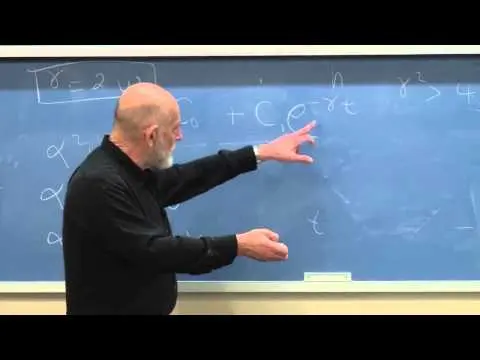
this program is brought to you by Stanford University please visit us at stanford.edu I I just want to do one thing actually before we start the uh the material of the Class A whole bunch of people a lot of people particularly people from Europe who actually follow these things on the Internet seem very puzzled they send me email even some of my fr... Read More
Install to Summarize YouTube Videos and Get Transcripts
Explore YouTube Video Summarizer or Get YouTube Transcript Extractor
Summary
This video is a lecture on quantum mechanics for non-traditional students who are part of a continuing education program at Stanford University. The lecturer explains the fundamental differences between classical mechanics and quantum mechanics, focusing on the concepts of randomness and uncertainty. He discusses examples such as the interference pattern in the two-slit experiment and the reversibility of physical laws. The lecturer highlights the unique nature of quantum mechanics and underscores how measurements can disturb and change the behavior of quantum systems.
Questions & Answers
Q: What is the purpose of this class?
This class is part of a continuing education program at Stanford University, aimed at non-traditional students who are interested in deepening their understanding of physics beyond the undergraduate or graduate level.
Q: What is the difference between classical mechanics and quantum mechanics?
Classical mechanics is the study of physical laws that govern the motion and behavior of macroscopic objects. It is based on deterministic principles, meaning that the equations of motion can predict the exact future behavior of a system given its initial conditions. On the other hand, quantum mechanics deals with the behavior of microscopic particles and is based on statistical thinking and uncertainty. While quantum mechanics includes a level of randomness and unpredictability, it is not the same as the classical randomness introduced by random kicks or fluctuations in the system.
Q: How does the age distribution of the students in this class differ from typical undergraduate or graduate courses?
Most of the students in this class are older and not traditional undergraduate or graduate students. They are part of the local community and are seeking continued education opportunities. While some may have connections to Stanford, such as being employed or past students, the majority are not current students.
Q: What are some characteristics of the lectures in this class?
The lectures in this class are not standard undergraduate or graduate courses. They focus on theoretical physics at a full-scale level, using equations and exploring complex concepts. The lecturer tries to simplify the material as much as possible while still maintaining accuracy and depth of understanding.
Q: What is the difference between classical randomness and quantum randomness?
Classical randomness is characterized by the introduction of random kicks or fluctuations into the laws of physics. It can lead to unpredictability and changes in energy or motion. However, quantum randomness in quantum mechanics is fundamentally different. It is based on statistical distributions and is not associated with changes in energy conservation. In quantum mechanics, even though the behavior of a system may be unpredictable, the energy is conserved.
Q: Can you provide an example of the oddness of quantum mechanics compared to classical randomness?
One example is the two-slit experiment. In classical randomness, if a beam of particles passing through a single hole is subjected to random kicks or fluctuations, the resulting distribution of particles on a screen behind the hole would form a blob-like pattern. However, in the two-slit experiment of quantum mechanics, where particles can pass through both slits simultaneously, the resulting distribution on the screen shows an interference pattern with areas of constructive and destructive interference. The randomness in quantum mechanics is quite different and has a unique effect on the behavior of particles.
Q: How does the ability to detect or measure a quantum system impact the behavior of the system?
In quantum mechanics, the act of detecting or measuring a quantum system can disturb it, leading to changes in its behavior. This is different from classical mechanics, where measurement can be done gently without significant disturbance. In quantum mechanics, the disturbance caused by measurement can change the outcome and introduce additional uncertainties. For example, in the two-slit experiment, if a measurement is made to determine which slit the particle passed through, the interference pattern will be destroyed.
Q: What is the role of the uncertainty principle in quantum mechanics?
The uncertainty principle in quantum mechanics states that there is a fundamental limit to the precision with which certain pairs of physical properties, such as position and momentum, can be simultaneously known. In the context of the discussion, the uncertainty principle helps explain why detecting the position or path of a particle in the two-slit experiment destroys the interference pattern. The act of detecting the particle's position introduces uncertainty in its momentum, which disrupts the interference pattern.
Q: Can the uncertainty principle explain why the interference pattern is preserved when a detector is not involved?
Yes, the uncertainty principle plays a key role in maintaining the interference pattern when no detector is involved. If the position of the detector is very well localized in space, the uncertainty in its momentum becomes large according to the uncertainty principle. This means that the detector's momentum becomes uncertain, making it difficult to determine whether it received a kick or not from the particle. As a result, the interference pattern is preserved because the uncertainty in the detector's momentum prevents the detection process from significantly altering the outcomes.
Read in Other Languages (beta)
Share This Summary 📚
Summarize YouTube Videos and Get Video Transcripts with 1-Click
Try YouTube Summary with ChatGPT & Claude or YouTube Transcript Generator
Explore More Summaries from Stanford 📚
Summarize YouTube Videos and Get Video Transcripts with 1-Click
Try YouTube Summary with ChatGPT & Claude or YouTube Transcript Generator