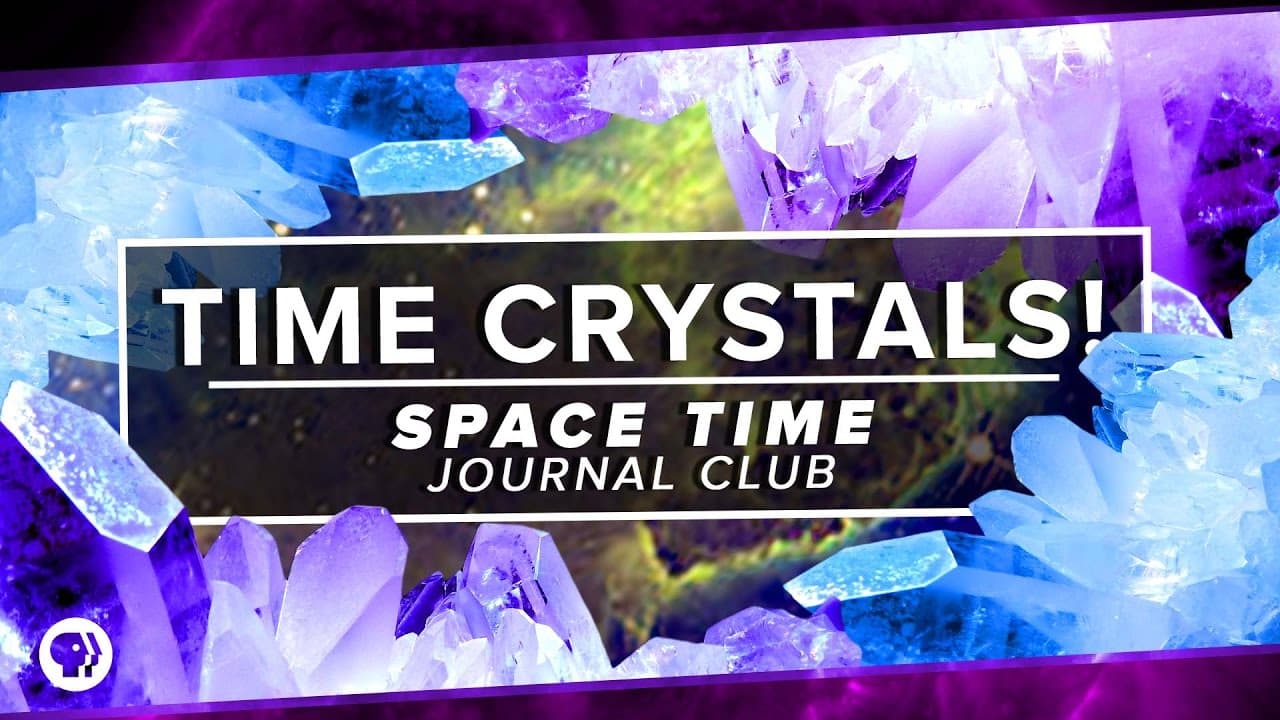
Time Crystals!
TL;DR
Time crystals are a new form of matter breaking time symmetry.
Transcript
MATT O'DOWD: This episode is supported by the Great Courses Plus. What exactly are time crystals? Are they the bling inside your time turner, the flux in your flux capacitor? Are they the heart of the Tardis? In today's edition of "Space Time Journal Club," we find out. [MUSIC PLAYING] In "Space Time Journal Club," we review new scientific papers t... Read More
Key Insights
- Time crystals are a form of matter that exhibit repeating cycles over time, breaking time translational symmetry.
- The concept was first proposed by Nobel laureate Frank Wilczek in 2012, suggesting a substance in perpetual motion while in equilibrium.
- Norman Yao's team proposed using external energy inputs to create time crystals, leading to successful synthesis by two research teams.
- Time crystals maintain oscillations at integer multiples of the driving period, even when the input energy is varied.
- The phase diagram for time crystals shows the conditions under which they maintain their unique oscillations.
- Two teams independently created time crystals using different methods, confirming their theoretical existence.
- Time crystals could revolutionize quantum computing by providing stable quantum memory elements.
- The discovery of time crystals may help bridge the gap between quantum mechanics and general relativity.
Install to Summarize YouTube Videos and Get Transcripts
Explore YouTube Video Summarizer or Get YouTube Transcript Extractor
Questions & Answers
Q: What are time crystals?
Time crystals are a new form of matter that exhibit periodic oscillations over time, breaking time translational symmetry. Unlike regular crystals, which have repeating patterns in space, time crystals repeat a state in time, maintaining oscillations even when the input energy is varied. This makes them a unique and potentially revolutionary discovery in physics.
Q: Who first proposed the concept of time crystals?
The concept of time crystals was first proposed by Nobel laureate Frank Wilczek in 2012. He suggested the existence of a type of matter that could exhibit perpetual motion while in equilibrium, breaking time translational symmetry and offering new insights into the fundamental nature of time and matter.
Q: How were time crystals first synthesized?
Time crystals were first synthesized by two independent research teams following the theoretical work of Norman Yao and his team. One team used a chain of ytterbium ions driven by a laser, while the other used microwaves to generate oscillations in the spins of nitrogen impurities in a diamond. Both methods confirmed the theoretical predictions of time crystals.
Q: What potential applications do time crystals have?
Time crystals have potential applications in quantum computing, particularly in the development of stable quantum memory elements. Their ability to maintain oscillations even when input energy is varied could help overcome the challenges of maintaining quantum states, making them a promising candidate for future quantum technologies.
Q: How do time crystals differ from regular crystals?
While regular crystals have repeating patterns in space, time crystals exhibit repeating cycles in time. This means that a certain property of the material goes through a repeating cycle over time, breaking time translational symmetry. This unique characteristic sets time crystals apart and offers new possibilities for understanding the nature of time and matter.
Q: What challenges did researchers face in creating time crystals?
One of the main challenges in creating time crystals was finding a way to maintain oscillations without external input energy. Norman Yao's team proposed using an external energy input to force oscillations, leading to successful synthesis. Researchers also had to ensure that the oscillations were maintained at integer multiples of the driving period, confirming the theoretical predictions of time crystals.
Q: How do time crystals relate to quantum mechanics and general relativity?
Time crystals offer a new avenue for exploring the fundamental differences between quantum mechanics and general relativity. By breaking time symmetry, they provide insights into the nature of time and space, potentially helping to bridge the gap between these two theories. This could lead to new understandings of the universe and the fundamental forces that govern it.
Q: What is the significance of the phase diagram for time crystals?
The phase diagram for time crystals plots interaction strength between atoms versus imperfection in the spin-flip driving signal. It shows the conditions under which time crystals maintain their oscillations, providing a roadmap for researchers to understand the stability and behavior of time crystals. This diagram is crucial for further research and potential applications in quantum technologies.
Summary & Key Takeaways
-
Time crystals are a novel form of matter proposed by Frank Wilczek, exhibiting periodic oscillations over time, breaking time translational symmetry. Norman Yao's team developed a practical approach to creating them, and two research teams have successfully synthesized them, confirming their existence and potential applications in quantum computing.
-
Time crystals maintain their oscillations at integer multiples of the driving period, even when the input energy is varied. This unique property makes them a promising candidate for stable quantum memory elements, potentially revolutionizing quantum computing by overcoming the challenges of maintaining quantum states.
-
The discovery of time crystals is significant for the potential unification of quantum mechanics and general relativity. By breaking time symmetry, time crystals provide a new avenue for exploring the fundamental differences between space and time in these two theories, potentially leading to new insights into the nature of the universe.
Read in Other Languages (beta)
Share This Summary 📚
Summarize YouTube Videos and Get Video Transcripts with 1-Click
Try YouTube Summary with ChatGPT & Claude or YouTube Transcript Generator
Explore More Summaries from PBS Space Time 📚
Summarize YouTube Videos and Get Video Transcripts with 1-Click
Try YouTube Summary with ChatGPT & Claude or YouTube Transcript Generator