What Is Synthetic Biology? Exploring Engineering in Biology
TL;DR
Synthetic biology aims to engineer biological systems for new functions, moving beyond traditional DNA manipulation to programming biological software. This field is growing exponentially, driven by advancements in DNA sequencing and synthesis, but faces challenges in designing complex biological circuits and integrating them with natural systems.
Transcript
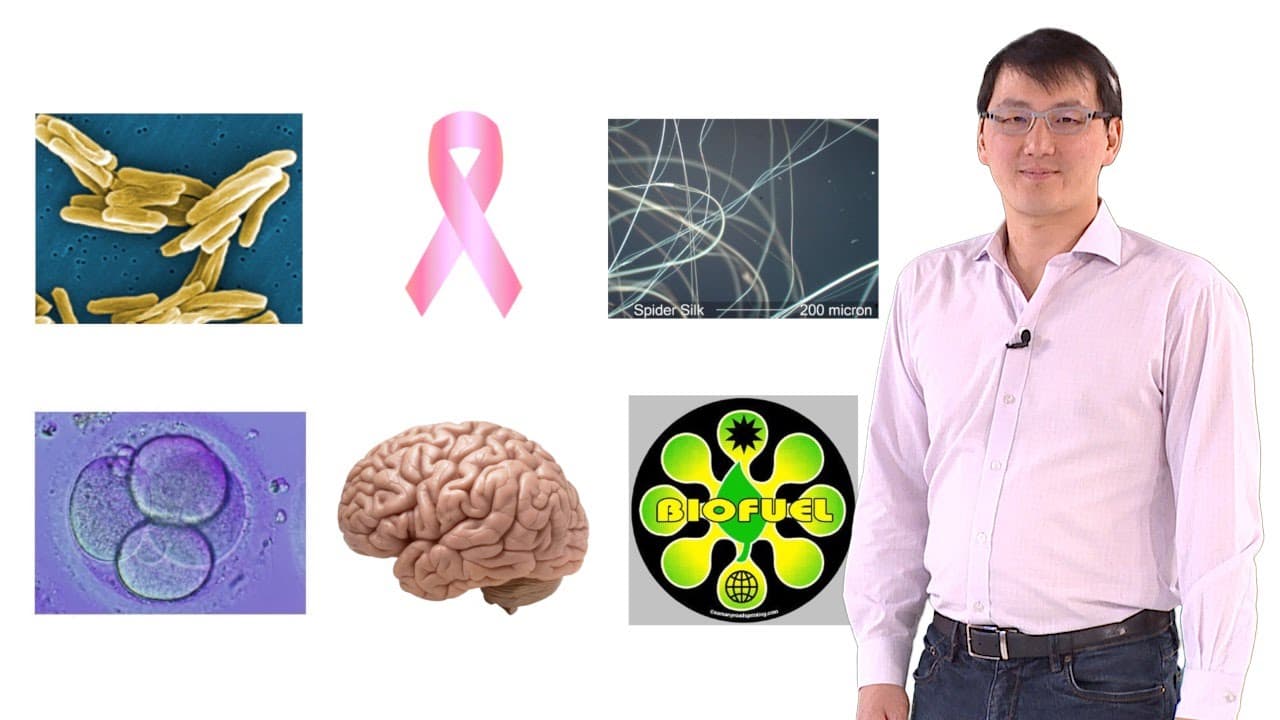
Hi, my name is Tim Lu. I'm a professor at MIT. I'm here to tell you today about synthetic biology. An emerging engineering discipline. One of the challenges in defining the term synthetic biology is that its a term that used to mean different things to different people. And I've listed several of the common definitions that people use for this part... Read More
Key Insights
- Synthetic biology is an engineering discipline focused on designing biological systems for new functions.
- Advancements in DNA sequencing and synthesis are driving the field's growth, enabling more complex programming of biological systems.
- Biological circuits can be digital or analog, allowing cells to perform computations and store memory.
- Challenges include designing circuits that operate within complex biological systems and creating robust programming languages for genetic circuits.
- Analog circuits in biology compute continuous information, such as logarithms, using minimal parts.
- The SCRIBE system allows dynamic genome engineering, encoding analog memory into the DNA of living cells.
- Potential applications of synthetic biology include therapeutics, diagnostics, and industrial processes.
- A major challenge remains in making the design, build, and test cycle more efficient, robust, and predictive.
Install to Summarize YouTube Videos and Get Transcripts
Explore YouTube Video Summarizer or Get YouTube Transcript Extractor
Questions & Answers
Q: What is synthetic biology?
Synthetic biology is an interdisciplinary field that combines principles from engineering and biology to design and construct new biological parts, devices, and systems. It aims to reprogram existing biological systems for specific functions, enhancing their capabilities or creating entirely new functions. This involves using genetic engineering techniques to modify DNA sequences, enabling cells to perform tasks beyond their natural abilities.
Q: How do biological circuits work in synthetic biology?
Biological circuits in synthetic biology function similarly to electronic circuits, using biological components like DNA, RNA, and proteins to process information and perform computations. These circuits can be digital, operating with binary states, or analog, processing continuous signals. They enable cells to sense environmental inputs, process this information, and produce specific outputs, such as gene expression changes, allowing cells to perform complex tasks and store memory of past inputs.
Q: What are the challenges in designing biological circuits?
Designing biological circuits presents several challenges, including the complexity of integrating them into existing biological systems, which are often intricate and not fully understood. Additionally, developing robust programming languages and frameworks for constructing these circuits is difficult, as is ensuring their stable operation within living cells. Another challenge is preventing unwanted evolutionary changes that could alter the circuit's function over time.
Q: What are potential applications of synthetic biology?
Synthetic biology has potential applications across various fields, including medicine, where it can be used to develop new diagnostics and therapeutics, such as engineered cells for targeted cancer treatment. In industry, it can optimize the production of biofuels and other chemicals. Additionally, it can aid in environmental sensing and remediation, as well as advancing our understanding of fundamental biological processes through the construction of synthetic systems.
Q: How has DNA sequencing and synthesis advanced synthetic biology?
Advancements in DNA sequencing and synthesis have significantly propelled synthetic biology by enabling more precise and efficient manipulation of genetic material. These technologies allow for rapid reading and writing of DNA sequences, facilitating the design and construction of complex genetic circuits and systems. This has expanded the possibilities for programming biological functions and accelerated research and development in the field.
Q: What is the SCRIBE system in synthetic biology?
The SCRIBE system is a method for dynamic genome engineering, allowing the encoding of analog memory into the DNA of living cells. It utilizes retron sequences to introduce specific mutations into the genome, which can be used to record information such as the magnitude or duration of an input. This system enables the storage of complex, quantitative data within the DNA, providing a novel approach to biological memory and information processing.
Q: How do analog circuits differ from digital circuits in synthetic biology?
Analog circuits in synthetic biology process continuous signals and perform computations based on the concentration of molecules, allowing for a range of responses rather than binary outputs. In contrast, digital circuits operate with discrete states, using binary logic (0s and 1s) to perform computations and control gene expression. Analog circuits are often more parsimonious, requiring fewer components, and can model natural biological processes more closely.
Q: What are the current bottlenecks in synthetic biology?
Current bottlenecks in synthetic biology include the lack of predictive modeling and simulation frameworks, which hinders the design of complex biological systems. Additionally, there is a need for more well-characterized genetic parts and a robust programming language for constructing genetic circuits. The physical construction and testing of circuits remain labor-intensive, and challenges in preventing unwanted evolutionary changes in engineered systems persist.
Summary & Key Takeaways
-
Synthetic biology is an emerging field that applies engineering principles to biology, aiming to design biological systems with new functions. It leverages advancements in DNA sequencing and synthesis to program biological software, moving beyond simple DNA manipulation.
-
Biological circuits, both digital and analog, enable cells to perform computations and store memory, with potential applications in diagnostics, therapeutics, and industrial processes. However, challenges remain in designing complex circuits and integrating them with natural biological systems.
-
The SCRIBE system allows for dynamic genome engineering, encoding temporal or magnitude information into living cells' DNA. Despite significant progress, the field faces challenges in developing robust programming languages and efficient design cycles to fully realize its potential.
Read in Other Languages (beta)
Share This Summary 📚
Summarize YouTube Videos and Get Video Transcripts with 1-Click
Try YouTube Summary with ChatGPT & Claude or YouTube Transcript Generator
Explore More Summaries from iBiology Techniques 📚
Summarize YouTube Videos and Get Video Transcripts with 1-Click
Try YouTube Summary with ChatGPT & Claude or YouTube Transcript Generator