What Is Imaging Flow Cytometry?
TL;DR
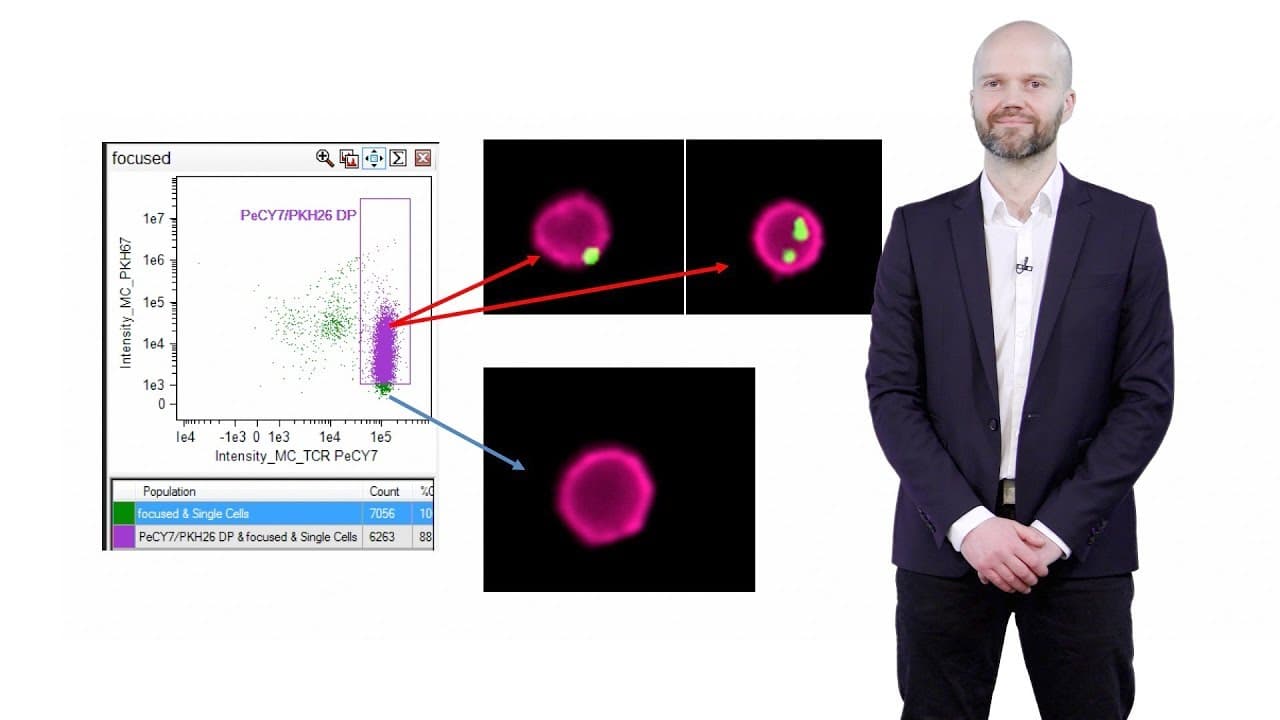
Imaging flow cytometry is a technique that combines the quantitative power of flow cytometry with the detailed imagery of microscopy. It allows for the analysis of cell morphology and spatial context at a single-cell level, providing more comprehensive data than traditional flow cytometry. This method is particularly useful for studying rare cell events or short-lived transitional states.
Transcript
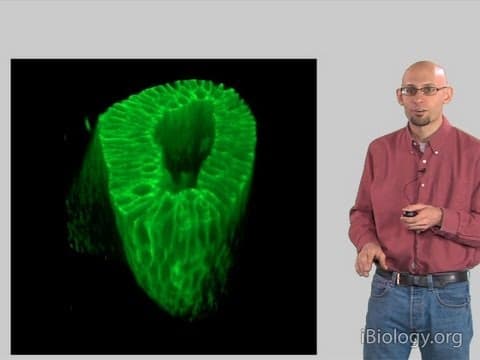
Hello, and welcome to iBiology. My name is Andrew Filby. I'm the Director of the Flow Cytometry Core Facility at Newcastle University in the United Kingdom. Today, I'd like to tell you about a very powerful analytical single cell technology called imaging flow cytometry. In this presentation, I'd like to cover the following subjects. I'd like to be... Read More
Key Insights
- Imaging flow cytometry combines flow cytometry's quantitative power with microscopy's detailed imagery.
- This technique allows for analysis of cell morphology and spatial context at a single-cell level.
- Imaging flow cytometry provides more comprehensive data than traditional flow cytometry.
- The method is useful for studying rare cell events or short-lived transitional states.
- Imaging flow cytometry uses digital images to derive mathematical data from cell phenotypes.
- The technique is scalable and high-throughput, allowing analysis of large cell populations.
- The technology is evolving, with advancements like ghost cytometry enhancing capabilities.
- Image analysis in imaging flow cytometry is complex, with almost infinite measurement possibilities.
Install to Summarize YouTube Videos and Get Transcripts
Explore YouTube Video Summarizer or Get YouTube Transcript Extractor
Questions & Answers
Q: How does imaging flow cytometry differ from traditional flow cytometry?
Imaging flow cytometry differs from traditional flow cytometry by combining quantitative analysis with detailed imagery. While traditional flow cytometry provides numerical data based on fluorescence intensity, imaging flow cytometry captures images of cells, allowing for the analysis of cell morphology and spatial context. This enables researchers to gain insights into the location and distribution of cellular components, offering a more comprehensive understanding of cell phenotypes.
Q: What are the advantages of using imaging flow cytometry?
The advantages of using imaging flow cytometry include the ability to analyze cell morphology and spatial context at a single-cell level, providing more detailed data than traditional flow cytometry. This technique is particularly useful for studying rare cell events or short-lived transitional states, as it allows for the rapid analysis of large cell populations. Additionally, imaging flow cytometry enables researchers to address complex biological questions that require an understanding of spatial distribution within cells.
Q: What kind of data can be derived from imaging flow cytometry?
Imaging flow cytometry allows for the derivation of both intensity-based and morphology-based data from digital images. Researchers can measure total fluorescence intensity, cell shape, texture, and spatial distribution of cellular components. This comprehensive data set provides insights into cell phenotypes, including the location of receptors and transcription factors, enabling a deeper understanding of cellular processes and interactions.
Q: Why is spatial context important in cell analysis?
Spatial context is crucial in cell analysis because the location and distribution of cellular components can significantly impact their function and role in biological processes. Understanding where molecules are within a cell can reveal insights into cellular signaling pathways, interactions, and responses to stimuli. Imaging flow cytometry provides this spatial information, allowing researchers to study cell morphology and the spatial arrangement of signals, which is essential for answering complex biological questions.
Q: How does imaging flow cytometry handle high-throughput analysis?
Imaging flow cytometry handles high-throughput analysis by using a flow cytometer setup that captures images of cells as they pass through a laser beam. The technique employs time-delay integration to produce blur-free images, allowing for the rapid processing of large numbers of cells. This high-throughput capability enables researchers to analyze extensive cell populations quickly, making it ideal for studying rare events or conducting large-scale experiments.
Q: What recent advancements have been made in imaging flow cytometry?
Recent advancements in imaging flow cytometry include the development of ghost cytometry and intelligent deep learning networks for cell sorting. Ghost cytometry allows for sorting cells based on image-derived morphological and spatial information, while deep learning networks enable rapid sort decisions based on cell images. These innovations enhance the capabilities of imaging flow cytometry, allowing for more refined and accurate analysis of cell populations.
Q: What challenges are associated with imaging flow cytometry?
Challenges associated with imaging flow cytometry include the complexity of image analysis and the vast number of potential measurements. The technique produces a wealth of data, making it difficult to select the best features or parameters for resolving cell populations. Additionally, ensuring the quantitative and controlled capture of images is crucial to avoid manipulation of image interpretation. Despite these challenges, imaging flow cytometry remains a powerful tool for cell analysis.
Q: How does imaging flow cytometry contribute to cytometry-based research?
Imaging flow cytometry contributes to cytometry-based research by providing a more detailed and comprehensive analysis of cell phenotypes. It combines the quantitative capabilities of flow cytometry with the spatial and morphological insights of microscopy, allowing researchers to study complex biological questions with greater precision. This technique is particularly valuable for investigating rare cell events, transitional states, and the spatial context of cellular signals, enhancing the understanding of cellular processes and interactions.
Summary & Key Takeaways
-
Imaging flow cytometry is a powerful technique that combines the quantitative capabilities of flow cytometry with the detailed imagery of microscopy. It allows researchers to analyze cell morphology and spatial context at a single-cell level, providing more comprehensive data than traditional methods. This approach is particularly beneficial for investigating rare cell events or short-lived transitional states, as it enables the rapid analysis of large cell populations.
-
The technology operates by deriving mathematical data from digital images, offering insights into both the intensity and spatial distribution of cellular signals. This makes it possible to address biological questions that require an understanding of cell morphology and the spatial context of signals within cells. Imaging flow cytometry is scalable and high-throughput, capable of processing large numbers of cells quickly and efficiently.
-
Recent advancements in the field, such as ghost cytometry and intelligent deep learning networks, are further enhancing the capabilities of imaging flow cytometry. These developments are paving the way for more refined cell sorting techniques based on morphological and spatial characteristics, highlighting the growing importance of imaging flow cytometry in cytometry-based research and other areas of cell biology.
Read in Other Languages (beta)
Share This Summary 📚
Summarize YouTube Videos and Get Video Transcripts with 1-Click
Try YouTube Summary with ChatGPT & Claude or YouTube Transcript Generator
Explore More Summaries from iBiology Techniques 📚
Summarize YouTube Videos and Get Video Transcripts with 1-Click
Try YouTube Summary with ChatGPT & Claude or YouTube Transcript Generator