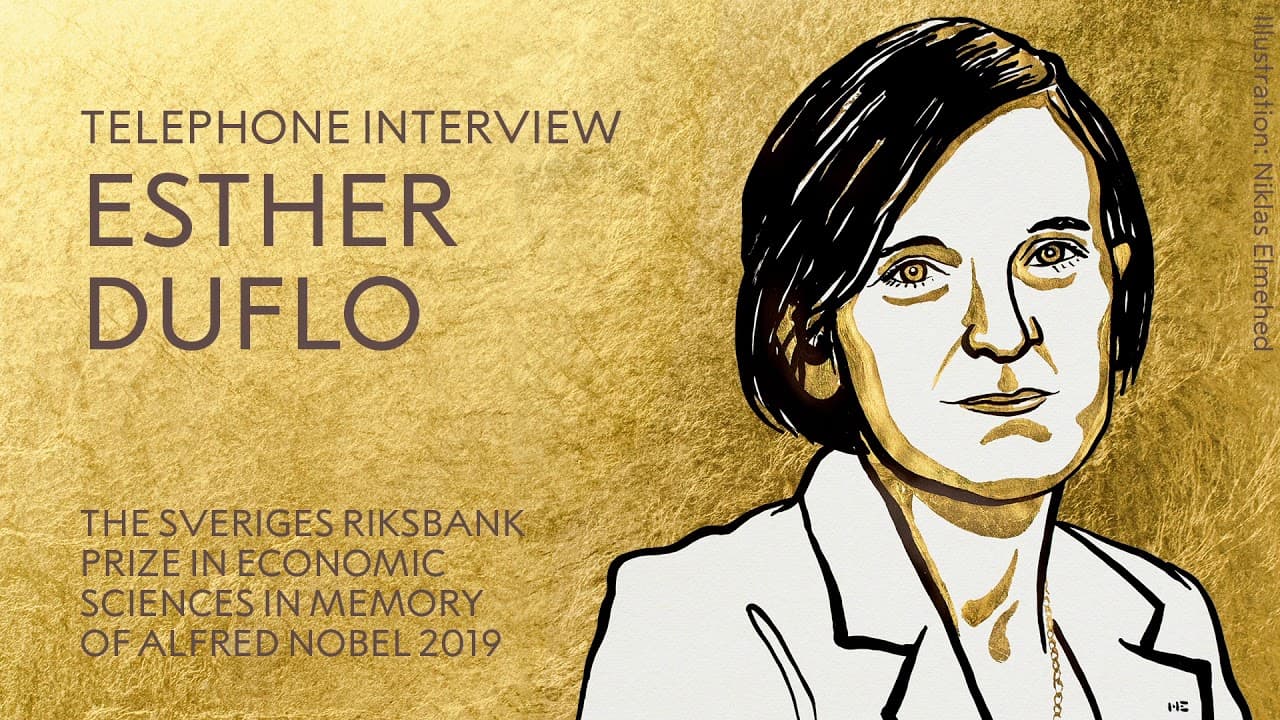
Esther Duflo: "Hopefully, it's onward and forward from now on."
Transcript
I don't oh hello my name is Adam Smith I'm calling from nobelprize.org the website of the Nobel Prize in Stockholm we have a tradition of recording as you may know very short interviews with new laureates are you he's your husband at the moment how very wise of him it must be very nice to be awarded in each other's company yes it's good work and fo... Read More
Install to Summarize YouTube Videos and Get Transcripts
Explore YouTube Video Summarizer or Get YouTube Transcript Extractor
Summary
In this video, the interviewer speaks to the laureate about their work and accomplishments in the field of economics. They discuss the importance of understanding the lives of the poor in order to devise effective policies to help them. The laureate also talks about the need for tailored solutions and the hopefulness in finding general lessons from human behavior that can be applied in different contexts. They touch on the progress made against poverty and other related issues, and the importance of rigorous policy-making. The interview also addresses the lack of female representation in the economics profession and the need for a more inclusive and respectful environment.
Questions & Answers
Q: What was the key lesson learned from the first experiment conducted in Kenya?
The first experiment conducted in Kenya taught the researchers that the obvious solutions are not always the real ones. It made them realize that the lives of the poor are more complex than initially assumed, and that understanding the intricacies of their choices and logic is crucial in designing effective approaches. This led to a shift in focus from a lack of textbooks to the actual content of the textbooks and what the children needed.
Q: Does the need for tailored solutions make the work seem insurmountable?
The need for tailored solutions may make the work seem daunting, but it is also tremendously hopeful. While each problem requires a specific understanding, there are general lessons that can be applied across different contexts. For example, understanding that children are being taught at a level that is too advanced for them is a general finding that can be applied to various locations. So, while the work may require careful attention to individual contexts, there is still the potential for cross-context solutions.
Q: Has there been progress against poverty in the last few decades?
Yes, there has been significant progress against poverty, not only in terms of income poverty, but also in addressing related issues such as infant mortality, maternal mortality, and low immunization rates. This progress can be attributed to better policies and a more rigorous approach to identifying and implementing effective solutions. While challenges remain, there are plenty of reasons to be hopeful.
Q: Why has there been a lack of female representation in the economics profession?
The lack of female representation in the economics profession is a structural and fundamental problem that starts at the entry level. Fewer women choose to pursue economics as graduate students, and those who do face barriers in career advancement and recognition. The profession as a whole needs to address the general environment and culture, ensuring it is more respectful and conducive for women to succeed. Additionally, the perception that economics is not about real-world problems may discourage women from entering the field.
Q: How can the profession attract more women and minority representation?
To attract more women and minority representation, the economics profession needs to show that it is relevant and impactful for addressing real-world problems. Creating a culture that is more respectful and inclusive is crucial, as is promoting the idea that economics can directly contribute to solving social issues and reducing poverty. By demonstrating the potential for influence and making the profession more appealing, it is hoped that more women will be encouraged to pursue economics.
Takeaways
The interview highlights the importance of understanding the lives of those in poverty and tailoring solutions to their specific contexts. It emphasizes the need for rigorous policy-making and the progress made against poverty in recent decades. The lack of female representation in the economics profession is acknowledged as a structural problem that needs to be addressed through a more respectful and inclusive environment. The hope is that inspiring more women to enter the profession and showcasing the relevance of economics in solving real-world problems will attract a more diverse pool of talent.
Read in Other Languages (beta)
Share This Summary 📚
Summarize YouTube Videos and Get Video Transcripts with 1-Click
Try YouTube Summary with ChatGPT & Claude or YouTube Transcript Generator
Explore More Summaries from Nobel Prize 📚


Summarize YouTube Videos and Get Video Transcripts with 1-Click
Try YouTube Summary with ChatGPT & Claude or YouTube Transcript Generator