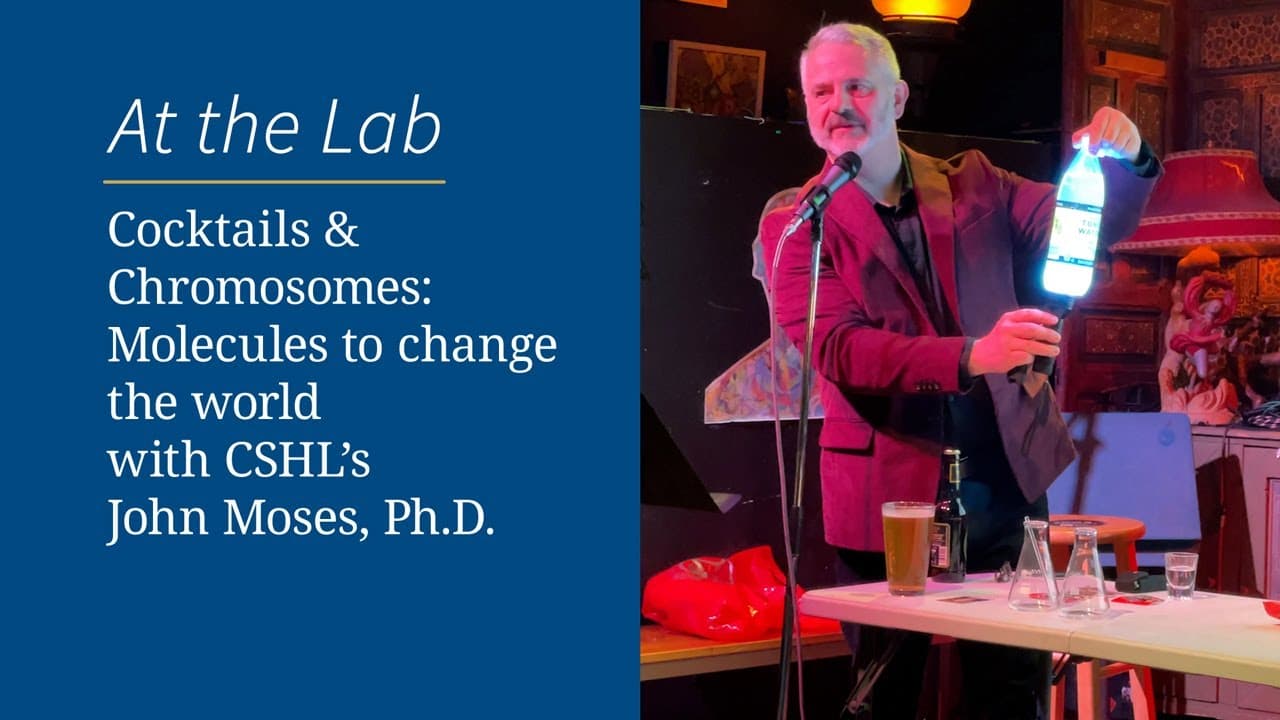
Cocktails & Chromosomes: Molecules to change the world, with CSHL’s John Moses, Ph.D.
TL;DR
John Moses discusses chemistry's impact on drug development and accessibility.
Transcript
[music] [applause] Thank you for allowing me to speak here tonight. Great privelege. So as Josh said, that's the title of my talk. I'm going to, it’s going to be a little bit interactive, so you guys get to ask me questions later, but I'm going to ask you a couple of questions along the way, so make it a bit more fun. Okay. So this is where we work... Read More
Key Insights
- John Moses emphasizes the importance of small molecules in biological processes, highlighting their role in drug development and the central dogma of molecular biology.
- The history of chemistry is marked by significant discoveries, such as the synthesis of LSD and the creation of synthetic quinine, which revolutionized medicine and industry.
- Moses discusses the challenges of drug discovery, noting the high costs and complexities involved, and suggests that improved chemistry can reduce these barriers.
- Click chemistry, a concept developed by Nobel laureate Barry Sharpless, is highlighted as a method for simplifying chemical synthesis and potentially democratizing drug production.
- The lecture includes a demonstration of quinine's fluorescence, illustrating the intersection of chemistry and everyday life through a gin and tonic cocktail.
- Moses introduces the concept of diversity clicking, which allows for the creation of diverse molecular structures and the exploration of new functions.
- The talk addresses the growing issue of antibiotic resistance, emphasizing the need for new drug development to combat resistant bacterial infections.
- The potential of click chemistry to create new molecules with unprecedented functions is discussed, with an emphasis on the importance of making medicines affordable and accessible to all.
Install to Summarize YouTube Videos and Get Transcripts
Explore YouTube Video Summarizer or Get YouTube Transcript Extractor
Questions & Answers
Q: What is the significance of small molecules in biology?
Small molecules play a crucial role in biological processes, serving as the building blocks for complex biological functions. They are integral to the central dogma of molecular biology, where DNA is transcribed to RNA and then translated into proteins. In drug development, small molecules are often used to interact with biological systems to treat diseases.
Q: How did quinine impact the development of synthetic drugs?
Quinine, originally isolated from the cinchona tree, was used to treat malaria and became highly valuable. Its significance prompted chemists to attempt synthetic production, leading to advances in understanding chemical structures and formulas. This laid the groundwork for the development of synthetic drugs, transforming the pharmaceutical industry and paving the way for future drug discoveries.
Q: What is click chemistry and why is it important?
Click chemistry, developed by Barry Sharpless, is a concept that emphasizes simplicity and efficiency in chemical synthesis. It involves reactions that are fast, reliable, and yield high output, much like assembling molecular Lego. This approach is important because it can democratize drug production, making it more accessible and affordable by reducing the complexity and cost of synthesizing new molecules.
Q: How does diversity clicking contribute to drug discovery?
Diversity clicking is a concept that allows chemists to create a wide array of molecular structures from a single reagent. By generating diverse structures, researchers can explore a vast range of functions, increasing the likelihood of discovering new and effective drugs. This approach leverages the power of click chemistry to expedite the drug discovery process and address pressing medical challenges.
Q: Why is antibiotic resistance a growing concern?
Antibiotic resistance is a significant concern because it renders existing drugs ineffective against bacterial infections, leading to increased mortality and morbidity. As bacteria evolve and develop resistance to current antibiotics, the need for new and effective drugs becomes urgent. The rising resistance rates highlight the importance of innovative drug development strategies to combat this global health threat.
Q: What role does quinine play in the demonstration during the lecture?
During the lecture, quinine is used to demonstrate the concept of fluorescence. Quinine, found in tonic water, fluoresces under ultraviolet light, emitting a blue glow. This demonstration highlights the intersection of chemistry and everyday life, showcasing how chemical properties can be observed in common substances, such as a gin and tonic cocktail.
Q: How can click chemistry help make medicines more affordable?
Click chemistry can make medicines more affordable by simplifying the synthesis of complex molecules. Its efficient and reliable reactions reduce the time and cost associated with drug development. By lowering these barriers, click chemistry can facilitate the production of inexpensive drugs, making them more accessible to a broader population and addressing healthcare disparities.
Q: What is the potential impact of shapeshifting molecules in drug development?
Shapeshifting molecules, like the vancomycin derivative discussed in the lecture, have the potential to overcome bacterial resistance by altering their structure dynamically. This innovation could lead to more effective treatments for resistant infections, as these molecules can adapt and maintain efficacy where traditional drugs fail. The development of such molecules represents a promising frontier in combating antibiotic resistance and improving patient outcomes.
Summary & Key Takeaways
-
John Moses discusses the role of small molecules in biology and their importance in drug development. He highlights the history of chemistry, including significant discoveries like LSD and synthetic quinine, which have transformed medicine and industry.
-
Moses emphasizes the challenges of drug discovery, noting its high costs and complexities. He suggests that advancements in chemistry, particularly click chemistry, can help reduce these barriers and make drugs more accessible.
-
The lecture includes a demonstration of quinine's fluorescence and introduces the concept of diversity clicking. Moses addresses antibiotic resistance and the potential of click chemistry to create new molecules with novel functions for affordable medicines.
Read in Other Languages (beta)
Share This Summary 📚
Summarize YouTube Videos and Get Video Transcripts with 1-Click
Try YouTube Summary with ChatGPT & Claude or YouTube Transcript Generator
Explore More Summaries from Cold Spring Harbor Laboratory 📚


Summarize YouTube Videos and Get Video Transcripts with 1-Click
Try YouTube Summary with ChatGPT & Claude or YouTube Transcript Generator