What Happens to Planets When the Sun Expands?
TL;DR
As the Sun expands into a red giant, it will enclose the orbits of the inner planets, including Mercury and possibly Earth, causing their positions to shift. Venus retains its thick atmosphere due to factors like its greater mass and lack of a global magnetosphere, although the exact reasons remain a mystery. Additionally, all mass theoretically emits some Hawking radiation over time, but the quantity is negligible for most objects.
Transcript
what will happen to the planets when the sun expands why is Venus's atmosphere so thick and does everything produce Hawking radiation all this and more in this week's question show Welcome to the question show your questions my answers as always wherever you are across my channel if a question Pops in your brain just write it down and I will gather... Read More
Key Insights
- 😪 The expansion of the sun in its red giant phase will alter the orbits of inner planets like Mercury and Venus due to loss of mass.
- 🌐 Venus's atmosphere remains thick despite the absence of a global magnetosphere, with the exact reasons still being a mystery.
- 💆 Hawking radiation is generated by the gradient of mass within a gravity well, and while all mass could emit Hawking radiation, the amount would be insignificant for most masses.
- 📛 Naming exoplanet categories using Neptune instead of Uranus is likely due to the avoidance of potential giggling.
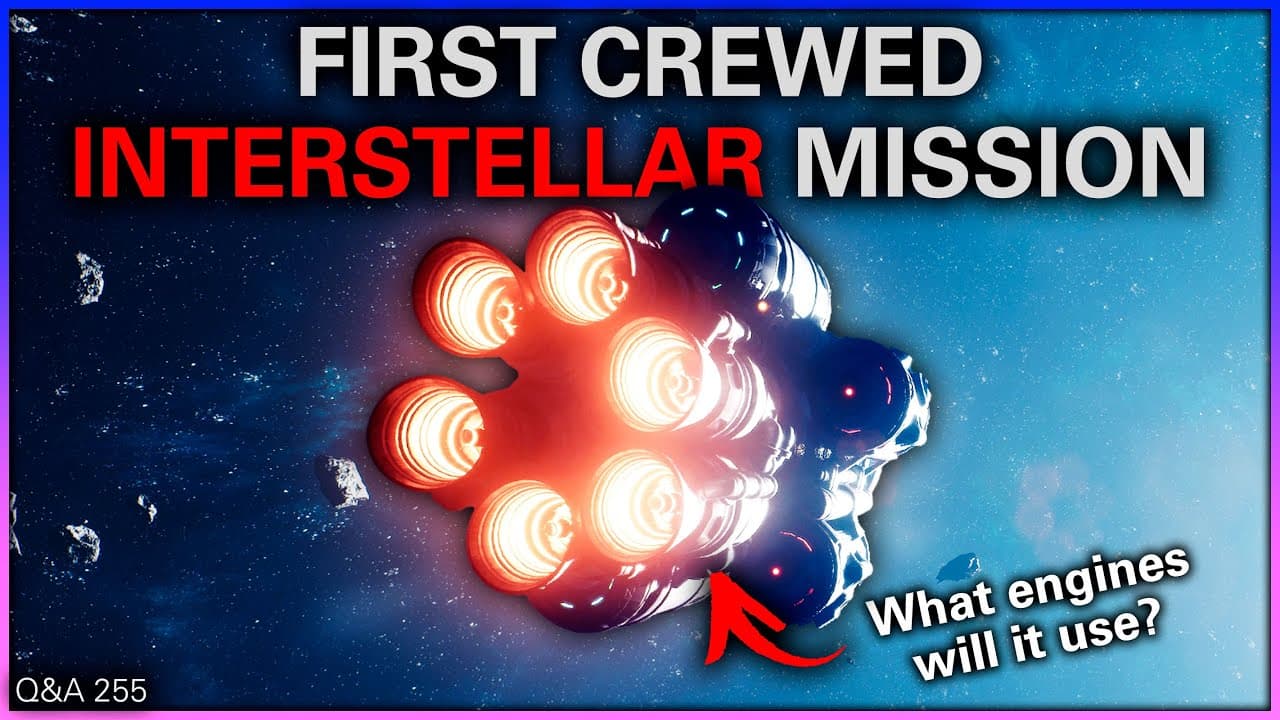
- 😒 Antimatter is currently the most efficient propulsion system for interstellar travel, but the high cost of production is a major barrier to its use.
Install to Summarize YouTube Videos and Get Transcripts
Explore YouTube Video Summarizer or Get YouTube Transcript Extractor
Questions & Answers
Q: How will the expansion of the sun affect the orbits of the planets in the Solar System?
As the sun expands in its red giant phase, it will enclose the orbits of inner planets like Mercury and Venus, potentially altering their positions. The amount of mass that the sun loses during this process affects the orbits of the planets.
Q: Why does Venus's atmosphere remain thick despite lacking a global magnetosphere?
While Venus does not possess a global magnetosphere like Earth, the absence of a magnetosphere alone does not explain the thickness of Venus's atmosphere. Other factors, such as Venus's greater mass compared to Mars, contribute to its ability to maintain its thick atmosphere.
Q: Does all mass create Hawking radiation, and would an immortal being evaporate like a black hole?
Hawking radiation is caused by the gradient of mass within a gravity well, not the event horizon of a black hole. In theory, all mass could emit Hawking radiation, but the amount would be insignificant for most masses. Over an infinite amount of time, even an immortal being could potentially evaporate like a black hole.
Q: Why is Neptune used for naming exoplanet categories, but Uranus is not?
Exoplanets that are smaller than Uranus are often referred to as sub-Neptunes or mini-Neptunes. This choice is likely due to Neptune being slightly smaller than Uranus and the avoidance of potential giggling by using the word "Uranus" in scientific classifications.
Q: What type of propulsion system is likely to be used for the first manned interstellar mission?
Antimatter is currently the most viable propulsion system for interstellar travel. While other propulsion systems exist, none come close to the efficiency of antimatter. However, the high cost of producing antimatter poses a significant obstacle to its use.
Summary & Key Takeaways
-
The sun, as it expands in its red giant phase, will enclose the orbits of inner planets like Mercury and Venus, potentially altering their positions. The amount of mass the sun loses during this process affects the orbits of the planets.
-
Venus's atmosphere is still an ongoing mystery. Factors such as its greater mass compared to Mars and the absence of a global magnetosphere contribute to its ability to maintain its thick atmosphere.
-
Hawking radiation, which is not related to the event horizon of a black hole but rather the gradient of mass within a gravity well, suggests that, in theory, all mass could eventually evaporate over an extended period of time.
Read in Other Languages (beta)
Share This Summary 📚
Summarize YouTube Videos and Get Video Transcripts with 1-Click
Try YouTube Summary with ChatGPT & Claude or YouTube Transcript Generator
Explore More Summaries from Fraser Cain / Universe Today Podcast 📚
Summarize YouTube Videos and Get Video Transcripts with 1-Click
Try YouTube Summary with ChatGPT & Claude or YouTube Transcript Generator