Q&A 56: Is Everything We See Long Dead? And More...
TL;DR
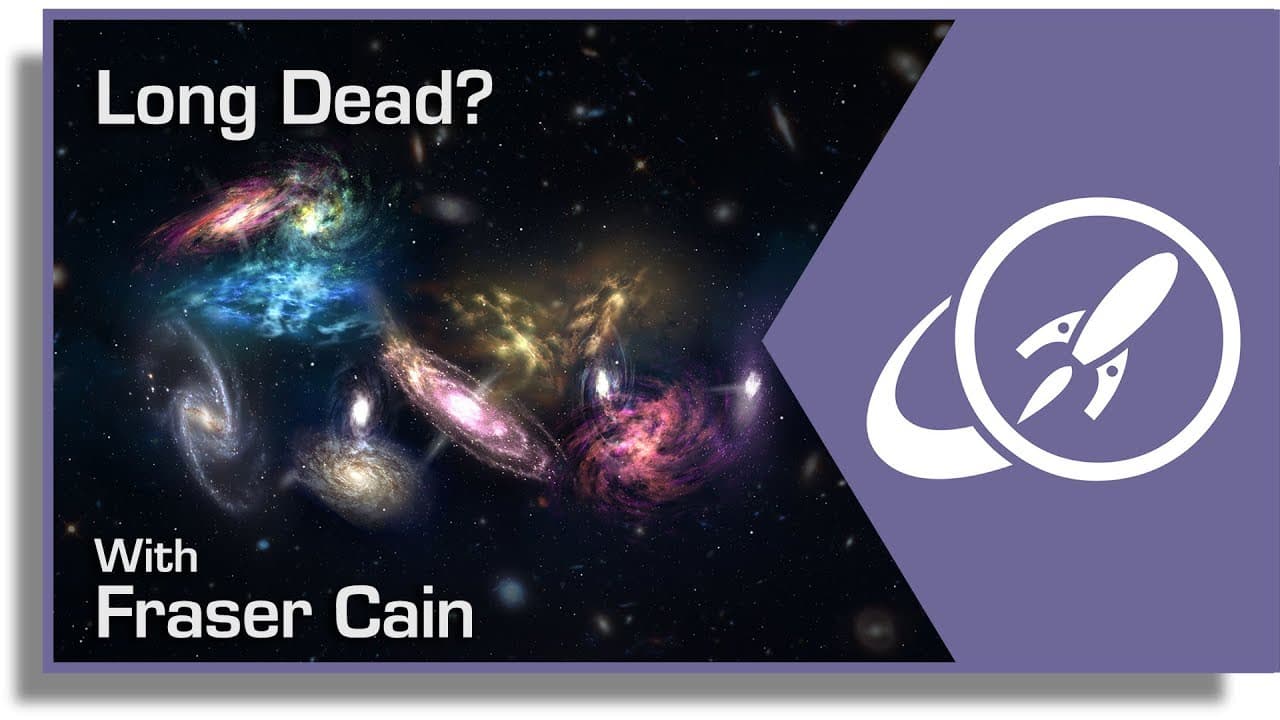
When we look at stars and galaxies in the far distance, we are essentially looking into the past, but it doesn't mean those objects could be dead already.
Transcript
question show time your questions my answers as always wherever you are on my channel if question pops into your brain type it in I see them all I see everything and I will gather them up and I will answer them here all right let's get into it dan dan hi Fraser I love your work keep it up have a question which is seriously bugging me when we look a... Read More
Key Insights
- 👀 Looking into space means looking back in time due to the speed of light.
- 🌃 Stars visible in the night sky are likely still alive, as they are within a few hundred light years of Earth.
- 🖤 Dark matter does not interact with itself or regular matter, affecting its ability to fall into black holes.
- 👶 Sending a module to repair a spacecraft can be economically feasible, but the cost needs to be justified compared to building a new spacecraft.
- 🌥️ The large-scale structure of the universe does not repeat at larger scales.
- 💪 Mars could be more habitable with greater mass and a stronger magnetosphere.
- ❓ Galaxies, like the Milky Way, remain stable and will continue their orbital paths.
- 😀 The delays of the James Webb Space Telescope are disappointing, but the complexity of the project contributes to the challenges faced.
Install to Summarize YouTube Videos and Get Transcripts
Explore YouTube Video Summarizer or Get YouTube Transcript Extractor
Questions & Answers
Q: Does looking into space mean the objects we see could be dead already?
When we look into space, we are looking at objects as they were in the past due to the speed of light. However, the stars visible in the night sky are likely still alive, as they are within a few hundred light years of Earth.
Q: Would dark matter fall into black holes?
It is believed that dark matter, if it is a particle, would fall into black holes. However, the amount of dark matter falling into black holes would likely be lower than regular matter due to dark matter's lack of interaction with itself or regular matter.
Q: Could a module be sent to repair the Kepler spacecraft?
There are plans for satellite rescue spacecraft, which would be able to repair satellites like Kepler by attaching additional propellant or reaction wheels. However, the cost of such a mission needs to be justified compared to building and launching a new spacecraft.
Q: Are galaxies small points of light in larger galaxy-like structures?
As we zoom out from the Milky Way, we see the local group, superclusters, and larger structures in the universe. However, there is no repetition of these structures at larger scales. The large-scale structure of the universe ends at the largest scale observable.
Q: How far are we from 3D printing an entire Space Station?
We are far from 3D printing entire Space Stations, but there have been advancements in 3D printing technology for space applications. Some companies are working on spacecraft that can provide a second life to satellites by attaching additional propellant or reaction wheels.
Q: Could Mars be habitable with more mass?
If Mars had more mass, similar to Earth or Venus, it would likely have a better chance of being habitable. It would have a stronger magnetosphere to protect its atmosphere and could potentially hold on to an atmosphere better.
Q: Could the galaxy collapse in on itself?
Galaxies, like the Milky Way, are stable and will continue to orbit around their collective center without collapsing in on themselves. Crashing two galaxies together could disrupt the stability, but on their own, galaxies will maintain their orbit as long as they exist.
Q: Are you disappointed with the delays of the James Webb Space Telescope?
While the delays of the James Webb Space Telescope are disappointing, the complexity and size of the telescope contribute to the challenges faced during its development. As long as it eventually launches successfully, the wait will be worth it.
Q: How many probes would be sent to Mars if signs of life are detected by Curiosity?
If Curiosity detects and validates signs of life on Mars, it would likely lead to a significant increase in the number of probes sent to Mars. However, cautious steps will be taken to build a strong case for life on Mars before sending additional missions.
Summary & Key Takeaways
-
When we look into space, we are looking backwards in time due to the speed of light.
-
Stars visible in the night sky are within a few hundred light years of Earth, so the chances of them being dead are remote.
-
Extreme cases, like supernovae or galaxies billions of light years away, could have changed since the light left them.
Read in Other Languages (beta)
Share This Summary 📚
Summarize YouTube Videos and Get Video Transcripts with 1-Click
Try YouTube Summary with ChatGPT & Claude or YouTube Transcript Generator
Explore More Summaries from Fraser Cain 📚



Summarize YouTube Videos and Get Video Transcripts with 1-Click
Try YouTube Summary with ChatGPT & Claude or YouTube Transcript Generator