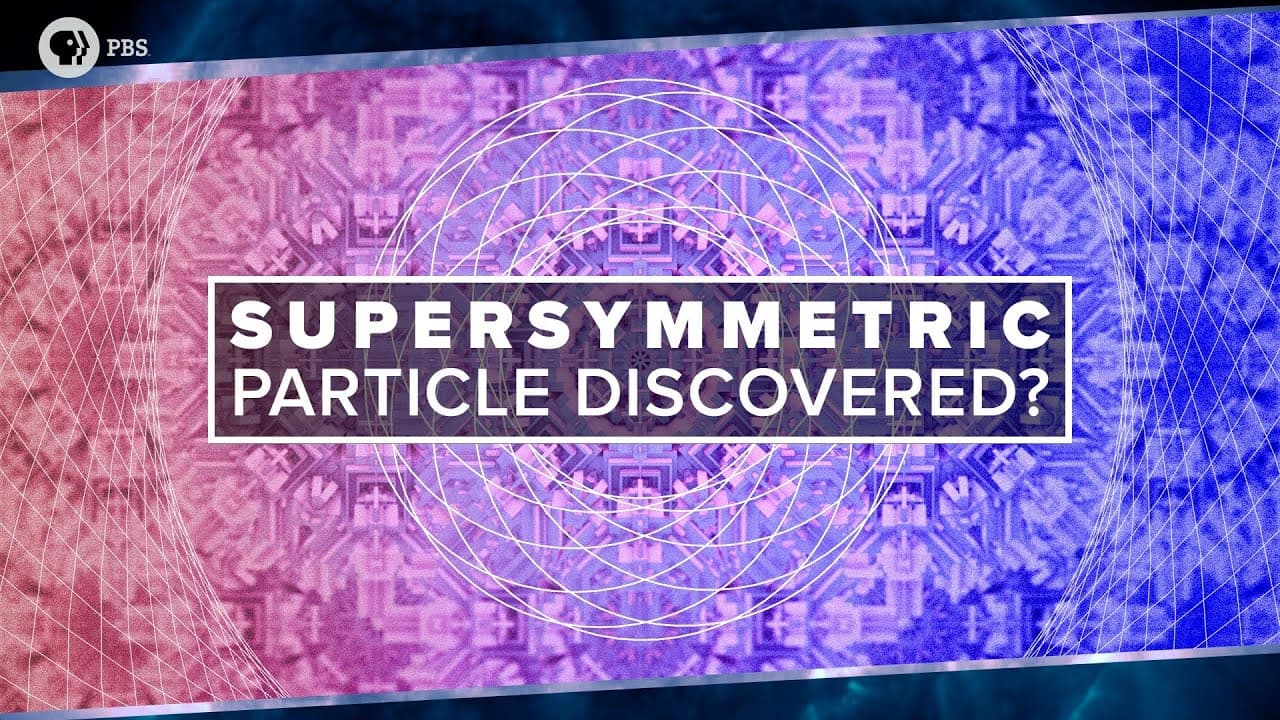
Supersymmetric Particle Found?
TL;DR
Supersymmetric particles may have been detected through cosmic rays.
Transcript
With the Large Hadron Collider running out of places to look for clues to a deeper theory of physics, we're going to need a bigger particle accelerator. And we have one, the galaxy. And the particles the galaxy flings at us may have finally revealed particles beyond the standard model. Physics is currently in a weird place. Historically, no matter ... Read More
Key Insights
- The Large Hadron Collider (LHC) has thoroughly tested the standard model, but no new particles have been found, prompting the search for a deeper theory.
- Supersymmetry (SUSY) is a proposed extension to the standard model, aiming to resolve the hierarchy problem by introducing a symmetry between fermions and bosons.
- Supersymmetry predicts that each standard model particle has a heavier supersymmetric partner, but the LHC has not detected these due to energy limitations.
- Cosmic rays, natural high-energy particles from the universe, may provide insights into particles beyond the standard model, as they can reach energies far higher than the LHC.
- ANITA, a cosmic ray experiment in Antarctica, detected unexpected high-energy events, possibly indicating the presence of supersymmetric particles like the stau.
- The stau particle, a supersymmetric partner of the tau lepton, could potentially travel through the Earth, explaining the unusual events detected by ANITA.
- Alternative explanations for the ANITA events include sterile neutrinos or unknown phenomena, but further investigation is needed to confirm any theory.
- The discovery of supersymmetric particles would significantly advance our understanding of physics, providing evidence for theories beyond the standard model.
Install to Summarize YouTube Videos and Get Transcripts
Explore YouTube Video Summarizer or Get YouTube Transcript Extractor
Questions & Answers
Q: What is the hierarchy problem in physics?
The hierarchy problem refers to the question of why gravity is so much weaker than the other fundamental forces in the universe. Supersymmetry offers a potential solution by introducing a symmetry between fermions and bosons, which could naturally explain the discrepancy in force strengths.
Q: How does ANITA detect cosmic rays?
ANITA is a cosmic ray experiment that uses radio antennae attached to a balloon flying over Antarctica. It detects high-energy neutrinos produced by cosmic rays interacting with the cosmic microwave background. These neutrinos create radio frequency Cherenkov radiation when they interact with atomic nuclei in the ice, which ANITA's antennae can detect.
Q: What are cosmic rays and why are they important for physics?
Cosmic rays are high-energy particles, such as electrons and atomic nuclei, that originate from astrophysical phenomena like supernovae and gamma-ray bursts. They can reach energies much higher than those achievable by human-made accelerators, providing a natural laboratory for studying particles beyond the standard model and potentially revealing new physics.
Q: What is the significance of the stau particle in supersymmetry?
The stau particle is the supersymmetric partner of the tau lepton, predicted by supersymmetry. Its detection would provide strong evidence for supersymmetry, helping to solve the hierarchy problem and advance grand unified theories. The stau's ability to travel through the Earth without losing energy could explain unusual high-energy events detected by experiments like ANITA.
Q: Why hasn't the Large Hadron Collider detected supersymmetric particles?
The Large Hadron Collider may not have detected supersymmetric particles because their masses could be much higher than expected, requiring greater collision energies than the LHC can provide. This limitation has led physicists to explore natural sources of high-energy particles, like cosmic rays, for potential discoveries.
Q: What are the alternative explanations for ANITA's observations?
Besides supersymmetry, ANITA's observations could be explained by sterile neutrinos, which are not part of the standard model but have been hinted at in other experiments. Another possibility is that there were intense bursts of regular neutrinos from events like supernovae, but these explanations remain speculative and require further investigation.
Q: How does the universe act as a particle accelerator?
The universe acts as a particle accelerator through extreme astrophysical events like supernova explosions, gamma-ray bursts, and black hole magnetic fields. These events can accelerate particles to incredibly high energies, far surpassing those achieved by human-made accelerators, allowing scientists to study particle interactions at unprecedented energy levels.
Q: What role does IceCube play in detecting high-energy neutrinos?
IceCube is a neutrino observatory located in Antarctica, designed to detect high-energy neutrinos by observing the Cherenkov radiation produced when neutrinos interact with atomic nuclei in the ice. It complements experiments like ANITA by providing additional data on neutrino events, helping to confirm or refute potential discoveries of new physics.
Summary & Key Takeaways
-
The Large Hadron Collider has not detected any new particles, leading physicists to explore cosmic rays for insights into supersymmetry. ANITA, a cosmic ray experiment, detected high-energy events that may indicate the presence of supersymmetric particles.
-
Supersymmetry proposes that each standard model particle has a heavier partner, aiming to solve the hierarchy problem. Cosmic rays, which can reach much higher energies than the LHC, may help detect these elusive particles.
-
ANITA observed unusual events that could be explained by the existence of the stau, a supersymmetric particle. However, alternative explanations exist, and further observations are necessary to confirm any new physics.
Read in Other Languages (beta)
Share This Summary 📚
Summarize YouTube Videos and Get Video Transcripts with 1-Click
Try YouTube Summary with ChatGPT & Claude or YouTube Transcript Generator
Explore More Summaries from PBS Space Time 📚
Summarize YouTube Videos and Get Video Transcripts with 1-Click
Try YouTube Summary with ChatGPT & Claude or YouTube Transcript Generator