Does Contextual Interference Improve Sports Practice?
TL;DR
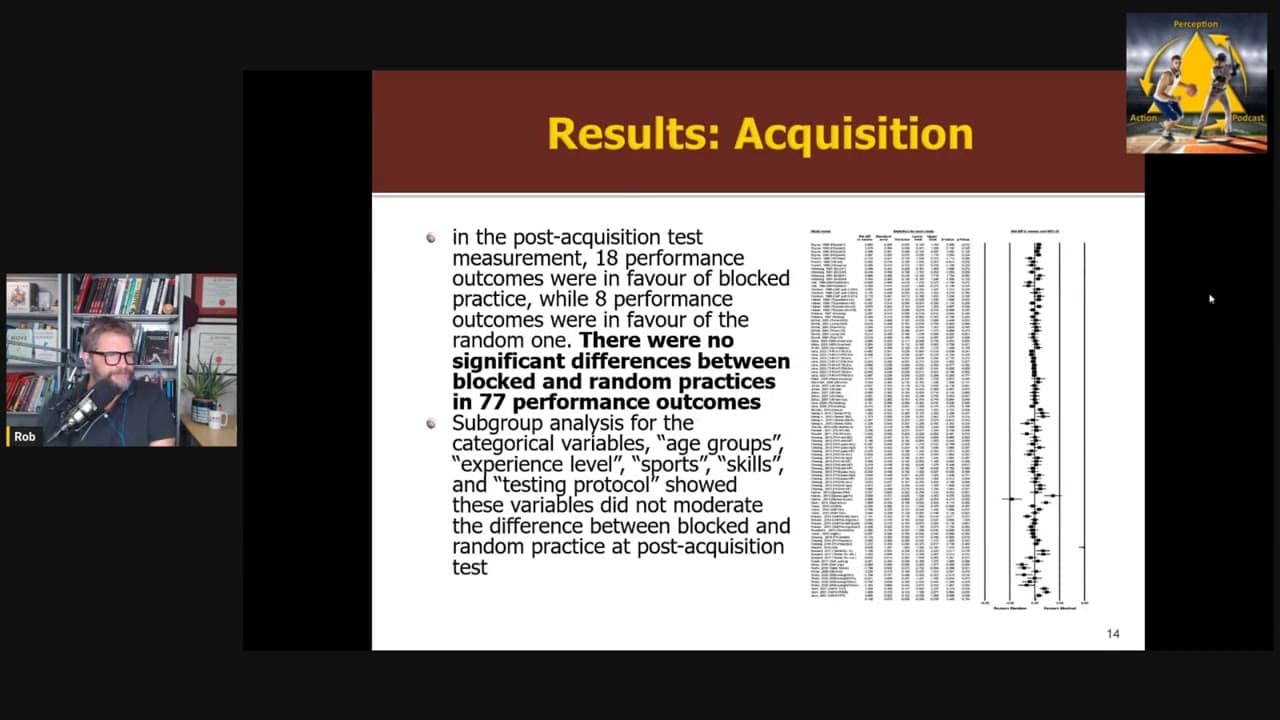
Recent research challenges the traditional belief that random practice is superior to blocked practice for skill acquisition in sports. A systematic review found weak evidence supporting contextual interference, suggesting that the benefits of variability in practice might be overstated and depend on individual factors like age and experience.
Transcript
hi everyone this is Rob Gray from ASU in the perception action podcast back with another article review in today's episode what I want to look at is a paper that is challenging one of the truths of motor learning there's a lot of those out there and we'll have more on the episodes coming soon but this one is challenging one of the you know long-hel... Read More
Key Insights
- Contextual interference is a cognitive psychology explanation for why random practice may enhance long-term skill acquisition.
- Blocked practice involves practicing one skill repeatedly before switching, while random practice involves mixing different skills.
- Traditional belief holds that random practice leads to better long-term learning despite poorer short-term performance.
- A systematic review found weak evidence supporting the contextual interference hypothesis in sports practice.
- The study found no significant moderator effects from factors like age or experience on the benefits of random practice.
- The variability of practice effect may not be as generalizable to real sports settings as previously thought.
- The study suggests that an optimal level of practice variability may exist, which varies among individuals.
- The dichotomy between random and blocked practice may be too simplistic, requiring more nuanced approaches.
Install to Summarize YouTube Videos and Get Transcripts
Explore YouTube Video Summarizer or Get YouTube Transcript Extractor
Questions & Answers
Q: What is contextual interference in sports practice?
Contextual interference refers to the interference that occurs when learning multiple skills simultaneously, often through random practice. It is believed to enhance long-term skill acquisition by forcing learners to repeatedly reconstruct motor programs, leading to better retention and transfer of skills. However, recent research suggests that its benefits may be overstated and not as universally applicable to all sports or individuals.
Q: How does blocked practice differ from random practice?
Blocked practice involves practicing one skill repeatedly before moving on to another, providing a stable and low-interference environment for skill acquisition. In contrast, random practice mixes different skills within a practice session, creating a higher level of contextual interference. While traditionally thought to hinder short-term performance, random practice is believed to enhance long-term learning by promoting better skill retention and transfer.
Q: What did the systematic review find about the variability of practice effect?
The systematic review found weak evidence supporting the variability of practice effect, which posits that random practice leads to better long-term skill acquisition compared to blocked practice. The review analyzed 37 studies and found that the expected benefits of random practice were not consistently supported, suggesting that the effect may not be as generalizable to real sports settings as previously thought.
Q: Are there any factors that influence the effectiveness of random practice?
The review found no significant moderator effects from factors like age, experience, or task complexity on the effectiveness of random practice. This contradicts previous beliefs that younger or less experienced athletes might benefit more from blocked practice due to cognitive load limitations. The findings suggest that individual differences and optimal levels of practice variability may play a more crucial role than previously understood.
Q: Why is the traditional belief in contextual interference being questioned?
The traditional belief in contextual interference is being questioned because recent systematic reviews and meta-analyses have found limited empirical support for its benefits in sports practice. The expected advantages of random practice over blocked practice in terms of long-term skill acquisition were not consistently observed, prompting a reevaluation of the contextual interference hypothesis and the need for more nuanced approaches to practice variability.
Q: What is the proposed alternative to the random vs. blocked practice dichotomy?
The proposed alternative to the random vs. blocked practice dichotomy is a more nuanced approach that considers optimal levels of practice variability tailored to individual learners. This approach suggests that both too much and too little variability can be suboptimal, and that factors beyond demographic variables, such as an individual's ability to handle frustration and failure, should be considered when designing practice regimens.
Q: How does the study's findings impact coaching practices?
The study's findings suggest that coaches should reconsider the blanket application of random practice based on the contextual interference hypothesis. Instead, they should adopt a more individualized approach, tailoring practice variability to the specific needs and capabilities of each athlete. This may involve adjusting the level of variability based on factors like the athlete's age, experience, and cognitive load capacity, rather than strictly adhering to random or blocked practice paradigms.
Q: What are the implications of the review for motor learning research?
The implications for motor learning research include the need to move beyond the simplistic dichotomy of random versus blocked practice and to explore more nuanced models of practice variability. Future research should focus on identifying the optimal levels of variability for different individuals and contexts, considering a broader range of factors that influence learning outcomes. This could lead to more effective and personalized training methodologies in sports and other skill-based activities.
Summary & Key Takeaways
-
The systematic review challenges the effectiveness of contextual interference in sports practice, finding limited support for the traditional belief that random practice enhances long-term skill acquisition. The study suggests that the benefits of practice variability may not be as universal as previously thought and could depend on individual factors.
-
The research analyzed 37 studies and found that the anticipated benefits of random practice over blocked practice were not consistently supported. The review highlights the need for more nuanced approaches to practice variability, considering individual differences and optimal levels of variability.
-
The findings suggest that the contextual interference hypothesis may be too simplistic, as no significant moderator effects from age or experience were found. The study calls for a more nuanced understanding of practice variability, moving beyond the traditional dichotomy of random versus blocked practice.
Read in Other Languages (beta)
Share This Summary 📚
Summarize YouTube Videos and Get Video Transcripts with 1-Click
Try YouTube Summary with ChatGPT & Claude or YouTube Transcript Generator
Explore More Summaries from Rob Gray 📚

Summarize YouTube Videos and Get Video Transcripts with 1-Click
Try YouTube Summary with ChatGPT & Claude or YouTube Transcript Generator