How Does Optic Flow Determine Motion in Images?
TL;DR
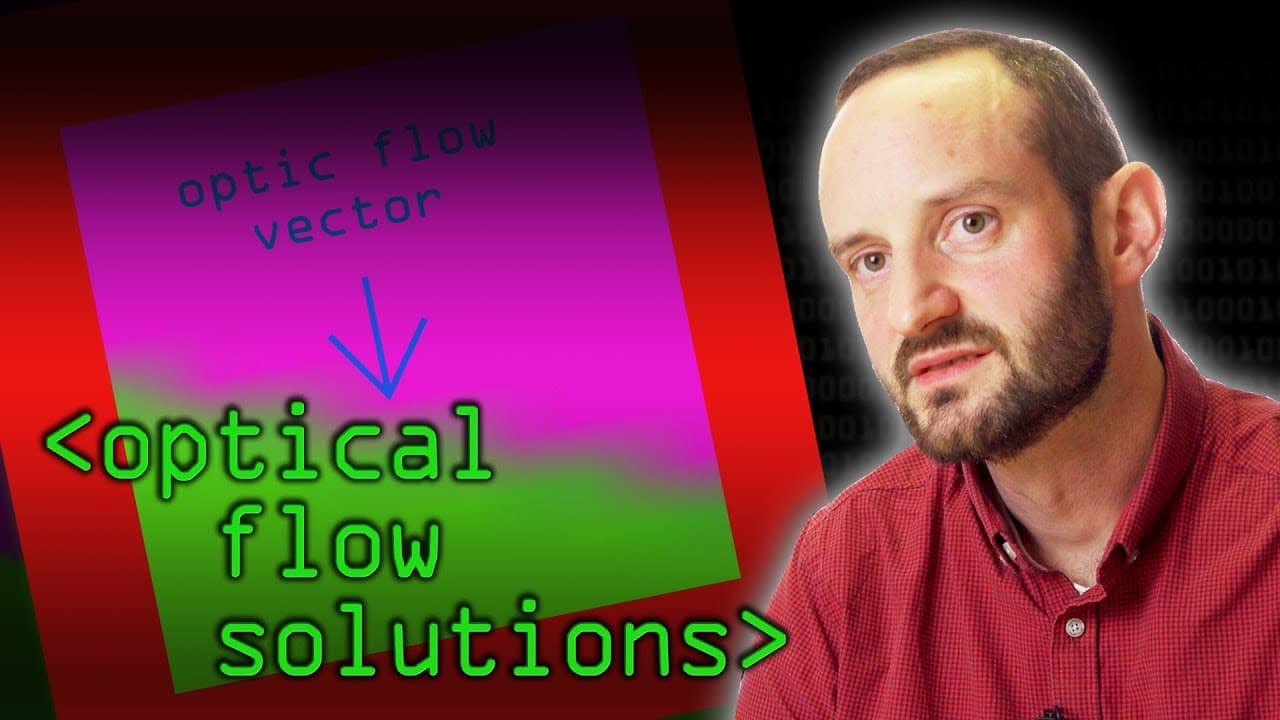
Optic flow calculates motion in images by analysing small changes in space and time, yielding motion vectors for pixels. Popular methods include the Horn and Schunk approach, which uses global optimisation, and the Lucas-Kanade method, which considers local pixel patches, each with distinct advantages for different applications.
Transcript
we thought about how you can talk about optic flow with little changes in space and little changes in time that means derivatives and so things like sabel which we can calculate across the image so there's something called the optic flow equation which basically combines these derivatives in the image these gradients and also in that equation are t... Read More
Key Insights
- ⏳ Optic flow is a technique that analyzes tiny changes in space and time to estimate motion in an image.
- 💐 The Horn and Schunk method and the Lucas-Kanade method are two popular approaches for calculating optic flow, with different advantages and disadvantages.
- 💐 Optic flow can be used for image stabilization, frame interpolation, and object tracking.
- 💐 A pyramid scheme of lower-resolution images can be used to overcome limitations of larger motion in optic flow calculations.
Install to Summarize YouTube Videos and Get Transcripts
Explore YouTube Video Summarizer or Get YouTube Transcript Extractor
Questions & Answers
Q: How does optic flow work?
Optic flow analyzes changes in brightness patterns across an image to estimate the motion vectors for each pixel by solving an equation based on derivatives and gradients.
Q: What are the assumptions made in optic flow calculations?
Optic flow assumes that neighboring pixels will have similar motion vectors, and it assumes small motion and negligible changes in a few pixels.
Q: What is the Horn and Schunk method?
The Horn and Schunk method is a global approach to calculate optic flow. It optimizes the motion vectors for each pixel by considering the average motion vectors in the local neighborhood and applying smoothness constraints.
Q: How does the Lucas-Kanade approach differ from the Horn and Schunk method?
The Lucas-Kanade approach is a local method that calculates optic flow by assuming the same motion vectors for all pixels in a small patch. It uses least squares to find the best fit for the motion vectors.
Summary & Key Takeaways
-
Optic flow analyzes derivatives and gradients in an image to calculate the motion vectors (u and v) for each pixel.
-
One popular method for calculating optic flow is the Horn and Schunk method, which uses a global approach and smoothness constraints.
-
Another method, the Lucas-Kanade approach, takes a local patch of pixels and assumes the same motion vectors for all pixels in that patch.
Read in Other Languages (beta)
Share This Summary 📚
Summarize YouTube Videos and Get Video Transcripts with 1-Click
Try YouTube Summary with ChatGPT & Claude or YouTube Transcript Generator
Explore More Summaries from Computerphile 📚
Summarize YouTube Videos and Get Video Transcripts with 1-Click
Try YouTube Summary with ChatGPT & Claude or YouTube Transcript Generator