Radioactivity (4 of 16) Three Types of Radioactive Decay, Example Problems
TL;DR
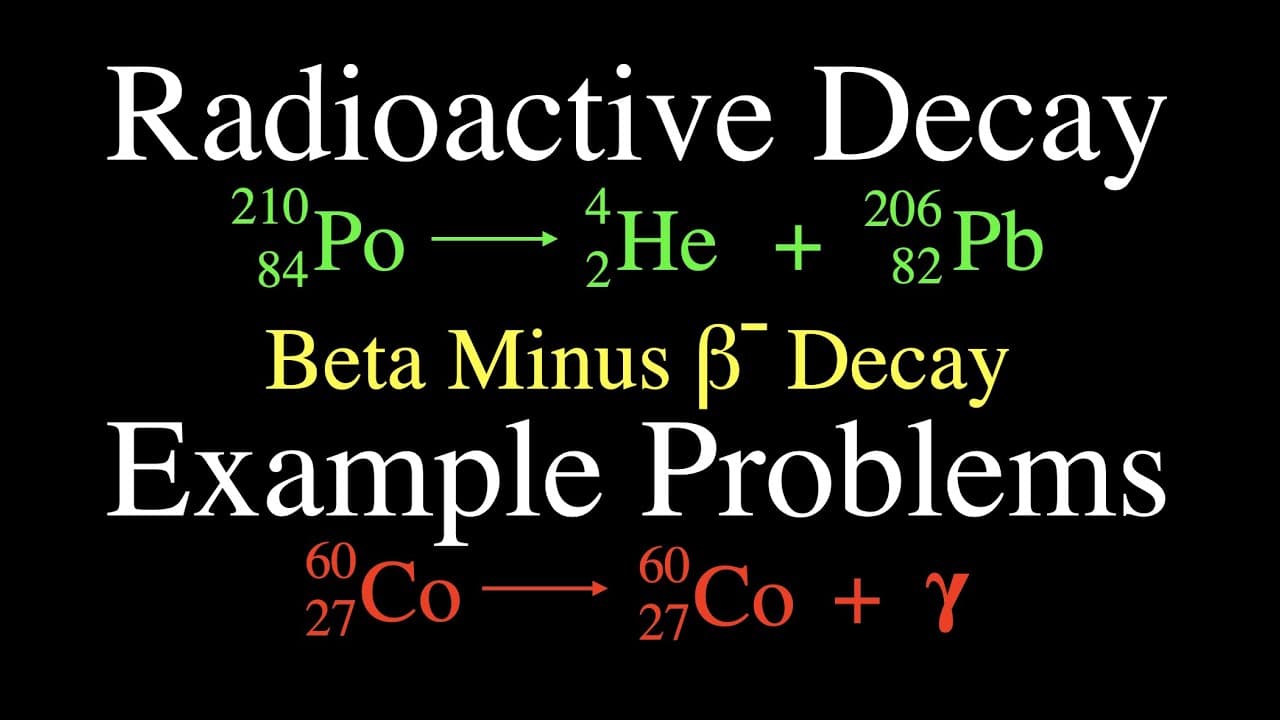
This video provides example problems for alpha, beta, and gamma decay, explaining the equations and processes involved.
Transcript
okay in today's video I am going to be going over a few example problems for radioactive decay that's alpha beta and gamma decay I've already made a video for radioactivity and also a general explanation of radioactive decay which we link to in the upper right-hand corner but let's do some problems for radioactive decay before we begin don't forget... Read More
Key Insights
- ☢️ There are different types of radioactive decay: alpha, beta (beta minus and beta plus), and gamma decay.
- 🫀 Alpha decay involves the emission of a helium nucleus, causing a decrease in the atomic and mass numbers.
- ➕ Beta minus decay emits an electron and an anti-electron neutrino, while beta plus decay emits a positron and a neutrino.
- ✋ Gamma decay is the emission of high-energy photons, resulting in no change in the element or the atomic and mass numbers.
- 🫀 Isotopes can be identified in decay reactions by comparing the atomic and mass numbers.
- 🅰️ Writing the complete decay reaction for each decay type helps understand the process and determine the resulting product.
- 🔨 The periodic table is a useful tool for identifying elements involved in decay reactions.
Install to Summarize YouTube Videos and Get Transcripts
Explore YouTube Video Summarizer or Get YouTube Transcript Extractor
Questions & Answers
Q: What is the difference between alpha, beta, and gamma decay?
Alpha decay involves the emission of a helium nucleus, causing a decrease in both the atomic number and mass number. Beta decay can be either beta minus or beta plus decay, where a neutron is converted into a proton (or vice versa) with the emission of an electron (or a positron) and an antineutrino (or a neutrino). Gamma decay is the emission of high-energy photons with no change in the atomic or mass number.
Q: How can you determine the product of a decay reaction?
To determine the product of a decay reaction, you need to consider the change in the atomic and mass numbers. For alpha decay, the atomic number goes down by two and the mass number by four. For beta minus decay, the atomic number goes up by one, while the mass number remains the same. For beta plus decay, the atomic number goes down by one, but the mass number stays constant. Gamma decay does not result in any change.
Q: How can isotopes be identified in decay reactions?
Isotopes can be identified in decay reactions by looking at the atomic and mass numbers. Isotopes have the same atomic number (which represents the element) but different mass numbers (which represent the different numbers of neutrons). By comparing the atomic and mass numbers before and after the decay, you can determine the isotopes involved in the reaction.
Q: Can you explain the difference between an electron and a beta particle?
In the context of beta decay, an electron is the beta particle emitted during beta minus decay. The beta particle is represented by the symbol e-, and it has very little mass. In some representations, it is denoted as β-. An electron is a subatomic particle with a negative charge and negligible mass. It is found in the electron cloud around the nucleus of an atom. During beta decay, a neutron decays into a proton, emitting an electron and an antineutrino (or a neutrino in the case of beta plus decay).
Summary & Key Takeaways
-
The video demonstrates examples of alpha decay, such as polonium 210 decaying into lead 206 through the emission of a helium nucleus.
-
It also shows examples of beta decay, including carbon-14 decaying into nitrogen-14 by emitting an electron and an electron antineutrino.
-
The concept of beta plus decay is explained using the example of neon 19 decay into fluorine 19 by emitting a positron and a neutrino.
-
Gamma decay is discussed, where there is no change in the element, using examples like nickel 60 remaining as nickel 60 but emitting energy in the form of a gamma ray.
Read in Other Languages (beta)
Share This Summary 📚
Summarize YouTube Videos and Get Video Transcripts with 1-Click
Try YouTube Summary with ChatGPT & Claude or YouTube Transcript Generator
Explore More Summaries from Step by Step Science 📚
Summarize YouTube Videos and Get Video Transcripts with 1-Click
Try YouTube Summary with ChatGPT & Claude or YouTube Transcript Generator