How to Calculate Tension in a Hanging Sign Using Torque
TL;DR
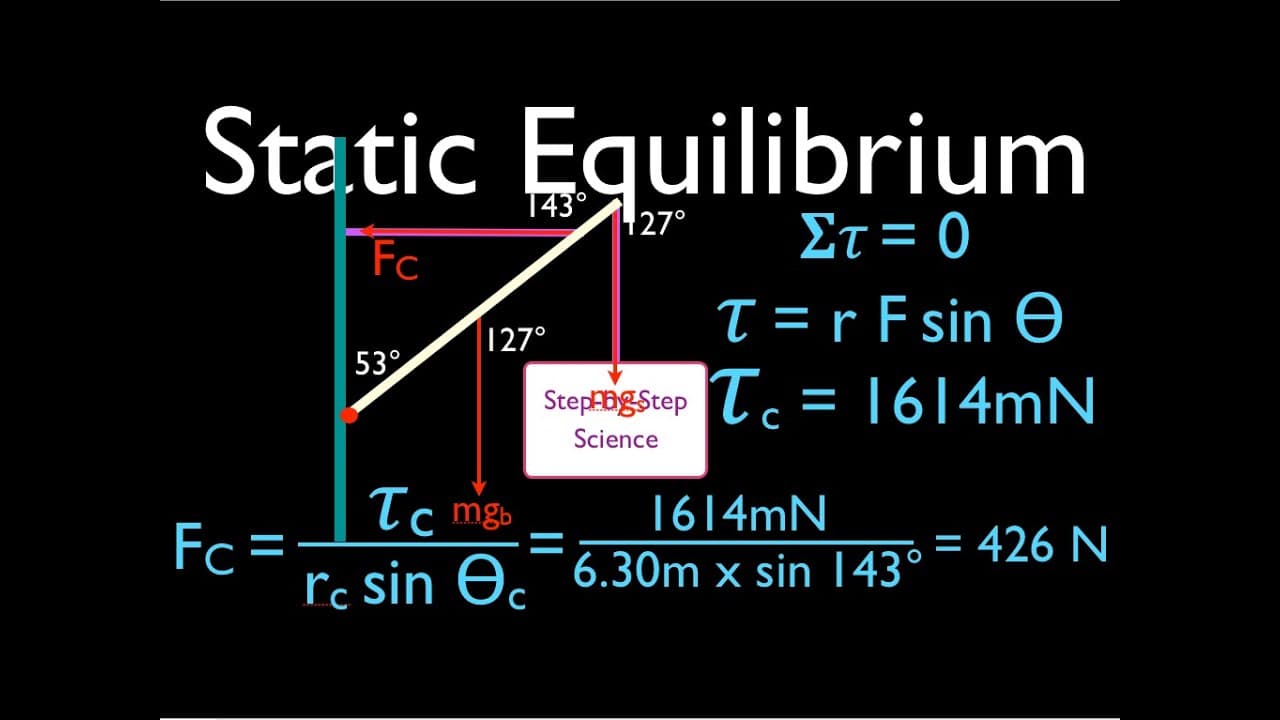
To calculate the tension in a cable supporting a hanging sign, use the torque equation τ = R * F * sin(θ) and set the torque from the cable equal to the sum of the torques from the sign and beam. Determine the distances, forces, and angles involved, and solve for the tension, which in this example amounts to 426 Newtons.
Transcript
okay in today's video we're going to go over a problem involving static equilibrium and this is the situation that we have we have the step-by-step sign sign which has a mass of 21.5 kg the sign is hanging by this cable the cable is attached to the beam the beam has a mass of 12 kg and a 7.5 M long the beam makes an angle with the wall of 53° this ... Read More
Key Insights
- 😁 The problem involves determining the force of tension in a cable holding a sign attached to a beam.
- 🔄 Torque is used to analyze the problem, with positive torques causing counterclockwise rotation and negative torques causing clockwise rotation.
- 🆓 The torque equation, torque = R * F * sin(Theta), is used to calculate the torques, where R is the radial distance, F is the force, and Theta is the angle.
- 🚠 By balancing the torques produced by the sign and beam with the torque produced by the cable, the force in the cable can be calculated.
- 🔨 The torque equation is a useful tool for solving static equilibrium problems and determining the forces involved.
- ❓ Understanding the concept of static equilibrium is crucial for determining forces and torques in such problems.
- 🔺 The angles involved in the problem, including the angle between the beam and wall and the angle between the cable and radial vector, are essential for calculating the forces and torques accurately.
Install to Summarize YouTube Videos and Get Transcripts
Explore YouTube Video Summarizer or Get YouTube Transcript Extractor
Questions & Answers
Q: How is static equilibrium defined and why is it relevant to this problem?
Static equilibrium means that everything is in balance, with no movement. This problem is about finding the force of tension in the cable when the sign and beam are in static equilibrium.
Q: How do I determine whether a torque is positive or negative?
Torques that cause objects to rotate counterclockwise are considered positive, while torques that cause objects to rotate clockwise are considered negative.
Q: What is the purpose of finding the torque equation in this problem?
The torque equation, which states that torque is equal to R * F * sin(Theta), is used to analyze the problem by summing up the torques and setting them equal to zero.
Q: What does the angle Theta represent in this problem?
In this problem, the angle Theta represents the angle between the radial vector and the force vector. It is the angle that determines the torque produced by each force.
Summary & Key Takeaways
-
The problem involves a sign hanging from a beam attached to a wall, and the goal is to find the force of tension in the cable.
-
Torque is used to analyze the problem, with the torque produced by the cable being equal to the sum of torques from the beam and sign.
-
Using the torque equation, the distances, forces, and angles are calculated to find the force in the cable.
Read in Other Languages (beta)
Share This Summary 📚
Summarize YouTube Videos and Get Video Transcripts with 1-Click
Try YouTube Summary with ChatGPT & Claude or YouTube Transcript Generator
Explore More Summaries from Step by Step Science 📚
Summarize YouTube Videos and Get Video Transcripts with 1-Click
Try YouTube Summary with ChatGPT & Claude or YouTube Transcript Generator