Products
Features
YouTube Video Summarizer
Summarize YouTube videos
Web & PDF Highlighter
Highlight web pages & PDFs
Chat with PDF
Ask any PDF questions with AI
Ask AI Clone
Chat with your highlights & memories
Audio Transcriber
Transcribe audio files to text
Glasp Reader
Read and highlight articles
Kindle Highlight Export
Export your Kindle highlights
Idea Hatch
Hatch ideas from your highlights
Integrations
Obsidian Plugin
Notion Integration
Pocket Integration
Instapaper Integration
Medium Integration
Readwise Integration
Snipd Integration
Hypothesis Integration
Apps & Extensions
Chrome Extension
Safari Extension
Edge Add-ons
Firefox Add-ons
iOS App
Android App
Discover
Discover
Ideas
Discover new ideas and insights
Articles
Curated articles and insights
Books
Book recommendations by great minds
Posts
Essays and notes from readers
Quotes
Inspiring quotes collection
Videos
Curated videos and summaries
Explore Glasp
Glasp Newsletter
Weekly insights and updates
Glasp Talk
Interview series with great minds
Glasp Blog
Latest news and articles
Glasp Use Cases
Learn how others use Glasp
Build & Support
Glasp API
Access Glasp's API for developers
MCP Connector
Connect Glasp to Claude & ChatGPT
Community
Glasp Reddit Community
Students
Student discount and benefits
FAQs
Frequently Asked Questions
AboutPricing
DashboardLog inSign up

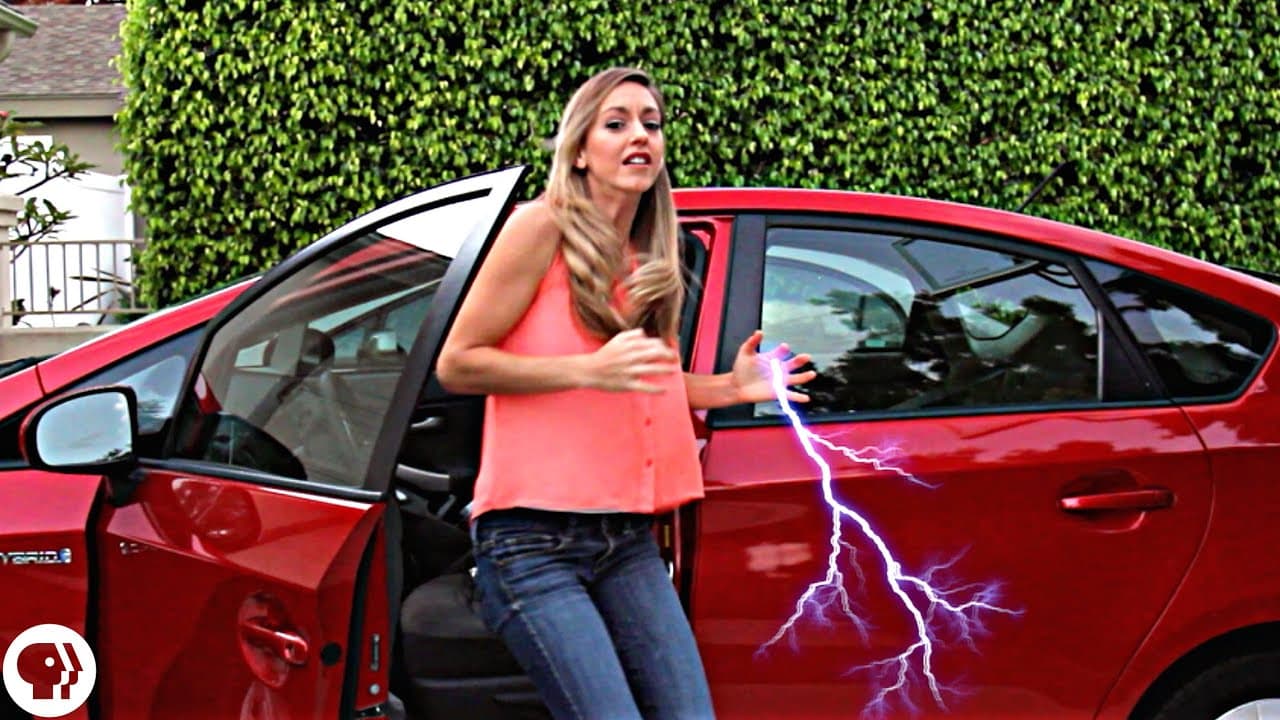
Avoid electric shock getting out of a car!
November 10, 2015
by
Physics Girl
YouTube video player
Avoid electric shock getting out of a car!

TL;DR

In this video, the host explains the phenomenon of static electricity, how it is generated, and provides tips on how to prevent getting shocked.

Transcript

[MUSIC PLAYING] [MUSIC PLAYING] [ZAP] I hate that! Why do you get shocked sometimes when you get out of your car? Or when you touch a doorknob? Or when you take off a sweater and hug someone? And is there a way to not get shocked? To prevent this from happening, you have to figure out what's happening. So this is called a Van de Graaff generator. I... Read More

Key Insights

  • 🙃 The Van de Graaff generator demonstrates how static charge can build up and create a spark.
  • 🥹 Insulators can hold a charge if they experience a violent event that strips electrons from one material and transfers them to another.
  • 😨 Sliding across a car seat can generate static electricity, but touching the metal of the car can prevent a shock.
  • âš¡ Air acts as an insulator until the voltage becomes high enough for static electricity to travel through it.

Install to Summarize YouTube Videos and Get Transcripts

Explore YouTube Video Summarizer or Get YouTube Transcript Extractor

Questions & Answers

Q: Why do you get shocked sometimes when you get out of your car?

When you slide across the car seat, both you and the seat become charged with static electricity. If you touch metal right after, the charge will transfer into the metal, preventing you from getting shocked.

Q: Can insulators hold a charge?

Yes, insulators, like Styrofoam, can still hold a charge. Rubbing two materials together can cause them to become charged, even if they are usually insulators.

Q: How does static electricity work?

Static electricity is generated when electrons are transferred from one material to another. This transfer can happen through rubbing materials together or through other forms of contact.

Q: What happens when the voltage is high enough for static electricity to travel through air?

When the voltage is high enough, it overcomes the insulating properties of air, causing ionization. This process releases light and creates a spark.

Summary & Key Takeaways

  • The Van de Graaff generator is a machine that builds up static charge and can create a spark that shocks you when you come close to it.

  • Insulators, such as Styrofoam, can still hold a charge, and rubbing two materials together can cause them to become charged.

  • When you get out of a car, sliding across the seat can generate static charge, and if you touch metal soon enough, the charge will transfer into the metal instead of shocking you.


Read in Other Languages (beta)

English

Share This Summary 📚

Summarize YouTube Videos and Get Video Transcripts with 1-Click

Download browser extensions on:

Try YouTube Summary with ChatGPT & Claude or YouTube Transcript Generator

Explore More Summaries from Physics Girl 📚

SLOW MOTION SCIENCE!  Ferrofluid dropping on magnet thumbnail
SLOW MOTION SCIENCE! Ferrofluid dropping on magnet
Physics Girl
What is the MAGIC RUSSIAN DIAMOND? thumbnail
What is the MAGIC RUSSIAN DIAMOND?
Physics Girl
How Do 3D Holograms Create the Illusion of Depth? thumbnail
How Do 3D Holograms Create the Illusion of Depth?
Physics Girl
Why aren't plants black? 🌿 thumbnail
Why aren't plants black? 🌿
Physics Girl
World’s Largest Camera Lens thumbnail
World’s Largest Camera Lens
Physics Girl
This result could change physics forever thumbnail
This result could change physics forever
Physics Girl

Summarize YouTube Videos and Get Video Transcripts with 1-Click

Download browser extensions on:

Try YouTube Summary with ChatGPT & Claude or YouTube Transcript Generator

Apps & Extensions

  • Chrome Extension
  • Safari Extension
  • Edge Add-ons
  • Firefox Add-ons
  • iOS App
  • Android App

Key Features

  • YouTube Video Summarizer
  • Web & PDF Summarizer
  • Web & PDF Highlighter
  • Chat with PDF
  • Ask AI Clone
  • Audio Transcriber
  • Glasp Reader
  • Kindle Highlight Export
  • Idea Hatch

Integrations

  • Obsidian Plugin
  • Notion Integration
  • Pocket Integration
  • Instapaper Integration
  • Medium Integration
  • Readwise Integration
  • Snipd Integration
  • Hypothesis Integration

More Features

  • APIs
  • MCP Connector
  • Blog & Post
  • Embed Links
  • Image Highlight
  • Personality Test
  • Quote Shots

Company

  • About us
  • Blog
  • Community
  • FAQs
  • Job Board
  • Newsletter
  • Pricing
Terms

•

Privacy

•

Guidelines

© 2026 Glasp Inc. All rights reserved.