Rewriting fractions as decimals | Math | 4th grade | Khan Academy
TL;DR
Learn how to convert fractions to decimals by breaking them down and recognizing place values.
Transcript
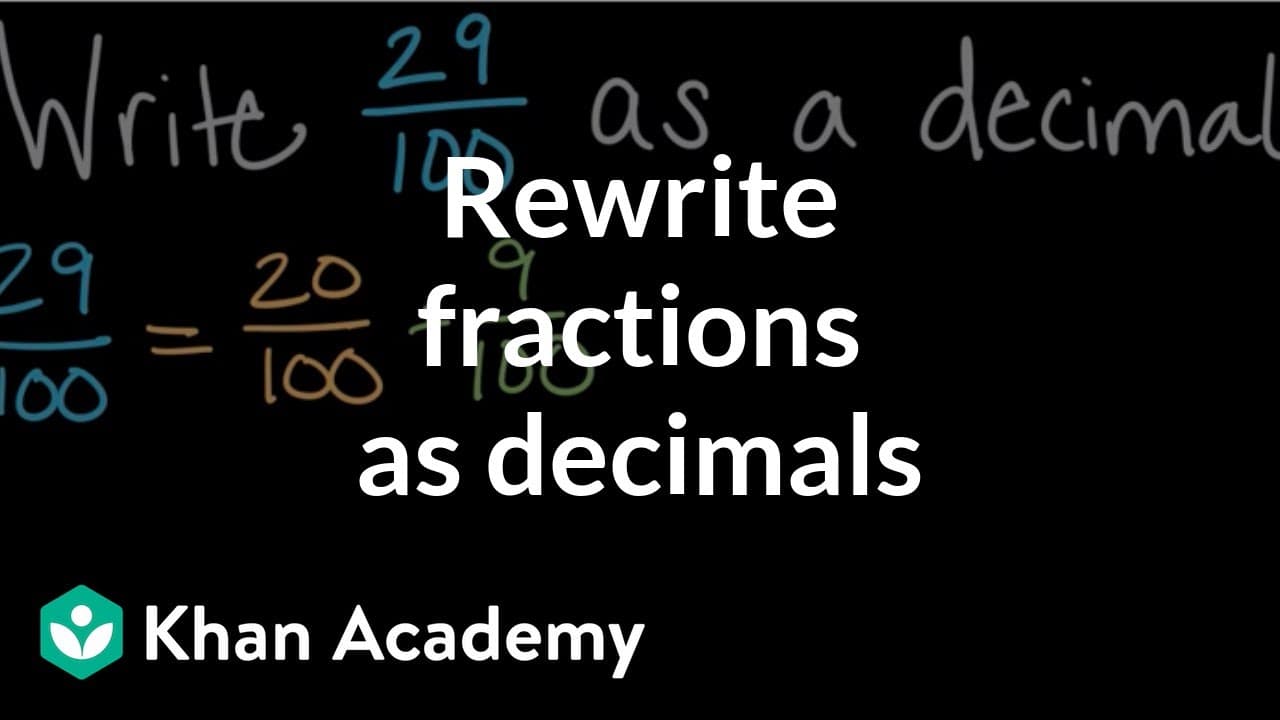
- [Voiceover] Let's write 29/100 as a decimal. So we'll start with 29 over 100, and let's start breaking that down till we can get to place values 'cause place values will help us to convert to write this as a decimal. 29/100 we can break that down into 20/100 plus 9/100. 20/100 plus nine more hundredths is equal to 29/100. So we've just broken it ... Read More
Key Insights
- 🥳 Breaking down fractions into simpler parts can aid in converting them to decimals.
- 🧑🏭 Simplifying fractions by dividing both the numerator and the denominator by a common factor results in equivalent fractions with smaller values.
- 🥇 Recognizing place values, such as tenths and hundredths, is crucial in understanding and writing decimals.
- 🌥️ Fractions where the numerator is larger than the denominator can still be converted to decimals.
Install to Summarize YouTube Videos and Get Transcripts
Explore YouTube Video Summarizer or Get YouTube Transcript Extractor
Questions & Answers
Q: How do you convert 29/100 to a decimal?
To convert 29/100 to a decimal, you can break it down into 20/100 plus 9/100. Simplifying these fractions leads to 2/10 and 9/100, which can be written as two-tenths and nine-hundredths. Therefore, 29/100 is equal to 0.29 or 29 hundredths as a decimal.
Q: How can place values help with converting fractions to decimals?
Place values provide a framework to determine the decimal representation of a fraction. By recognizing the tenths and hundredths place values, it becomes easier to convert fractions to decimals. For example, in the fraction 29/100, we have two-tenths and nine-hundredths.
Q: Can fractions with a numerator larger than the denominator be converted to decimals?
Yes, fractions with a numerator larger than the denominator can be converted to decimals. For example, to convert 53/10 to a decimal, we break it down into 50/10 plus 3/10. Simplifying these fractions gives us 5/1 and 3/10, which can be written as five and three-tenths. Therefore, 53/10 is equal to 5.3 as a decimal.
Q: Why is it important for the fraction and decimal to be read the same way?
When both the fraction and the decimal representation of a number are read the same way, it indicates that the conversion from fraction to decimal was done correctly. In the example given, 29 hundredths is equivalent to 29/100, reinforcing the accuracy of the conversion.
Summary & Key Takeaways
-
The video demonstrates how to convert the fraction 29/100 to a decimal by breaking it down into two parts: 20/100 and 9/100.
-
The fractions 20/100 and 9/100 can be simplified to 2/10 and 9/100 respectively, which can then be written as two-tenths and nine-hundredths.
-
Using place values, the decimal representation of 29/100 is found to be 0.29 or 29 hundredths.
Read in Other Languages (beta)
Share This Summary 📚
Summarize YouTube Videos and Get Video Transcripts with 1-Click
Try YouTube Summary with ChatGPT & Claude or YouTube Transcript Generator
Explore More Summaries from Khan Academy 📚



Summarize YouTube Videos and Get Video Transcripts with 1-Click
Try YouTube Summary with ChatGPT & Claude or YouTube Transcript Generator