What Is the Cosmic Microwave Background and Its Significance?
TL;DR
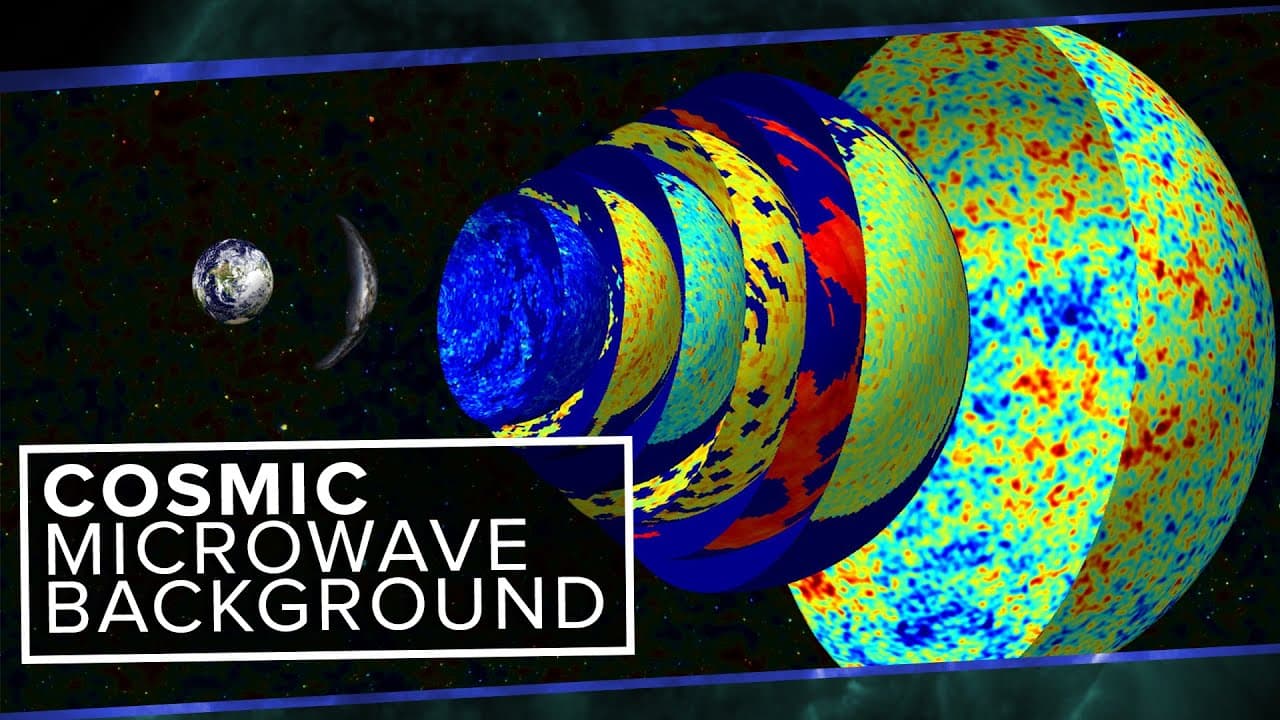
The cosmic microwave background (CMB) is the afterglow of the universe's early light, originating from when atoms formed, roughly 13.8 billion years ago. Initially, the universe appeared orange due to hot plasma, but as it expanded, this light redshifted into microwaves, resulting in the CMB we observe today, which supports theories of cosmic expansion and atom formation.
Transcript
Outer space looks black, but the entire universe used to be this color. How's that possible? Let's find out. Stars and galaxies notwithstanding, space is pitch black. So pick a dark spot in the sky and point an analog satellite dish at it. You might expect to get nothing, but you don't. You get static. Pick another point and more static. Move your... Read More
Key Insights
- The cosmic microwave background (CMB) is a pervasive static detected in space, originating from the early universe's formation of atoms.
- Initially, the universe was filled with a hot plasma that prevented light from traveling far, creating a 'fog' that eventually cleared as atoms formed.
- As the universe expanded, the light from this plasma redshifted from visible orange to microwave wavelengths, becoming the CMB.
- The CMB perfectly matches a thermal spectrum, indicating a precise temperature of 2.7 Kelvin, despite space being mostly empty.
- The early universe's plasma emitted a thermal distribution of electromagnetic waves, similar to how objects emit light based on their temperature.
- The expansion of the universe stretched the wavelengths of light, transitioning the sky from bright orange to dark as perceived by human eyes.
- The CMB's thermal spectrum is compelling evidence of the universe's transformation from an orange glow to the blackness of space.
- Understanding the CMB provides insights into the universe's early conditions, expansion, and the formation of matter as we know it.
Install to Summarize YouTube Videos and Get Transcripts
Explore YouTube Video Summarizer or Get YouTube Transcript Extractor
Questions & Answers
Q: What is the cosmic microwave background (CMB)?
The cosmic microwave background (CMB) is a pervasive static detected across the universe, originating from the early universe's formation of atoms. It is the remnant radiation from the hot plasma that filled the universe shortly after the Big Bang, which has since redshifted into the microwave spectrum due to the expansion of the universe.
Q: Why was the early universe orange?
The early universe was orange because it was filled with a hot plasma emitting a thermal distribution of electromagnetic waves. This plasma emitted light in the visible spectrum, and as the universe expanded, the wavelengths of this light were stretched, transitioning from orange to longer wavelengths, eventually becoming the cosmic microwave background we observe today.
Q: How does the CMB match a thermal spectrum?
The CMB matches a thermal spectrum because it originates from the hot plasma of the early universe, which emitted electromagnetic waves based on its temperature. The CMB's spectrum is one of the closest approximations to a mathematically perfect thermal spectrum, indicating a precise temperature of 2.7 Kelvin, despite the emptiness of space.
Q: What role did the expansion of the universe play in the CMB?
The expansion of the universe played a crucial role in transforming the CMB. As space expanded, the wavelengths of the light emitted by the early universe's plasma were stretched, a process known as cosmological redshift. This redshift caused the light to transition from visible orange to the longer microwave wavelengths we detect as the CMB today.
Q: How did the universe become transparent?
The universe became transparent when the hot plasma cooled enough for electrons and protons to combine and form neutral atoms. This process, known as recombination, allowed light to travel freely without being constantly scattered by free electrons. This marked the end of the 'fog' and the beginning of the universe's transparency, allowing the light from the last scattering surface to travel across the cosmos.
Q: What evidence does the CMB provide about the universe?
The CMB provides compelling evidence about the universe's early conditions, including its temperature, composition, and expansion history. The precise thermal spectrum of the CMB supports the Big Bang theory and offers insights into the universe's transformation from a hot, dense plasma to the complex structures we observe today, such as galaxies and stars.
Q: How does the CMB relate to the formation of matter?
The CMB is closely related to the formation of matter because it represents the last scattering surface of the early universe's plasma. As the universe cooled and recombination occurred, the light from this era was released, and the remaining atoms began to clump together under gravity, eventually forming stars, galaxies, and other cosmic structures.
Q: Why is the CMB important for cosmology?
The CMB is crucial for cosmology because it provides a snapshot of the universe at a pivotal moment in its history, allowing scientists to study its early conditions and subsequent evolution. By analyzing the CMB's properties, such as its temperature fluctuations and polarization, researchers can gain insights into the universe's composition, geometry, and the processes that shaped its large-scale structure.
Summary & Key Takeaways
-
The cosmic microwave background is a static noise detected across the universe, originating from the early universe's formation of atoms. Initially, the universe was filled with a hot plasma that created a 'fog,' preventing light from traveling far. As the universe expanded, this light redshifted into the microwave spectrum.
-
The CMB perfectly matches a thermal spectrum, indicating a temperature of 2.7 Kelvin, despite space being mostly empty. The early universe's plasma emitted electromagnetic waves based on temperature, similar to how objects emit light, and the universe's expansion stretched these wavelengths.
-
This transition explains the universe's shift from an orange glow to the blackness of space. Understanding the CMB provides insights into the universe's early conditions, expansion, and the formation of matter, offering a glimpse into the universe's transformation over billions of years.
Read in Other Languages (beta)
Share This Summary 📚
Summarize YouTube Videos and Get Video Transcripts with 1-Click
Try YouTube Summary with ChatGPT & Claude or YouTube Transcript Generator
Explore More Summaries from PBS Space Time 📚
Summarize YouTube Videos and Get Video Transcripts with 1-Click
Try YouTube Summary with ChatGPT & Claude or YouTube Transcript Generator