Robots: Crash Course Computer Science #37
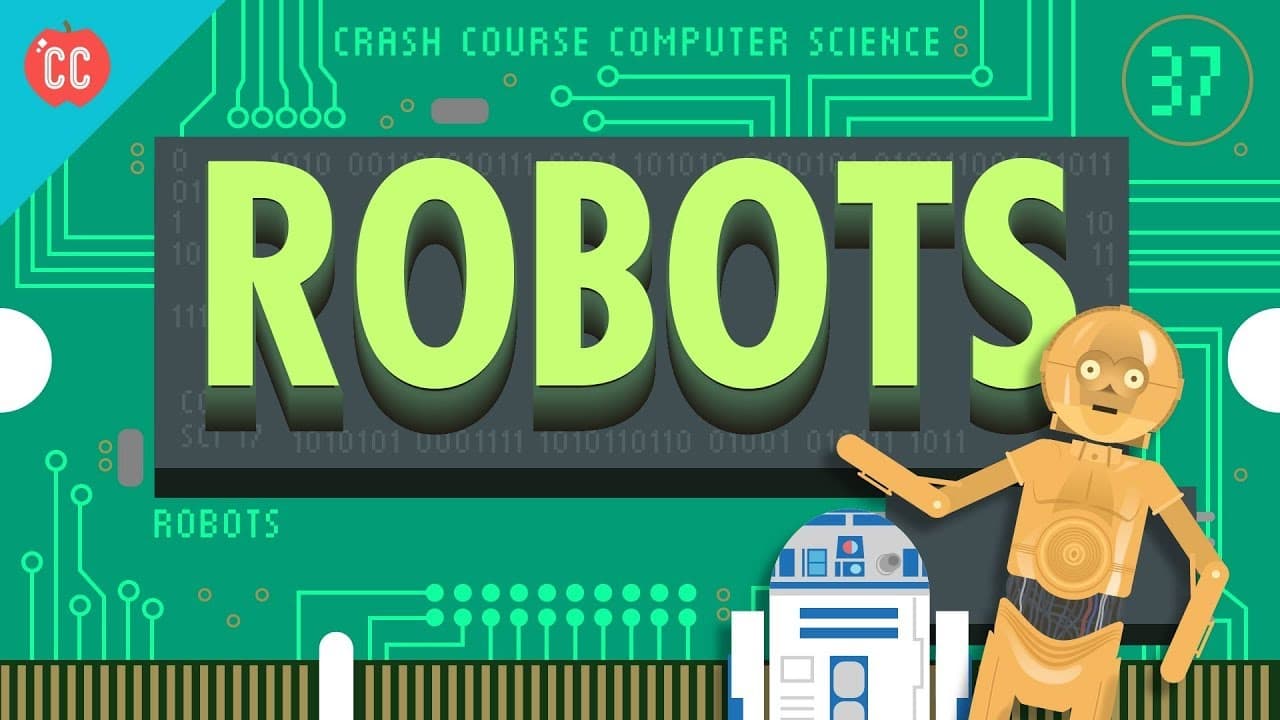
TL;DR
Robots are here, aiding us in numerous capacities.
Transcript
Hi, I’m Carrie Anne, and welcome to CrashCourse Computer Science! Today we’re going to talk about robots. The first image that jumps to your mind is probably a humanoid robot, like we usually see in shows or movies. Sometimes they’re our friends and colleagues, but more often, they’re sinister, apathetic and battle-hardened. We also tend to think o... Read More
Key Insights
- Robots are not just futuristic concepts but are already prevalent in various industries, assisting with tasks that require precision and efficiency.
- The term 'robot' implies a physical embodiment that interacts with the real world, differing from virtual agents or bots.
- Historically, automatons were early forms of robots, demonstrating mechanical functions without electronic control.
- The introduction of CNC machines marked a significant advancement in robotics, allowing for precise and automated manufacturing processes.
- PID controllers are crucial in robotics, helping maintain desired states by adjusting actions based on proportional, integral, and derivative calculations.
- Challenges remain in robotics, especially in tasks that are simple for humans, such as walking or grasping objects, which require advanced AI solutions.
- Autonomous vehicles represent a significant breakthrough, relying heavily on sensors and computer vision to navigate complex environments.
- Ethical considerations in robotics are crucial, particularly concerning lethal autonomous weapons and the potential for misuse.
Install to Summarize YouTube Videos and Get Transcripts
Explore YouTube Video Summarizer or Get YouTube Transcript Extractor
Questions & Answers
Q: What distinguishes a robot from a virtual agent or bot?
A robot is a physical entity that interacts with the real world, performing tasks through mechanical actions. In contrast, a virtual agent or bot operates within digital environments, executing tasks without a physical presence. The distinction lies in the robot's ability to manipulate physical objects and environments, which is not a characteristic of virtual agents.
Q: How did early automatons function without electronic control?
Early automatons were mechanical devices designed to perform specific tasks automatically. They used intricate systems of gears, levers, and pulleys to mimic human or animal actions. These machines relied on mechanical principles rather than electronic control, demonstrating the ingenuity of inventors in creating self-operating devices long before the advent of modern electronics.
Q: What are the components of a PID controller in robotics?
A PID controller consists of three components: proportional, integral, and derivative. The proportional component addresses the current error, the integral accounts for accumulated past errors, and the derivative anticipates future errors. Together, these components adjust the robot's actions to maintain desired states, ensuring stability and precision in dynamic environments.
Q: Why are certain tasks difficult for robots that are easy for humans?
Tasks like walking or grasping objects involve complex sensory and motor functions that humans perform effortlessly due to our evolved neural and muscular systems. Robots, however, require sophisticated algorithms and sensors to replicate these actions. The complexity of real-world interactions, such as varying object shapes and textures, adds to the challenge, necessitating advanced AI solutions.
Q: How do autonomous vehicles navigate complex environments?
Autonomous vehicles use a combination of sensors, such as LIDAR and cameras, to perceive their surroundings. They employ computer vision algorithms to identify and interpret road signs, lanes, and obstacles. These vehicles process real-time data to make driving decisions, adjusting speed and direction to safely navigate through traffic and other dynamic elements.
Q: What ethical concerns arise with lethal autonomous weapons?
Lethal autonomous weapons raise significant ethical concerns due to their potential to make life-and-death decisions without human intervention. The lack of human judgment in complex situations, the risk of malfunction, and the potential for misuse in warfare are critical issues. These concerns necessitate discussions on regulations and the moral implications of deploying such technologies.
Q: How have CNC machines impacted the manufacturing industry?
CNC machines revolutionized manufacturing by automating the control of machine tools through computer programming. This advancement allowed for precise and complex operations, reducing labor costs and increasing production efficiency. CNC technology enabled the creation of intricate designs and components that were previously challenging to produce manually, significantly enhancing industrial capabilities.
Q: What role does artificial intelligence play in advancing robotics?
Artificial intelligence is crucial in overcoming the limitations of traditional robotics, enabling machines to learn from experience and adapt to new situations. AI techniques, such as machine learning and neural networks, allow robots to perform complex tasks, improve decision-making, and enhance interaction with dynamic environments. AI-driven advancements are key to achieving greater autonomy and functionality in robots.
Summary & Key Takeaways
-
Robots are widely used across various fields, assisting humans with tasks that enhance productivity and efficiency. They are not just futuristic concepts but are already integrated into our daily lives and industries.
-
The history of robotics dates back to ancient automatons, evolving to complex systems like CNC machines and PID controllers that offer precise control and automation in manufacturing and other sectors.
-
While robots excel in many areas, they struggle with tasks simple for humans, presenting ongoing challenges. Ethical concerns, especially regarding autonomous weapons, highlight the need for responsible development and deployment of robotic technologies.
Read in Other Languages (beta)
Share This Summary 📚
Summarize YouTube Videos and Get Video Transcripts with 1-Click
Try YouTube Summary with ChatGPT & Claude or YouTube Transcript Generator
Explore More Summaries from CrashCourse 📚


Summarize YouTube Videos and Get Video Transcripts with 1-Click
Try YouTube Summary with ChatGPT & Claude or YouTube Transcript Generator