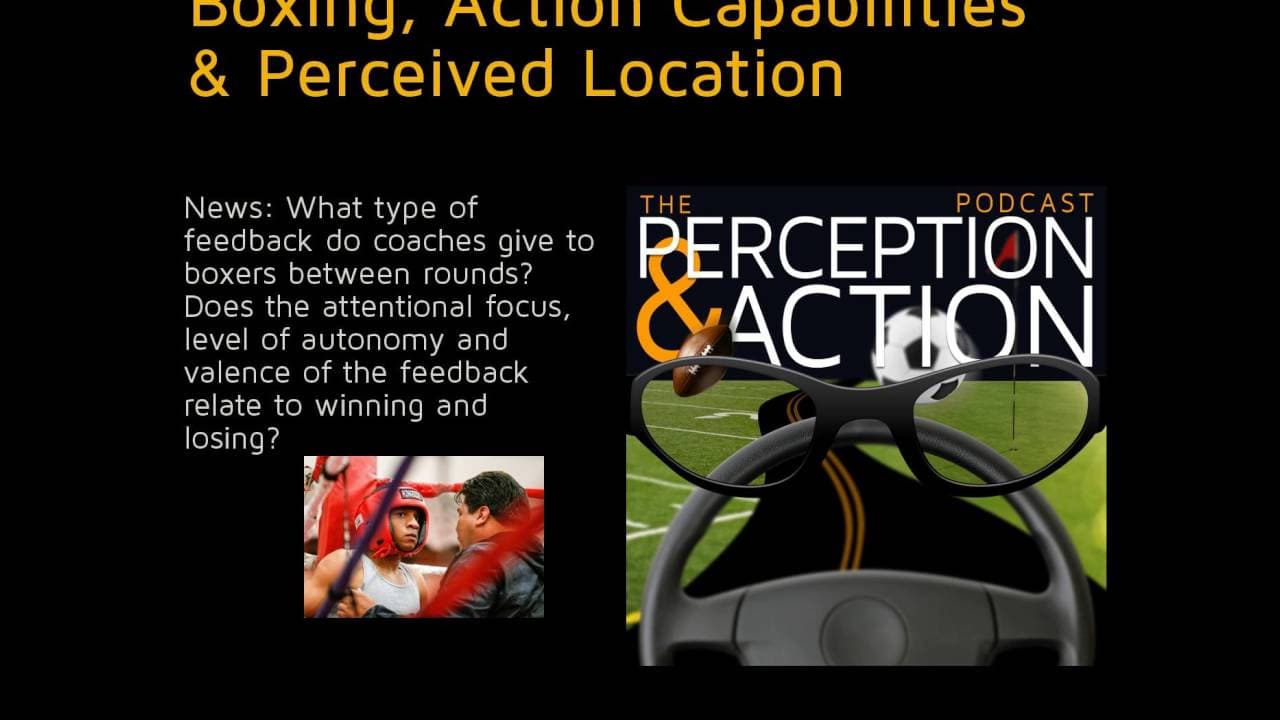
How Does Ringside Feedback Affect Boxing Outcomes?
TL;DR
Ringside feedback in boxing significantly influences performance, with positive feedback being more prevalent in winning bouts. Coaches' feedback, focusing on attentional focus, autonomy support, and feedback valence, correlates with boxers' success. Understanding these dynamics can enhance coaching strategies and athlete performance.
Transcript
today on the perception and Action News an analysis of ringside feedback in boxing and how does our ability to localize objects depend on our inherent and momentary action capabilities so it's time for a call to action hi everyone this is Rob Gray from ASU and perception action.com welcome to the perception and action podcast where I discuss how ps... Read More
Key Insights
- Ringside feedback significantly impacts boxers' performance, with positive feedback more common in winning bouts.
- Attentional focus in feedback can be internal, external, or neutral, affecting athletes' concentration and performance.
- Autonomy support in feedback encourages athlete independence, contrasting with controlling feedback that dictates actions.
- Feedback valence, whether positive, negative, or neutral, can influence athletes' motivation and confidence.
- Winning bouts see less internal and controlling feedback, highlighting the effectiveness of external and autonomy-supportive feedback.
- Inherent action capabilities refer to skill level, while momentary capabilities involve temporary factors like fatigue.
- Gamers exhibit better distance estimation under difficult conditions, suggesting superior perception-action coupling.
- Experimental designs in perception-action research should evolve to incorporate more realistic action tasks for better insights.
Install to Summarize YouTube Videos and Get Transcripts
Explore YouTube Video Summarizer or Get YouTube Transcript Extractor
Questions & Answers
Q: How does ringside feedback affect boxers' performance?
Ringside feedback significantly influences boxers' performance. Positive feedback is more common in winning bouts, suggesting it boosts motivation and confidence. Feedback focusing on attentional aspects, autonomy support, and valence correlates with athletes' success. Understanding these dynamics can help coaches enhance their strategies and improve athletes' performance.
Q: What are the types of attentional focus in feedback?
Attentional focus in feedback can be categorized as internal, external, or neutral. Internal focus directs athletes' attention to their own movements, while external focus emphasizes the effects of their actions on the environment. Neutral focus does not specifically direct attention. The type of focus used can significantly impact athletes' concentration and performance.
Q: What is the role of autonomy support in feedback?
Autonomy support in feedback encourages athletes' independence by allowing them to make decisions and control their actions. This contrasts with controlling feedback, which dictates specific actions. Autonomy-supportive feedback can enhance motivation, confidence, and performance by fostering a sense of ownership and responsibility in athletes.
Q: How does feedback valence influence athletes?
Feedback valence refers to whether feedback is positive, negative, or neutral. Positive feedback can boost athletes' motivation and confidence, while negative feedback might highlight areas for improvement but can also demotivate if not delivered constructively. Neutral feedback provides information without emotional impact. The balance of these can influence athletes' overall performance and mindset.
Q: What differences exist in feedback for winning vs. losing bouts?
In winning bouts, coaches tend to provide more positive feedback and less internal and controlling feedback compared to losing bouts. This suggests that positive, autonomy-supportive, and externally focused feedback is more effective in enhancing performance, as it aligns with findings from laboratory research on motor control.
Q: How do inherent and momentary action capabilities interact?
Inherent action capabilities relate to an individual's skill level, while momentary capabilities involve temporary factors like fatigue. These capabilities interact to influence perception and performance. In challenging conditions, individuals with higher inherent capabilities, such as gamers, tend to perform better, highlighting the importance of both skill and situational factors.
Q: What did the study reveal about gamers' perception-action coupling?
The study found that gamers have superior perception-action coupling, especially under difficult conditions. Gamers could accurately estimate distances even in challenging trials, unlike non-gamers who made significant errors. This suggests that gamers have better-developed skills for processing perceptual information and executing actions, possibly due to their gaming experience.
Q: Why should perception-action research evolve its experimental designs?
Perception-action research should evolve its experimental designs to include more realistic action tasks beyond simple button presses. Current designs often simplify actions, which may not fully capture the complexity of real-world tasks. Incorporating realistic actions could provide deeper insights into the interaction between perception and action capabilities, leading to more applicable findings.
Summary & Key Takeaways
-
Ringside feedback in boxing is crucial, with positive feedback being more prevalent in winning bouts. This feedback focuses on attentional aspects, autonomy support, and feedback valence, which correlate with athletes' success. Coaches should consider these dynamics to enhance performance.
-
The study of action capabilities reveals that inherent skills and momentary factors like fatigue interact to influence perception. Gamers outperform non-gamers in difficult tasks, highlighting the role of perception-action coupling.
-
Research suggests evolving experimental designs in perception-action studies to include more realistic action tasks, moving beyond simple button presses. This approach could provide deeper insights into the interaction between perception and action capabilities.
Read in Other Languages (beta)
Share This Summary 📚
Summarize YouTube Videos and Get Video Transcripts with 1-Click
Try YouTube Summary with ChatGPT & Claude or YouTube Transcript Generator
Explore More Summaries from Rob Gray 📚
Summarize YouTube Videos and Get Video Transcripts with 1-Click
Try YouTube Summary with ChatGPT & Claude or YouTube Transcript Generator