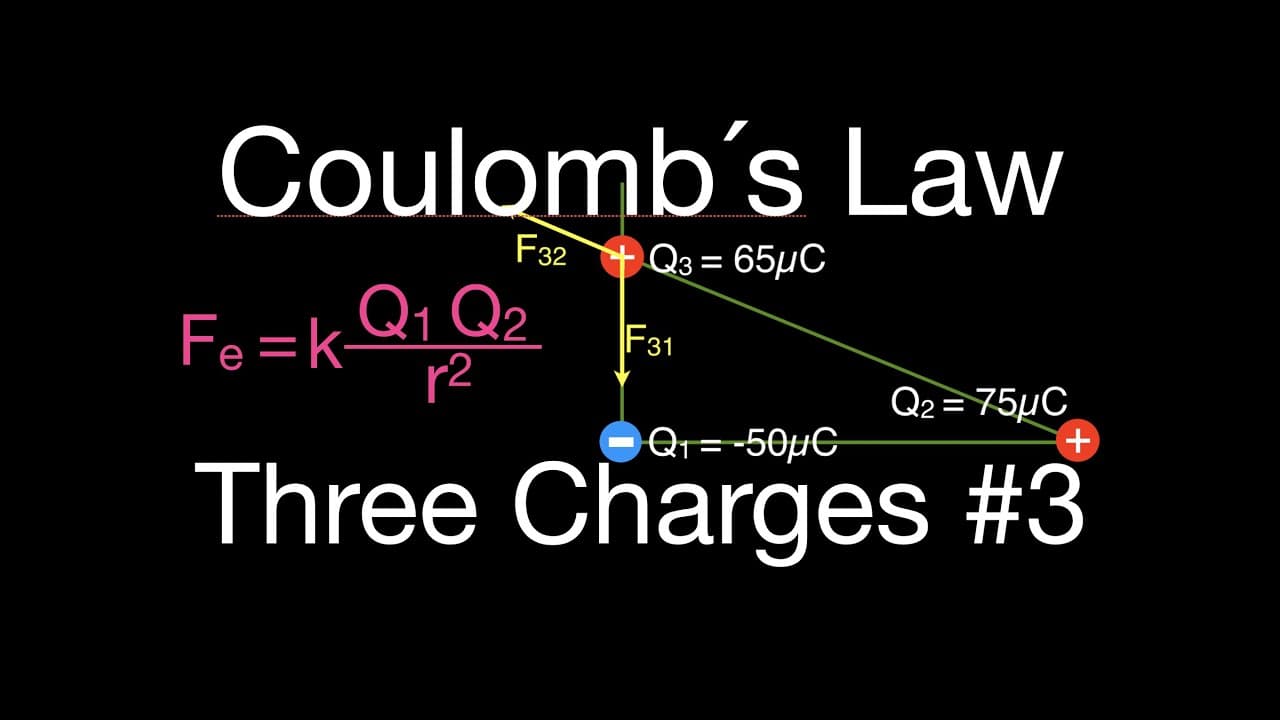
Coulomb's Law (7 of 7) Force on Three Charges Arranged in a Right Triangle
TL;DR
This video discusses how to calculate the magnitude and direction of the force on a charge in a triangular arrangement using Kum's law and trigonometry.
Transcript
okay in today's video as you can see I'm going to go over a kums law problem we have three charges in this problem and this is the situation we have we have this three charges set up in this triangular Arrangement and we want to find the magnitude and the direction of the force on Q3 this is Q3 Q3 is 65 micrum q1 is-50 micrum and Q2 is 75 micrum an... Read More
Key Insights
- 🈂️ Triangular arrangements of charges can result in attractive and repulsive forces between charges.
- 👮 Kum's law is used to calculate the magnitude of the force between charges.
- 🇾🇪 Trigonometry is used to decompose the forces into X and Y components.
- 👻 Adding the X and Y components allows the determination of the net force on a charge.
- 🔺 Angles and directions can be determined using trigonometric functions.
- ❓ Magnitude is determined using the Pythagorean theorem.
- 🤘 Charges with opposite signs attract each other, while charges with the same sign repel each other.
Install to Summarize YouTube Videos and Get Transcripts
Explore YouTube Video Summarizer or Get YouTube Transcript Extractor
Questions & Answers
Q: How is the direction of the force between charges determined?
The direction is determined by whether the charges are positive or negative. Opposite charges attract, while like charges repel.
Q: What is the formula used to calculate the magnitude of the force?
The formula is F = kq1q2/r^2, where F is the force, k is the Kum's constant, q1 and q2 are the charges, and r is the distance between the charges.
Q: Why are the negative and positive signs ignored when calculating the magnitude?
The signs are ignored because they are used to determine the direction of the force, not the magnitude. Magnitude is always positive.
Q: How are the forces decomposed into X and Y components?
The forces are decomposed using trigonometric functions. The sine function is used to find the Y component, and the cosine function is used to find the X component.
Summary & Key Takeaways
-
The video explains the setup of three charges in a triangular arrangement and the goal of finding the magnitude and direction of the force on one of the charges (Q3).
-
The direction of the force between charges Q1 and Q3 is attractive, while the direction between charges Q2 and Q3 is repulsive.
-
Using Kum's law and trigonometry, the magnitudes of the forces are calculated to be 214 Newtons and 80 Newtons, respectively.
Read in Other Languages (beta)
Share This Summary 📚
Summarize YouTube Videos and Get Video Transcripts with 1-Click
Try YouTube Summary with ChatGPT & Claude or YouTube Transcript Generator
Explore More Summaries from Step by Step Science 📚
Summarize YouTube Videos and Get Video Transcripts with 1-Click
Try YouTube Summary with ChatGPT & Claude or YouTube Transcript Generator