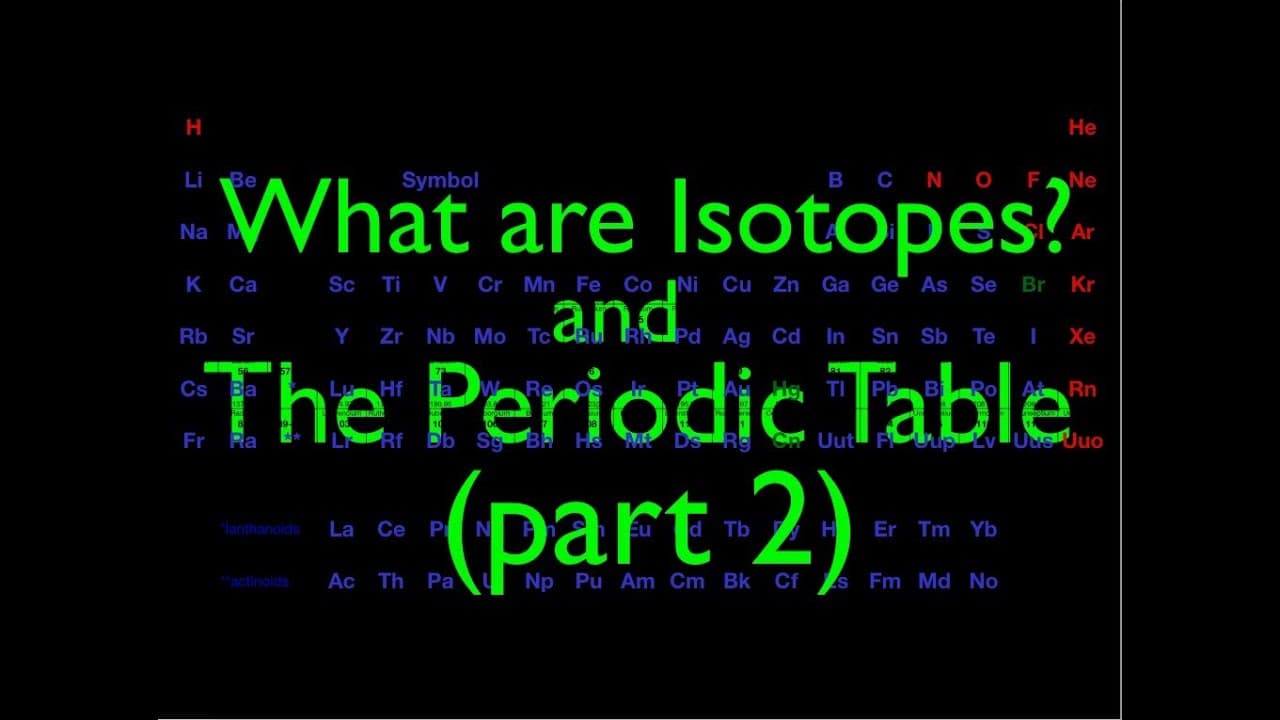
Atomic Structure (4 of 6) What are Isotopes? Solving Simple Isotope Problems
TL;DR
This video explains how to solve and answer questions about isotopes in the periodic table, covering atomic number, mass number, and neutral atom symbols.
Transcript
okay today's video is entitled the periodic table and the isotope part two in today's video we are going to go over how to solve and answer some simple questions concerning Isotopes in part one of the periodic table and Isotopes I went over what and explained what Isotopes are and how to write isotope symbols before we go on and actually solve some... Read More
Key Insights
- #️⃣ Atomic number represents the number of protons in an atom's nucleus, while mass number is the sum of protons and neutrons.
- 🫀 Isotopes are atoms of the same element with different numbers of neutrons in their nuclei.
- #️⃣ Determining the number of protons, neutrons, and electrons in isotopes can be done by subtracting the atomic number from the mass number.
Install to Summarize YouTube Videos and Get Transcripts
Explore YouTube Video Summarizer or Get YouTube Transcript Extractor
Questions & Answers
Q: What is the difference between atomic number and mass number?
The atomic number represents the number of protons in an atom's nucleus, while the mass number is the sum of protons and neutrons. Atomic number is always a whole number, while mass number can vary.
Q: Can you explain further how to calculate the number of neutrons in an atom?
To find the number of neutrons, subtract the atomic number (protons) from the mass number (protons + neutrons). The result will be the number of neutrons present.
Q: How do you determine the number of protons and neutrons in a neutral atom?
By using the isotope symbol, which includes the element symbol and the mass number, subtract the atomic number (protons) from the mass number. The result is the number of neutrons. The number of protons is equal to the atomic number.
Q: Can you provide an example of writing the isotope symbol for an atom?
Sure! Let's take phosphorus-31. The isotope symbol would be "P-31", indicating that it is a neutral atom of phosphorus with 15 protons and 16 neutrons.
Summary & Key Takeaways
-
The video reviews important terms such as atomic number and mass number, explaining how they relate to protons and neutrons in the nucleus of an atom.
-
Isotopes are defined as atoms of the same element with different numbers of neutrons in their nuclei.
-
By using the periodic table and subtracting the atomic number from the mass number, it is possible to determine the number of protons, neutrons, and electrons in neutral atoms of different isotopes.
Read in Other Languages (beta)
Share This Summary 📚
Summarize YouTube Videos and Get Video Transcripts with 1-Click
Try YouTube Summary with ChatGPT & Claude or YouTube Transcript Generator
Explore More Summaries from Step by Step Science 📚
Summarize YouTube Videos and Get Video Transcripts with 1-Click
Try YouTube Summary with ChatGPT & Claude or YouTube Transcript Generator