Lecture 1 | New Revolutions in Particle Physics: Basic Concepts

Transcript
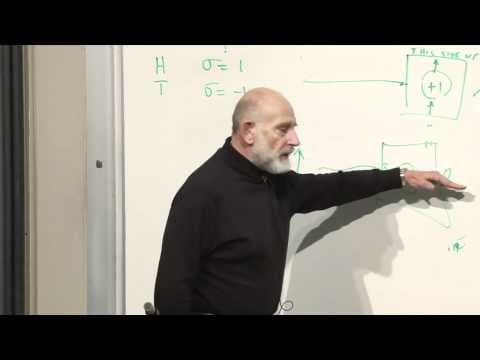
Stanford University all right so what is particle physics about particle physics is about particles it's about the question and this is a very ancient question at least I suspect about 2500 years old is nature discreet discreet meaning to say not that it's polite but that uh that it um that matter and substances and energy they didn't think about e... Read More
Install to Summarize YouTube Videos and Get Transcripts
Explore YouTube Video Summarizer or Get YouTube Transcript Extractor
Summary
This video discusses the question of whether nature is discrete or continuous, with a focus on particle physics and the properties of light and electrons. It explores the historical evidence and experiments that led to our understanding of particles and waves, and introduces the concept of quantum mechanics.
Questions & Answers
Q: What is particle physics about?
Particle physics is about particles, specifically the question of whether nature is made up of discrete particles or continuous fields.
Q: How old is the question of whether nature is discrete?
The question of whether nature is discrete is at least 2500 years old, dating back to ancient Greece.
Q: What are particles and why are they important in particle physics?
Particles are discrete, indivisible units that make up matter and substances in the universe. They are important in particle physics because they form the building blocks of everything.
Q: What is the opposite idea to particles?
The opposite idea to particles is the concept of continuous fields, which are uniform and distributed in space.
Q: How did the discovery of atoms provide evidence for the discrete nature of matter?
The discovery of atoms, starting with John Dalton's realization that different substances had masses that were integer multiples of the mass of a mole of hydrogen atoms, provided evidence that matter is made up of discrete units.
Q: How did the discovery of radioactivity contribute to our understanding of particles and waves?
The discovery of radioactivity, specifically the observation that radioactive materials emitted three types of radiation (alpha, beta, and gamma), led to the realization that particles and waves are intimately connected.
Q: What did the experiment with two holes in a screen reveal about the nature of light?
The experiment with two holes in a screen, known as Young's experiment, revealed that light behaved like a wave, exhibiting interference patterns. This indicated that light had wave-like properties.
Q: How did the discovery of discrete blips in attenuated light experiments challenge our understanding of light?
Attenuated light experiments, in which the intensity of light passing through an obstruction was reduced, showed that light occurred as individual blips or photons. This challenged the wave theory of light and provided evidence for its discrete nature.
Q: Did electrons show wave properties as well?
Yes, electrons also showed wave properties, as evidenced by their ability to form interference patterns when passed through two holes. This indicated that particles, like light, could exhibit wave-like behavior.
Q: How are particles and waves connected in quantum mechanics?
Quantum mechanics introduced the concept that particles and waves are two manifestations of the same thing. This theory explains the probabilistic nature of particles and the wave-like behavior observed in experiments.
Takeaways
Particles and waves are not separate entities but interconnected aspects of nature. The discovery of atoms, radioactivity, and the behavior of light and electrons revealed the duality of particles and waves. Quantum mechanics provided a framework to understand this duality and the probabilistic nature of particles. This understanding is fundamental to the study of particle physics and the nature of reality.
Read in Other Languages (beta)
Share This Summary 📚
Summarize YouTube Videos and Get Video Transcripts with 1-Click
Try YouTube Summary with ChatGPT & Claude or YouTube Transcript Generator
Explore More Summaries from Stanford 📚
Summarize YouTube Videos and Get Video Transcripts with 1-Click
Try YouTube Summary with ChatGPT & Claude or YouTube Transcript Generator