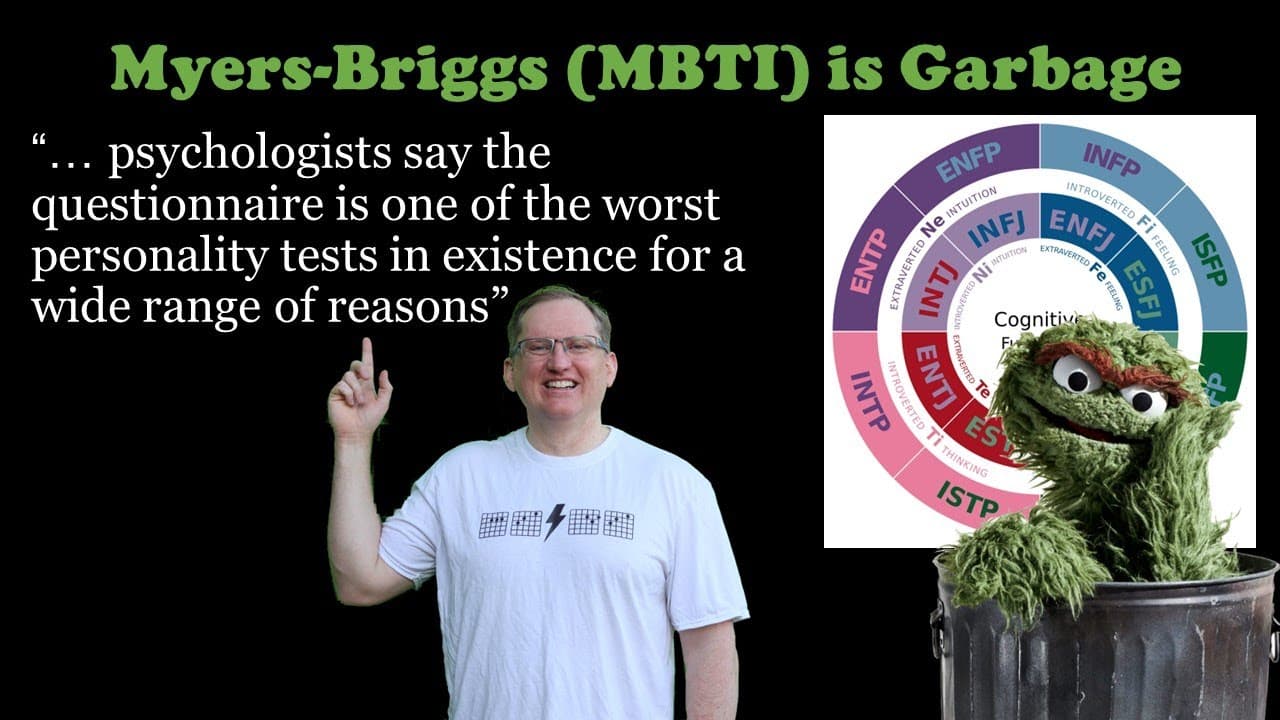
Why the Myers-Briggs Type Indicator (MBTI) is garbage
TL;DR
The Myers-Briggs Type Indicator is flawed and lacks scientific validity.
Transcript
hi friends today I wanted to talk to you about the Maya Briggs type indicator and in particular why you should not be using it and if you come across people that are using it uh some information that you can pass on to them about why they shouldn't be using it as well so we're going to start off by looking at what is my Briggs type indicator mbti t... Read More
Key Insights
- 🖤 The MBTI was developed by individuals lacking formal expertise in psychology, compromising its credibility.
- 🖤 Psychological research has deemed the MBTI as lacking essential reliability and construct validity, which are crucial for assessing personality.
- ❓ The binary nature of MBTI categories oversimplifies human personality, failing to capture the complexities of individual behavior.
- 👯 Critics argue that MBTI results often resemble vague personal statements which people can easily identify with, similar to horoscopes.
- ❓ Alternative models like the Big Five and HEXACO excel in scientific support and provide a more detailed perspective on personality assessment.
- 🥰 The prevalence of the MBTI in workplaces highlights a gap in understanding better psychometric tools available to employers and HR professionals.
- ⁉️ Research indicates that individuals often experience inconsistent results when retaking the MBTI, questioning its effectiveness in personality profiling.
Install to Summarize YouTube Videos and Get Transcripts
Explore YouTube Video Summarizer or Get YouTube Transcript Extractor
Questions & Answers
Q: What are the origins of the Myers-Briggs Type Indicator?
The Myers-Briggs Type Indicator (MBTI) was created in the 1940s by Isabel Briggs Myers and her mother, Katharine Cook Briggs. They sought to classify individuals based on a questionnaire designed primarily around Myers' son-in-law's personality traits. This lack of scientific training raises questions about the rigor behind its development, which is often criticized for its unsatisfactory psychometric qualities.
Q: Why is the Myers-Briggs Type Indicator considered ineffective by psychologists?
Psychologists critique the MBTI for several reasons, notably its poor construct validity and reliability. Studies show that while some dimensions correlate with other established measures, the majority do not. Furthermore, many individuals score differently when they retake the MBTI after a short interval, indicating that it may not consistently measure stable personality traits.
Q: How does the Myers-Briggs approach dichotomies differently from other personality tests?
The MBTI simplifies personality traits into binary options, categorizing individuals strictly as either introverted or extroverted. In contrast, other models, such as the Big Five, view traits as continuums, allowing for a more nuanced understanding of personality by showing where an individual falls on the scale rather than forcing them into a specific category.
Q: What are the recommended alternatives to the Myers-Briggs Type Indicator?
The video recommends using either the Big Five personality model or the HEXACO model. The Big Five measures five traits—conscientiousness, extroversion, agreeableness, neuroticism, and openness—on a continuous scale, while the HEXACO model adds a sixth trait, honesty-humility. Both models are considered to have strong empirical support and provide a richer understanding of personality than the MBTI.
Q: Why do some people still advocate for the use of the Myers-Briggs Type Indicator?
Some advocates appreciate the MBTI for its simplicity and the relatable language used in its descriptions. This can resonate with individuals who may find the vague interpretations relevant to their self-perceptions. However, this might be due to a lack of exposure to more comprehensive and scientifically backed personality assessments available in the field today.
Q: What is the main criticism regarding the vagueness of MBTI descriptions?
The descriptions provided by the MBTI are often criticized for being sufficiently vague, allowing individuals to interpret them in a way that fits their personal experience. This resembles astrology, where broad statements seem to apply to anyone. This lack of precision renders the results less useful for understanding true personality differences.
Q: How does the Big Five model address the shortcomings of the MBTI?
The Big Five model tackles the shortcomings of MBTI by measuring five distinct personality dimensions on a continuous scale, leading to a more refined understanding of individual differences. This approach also adheres to rigorous psychometric standards, ensuring that the dimensions reflect true traits rather than arbitrary classifications.
Q: What role does scientific validation play in personality assessments?
Scientific validation is critical for ensuring that a personality assessment accurately measures the traits it intends to measure and is reliable over time. Instruments like the Big Five and HEXACO have undergone extensive research and testing, establishing them as robust psychological tools, unlike the MBTI, which lacks substantial validation from independent studies.
Summary & Key Takeaways
-
The Myers-Briggs Type Indicator (MBTI) was developed by untrained individuals and claims to categorize people into 16 types based on dichotomies, despite lacking solid psychometric foundations.
-
Critics, including psychologists and researchers, consider the MBTI ineffective due to issues with construct validity, reliability, and the simplistic dichotomy of personality traits.
-
Alternatives like the Big Five and HEXACO models offer more nuanced, scientifically validated approaches to understanding personality traits through continuous measures rather than binary classifications.
Read in Other Languages (beta)
Share This Summary 📚
Summarize YouTube Videos and Get Video Transcripts with 1-Click
Try YouTube Summary with ChatGPT & Claude or YouTube Transcript Generator
Explore More Summaries from Dr Lyndon Walker 📚



Summarize YouTube Videos and Get Video Transcripts with 1-Click
Try YouTube Summary with ChatGPT & Claude or YouTube Transcript Generator