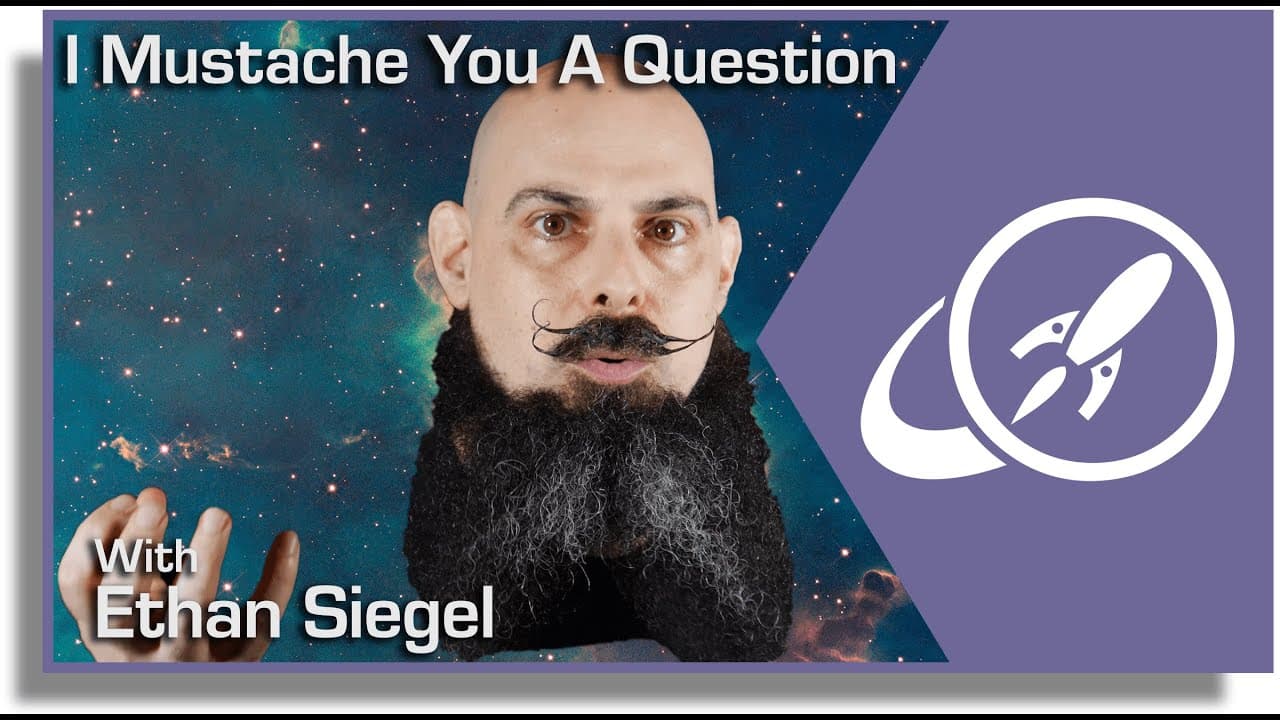
Q&A 112: Are Stars Moving The Same Speed And More... Featuring Ethan Siegel
TL;DR
Astronomer Ethan Siegel answers various questions about stars, black holes, black hole evaporation, quantum entanglement, and more.
Transcript
so we're at the double-a s meeting 2:35 in Honolulu Hawaii and 3,500 astronomers are presenting all of their latest space science news and I had a chance to hang it with my good friend Ethan Siegel here at the conference and I thought I would just throw an entire question show his way all the questions I've been avoiding all the zingers all the rea... Read More
Key Insights
- 🤩 Stars in the Milky Way rotate at different speeds depending on their distance from the galactic center.
- 🐬 Photons do not have antiparticles because they possess the same quantum numbers when flipped.
- 💥 Observing Betelgeuse when it explodes requires a filter to reduce its brightness.
- 🌟 Stars twinkle on Mars, but at a significantly lower level than on Earth due to Mars' thinner atmosphere.
- 👋 Recombination prior to 370,000 years after the Big Bang is a wall for observing the universe, but neutrino and gravitational wave astronomy offer insights into earlier times.
- 👣 Starlink satellites pose challenges for astronomy, and real-time communication systems will be needed to track and mitigate their impact.
- 🙂 The Hubble tension in cosmology indicates a difference in expanding universe measurements, suggesting changes in the universe, light propagation, dark energy, or the presence of new energy.
- ✴️ The mass limit for a star to collapse into a black hole depends on its composition, and direct collapse observations have revealed surprises.
- 🖤 Entangled particles falling into a black hole remain entangled, but no communication is possible due to the no communication theorem.
- 🍂 Matter falling into a black hole will never reach the singularity due to time dilation, but the event horizon grows larger as more matter falls in.
- 👨🚀 Astronauts can arrest their rotation in space by extending themselves in one dimension or by throwing mass, following the conservation of angular momentum.
- 🚾 The self-interaction of gravitational waves emitted by objects in space causes them to lose energy and eventually slow down and come to a rest, but this process takes an incredibly long time.
Install to Summarize YouTube Videos and Get Transcripts
Explore YouTube Video Summarizer or Get YouTube Transcript Extractor
Questions & Answers
Q: Do all stars, including our Sun, travel through the Milky Way galaxy at the same speed?
Stars, including our Sun, move at different speeds depending on their distance from the galactic center. The rotation speed decreases with distance, but there are bumps in the rotation profile.
Q: How is a photon its own antiparticle?
Photons have the same quantum numbers, including electric charge and spin, when flipped, making them their own antiparticles.
Q: Is it safe to observe Betelgeuse through a telescope when it explodes?
It is safe to observe Betelgeuse through a telescope when it explodes, but a filter is needed to reduce its brightness to avoid eye damage. Telescopes can still gather useful data without filters.
Q: Do stars twinkle in the Mars sky?
Stars do twinkle in the Mars sky, but at a much lower level than on Earth due to Mars' thinner atmosphere. Twinkling is more noticeable close to the horizon.
Summary & Key Takeaways
-
Stars in the Milky Way galaxy, including our Sun, travel at different speeds depending on their distance from the galactic center.
-
Photons are their own antiparticles because they possess the same quantum numbers when flipped.
-
It would be safe to observe Betelgeuse through a telescope when it explodes, but a filter is needed to reduce its brightness.
-
Stars twinkle in the Mars sky, but at only 1% of the level seen on Earth due to Mars' thinner atmosphere.
Read in Other Languages (beta)
Share This Summary 📚
Summarize YouTube Videos and Get Video Transcripts with 1-Click
Try YouTube Summary with ChatGPT & Claude or YouTube Transcript Generator
Explore More Summaries from Fraser Cain 📚
Summarize YouTube Videos and Get Video Transcripts with 1-Click
Try YouTube Summary with ChatGPT & Claude or YouTube Transcript Generator