How Does Movement Variability Enhance Training?
TL;DR
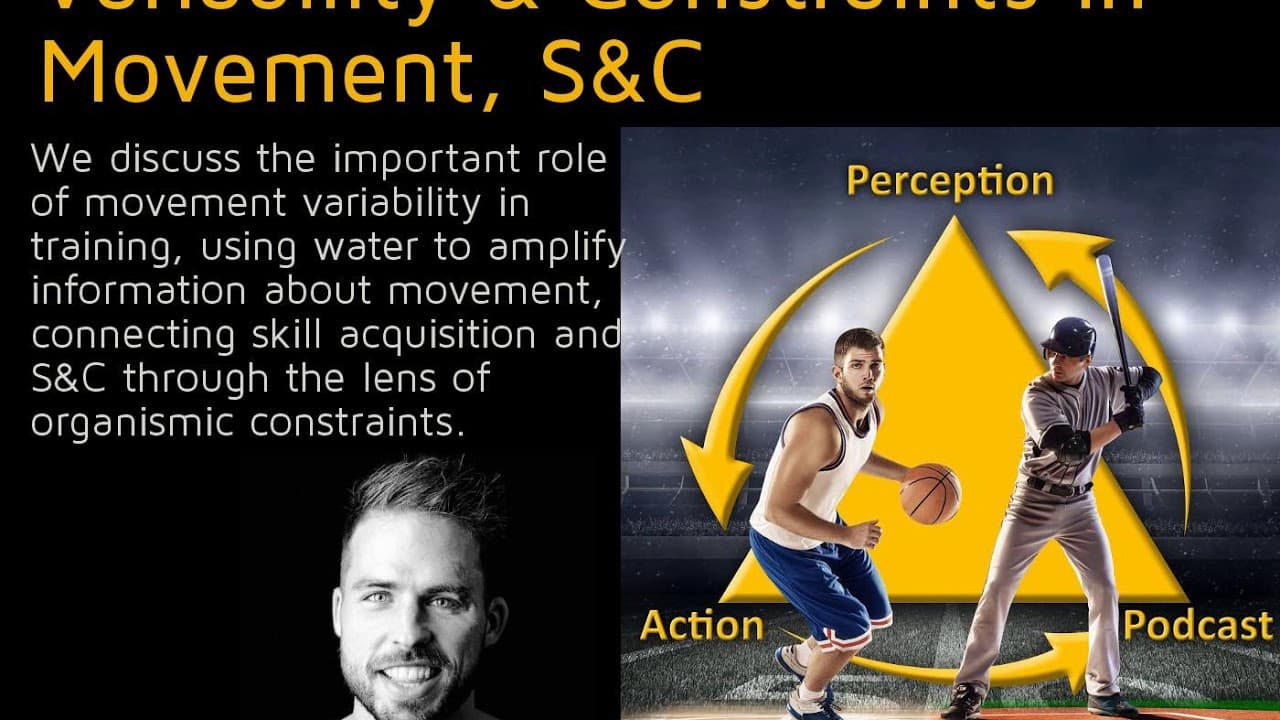
Movement variability is crucial for enhancing training outcomes by allowing the body to adapt and self-organize through unpredictable exercises. Using tools like water amplifies movement information, helping athletes explore different solutions and improve skill acquisition. This approach connects strength and conditioning with skill learning by leveraging organismic constraints.
Transcript
this is Rob gray from ASU and perception action calm today on the perception and action podcast my interview with Paul venner head of athletic performance at Dutch baseball and founder of ultimate instability hi everyone welcome to the perception and action podcast where I discuss how psychological research can be applied to improving performance a... Read More
Key Insights
- Movement variability is essential for effective training and skill acquisition.
- Using water in exercises provides more movement information for athletes.
- Organismic constraints, like fatigue, can steer motor output and learning.
- Strength and conditioning can be integrated with skill acquisition through constraints.
- Heavy lifting constrains movement options, limiting variability.
- Exercises should allow athletes to self-organize towards desired outcomes.
- Fatigue can be used as a tool to enhance learning by altering organismic constraints.
- Contextual interference, like mixing exercises, improves skill retention.
Install to Summarize YouTube Videos and Get Transcripts
Explore YouTube Video Summarizer or Get YouTube Transcript Extractor
Questions & Answers
Q: How does movement variability benefit athletic training?
Movement variability benefits athletic training by allowing athletes to explore different movement solutions and adapt to changing conditions. It enhances skill acquisition by providing a broader range of experiences and feedback, which helps in developing more robust and adaptable motor skills. This approach also improves performance under unpredictable real-world conditions.
Q: What role does water play in movement training?
Water plays a significant role in movement training by amplifying feedback and providing more information about the movement. When used in exercises, the unpredictable nature of water challenges athletes to adapt and adjust their movements, leading to improved coordination and skill acquisition. This technique enhances the body's ability to self-organize and respond to dynamic conditions.
Q: How can organismic constraints be used in training?
Organismic constraints, such as fatigue, can be strategically used in training to alter the body's response and encourage exploration of different movement patterns. By introducing fatigue, athletes are forced to adapt and find new solutions, which can enhance learning and skill retention. This approach connects strength and conditioning with skill acquisition, leveraging the body's natural responses to improve performance.
Q: Why is integrating strength and conditioning with skill acquisition important?
Integrating strength and conditioning with skill acquisition is important because it allows for a holistic approach to athletic development. By considering both physical and skill aspects, training can be more effective in preparing athletes for real-world challenges. This integration helps in developing adaptable skills and improving overall performance by leveraging organismic constraints and movement variability.
Q: What is the impact of heavy lifting on movement variability?
Heavy lifting can constrain movement variability by limiting the range of movement options available to the athlete. The weight dictates the movement path, reducing the opportunity for exploration and adaptation. While beneficial for strength development, heavy lifting should be complemented with exercises that encourage variability to ensure well-rounded skill acquisition and adaptability.
Q: How does contextual interference enhance skill retention?
Contextual interference enhances skill retention by introducing variability and unpredictability into training sessions. By mixing different exercises and tasks, athletes are challenged to constantly adapt and problem-solve, leading to better retention of skills. This approach keeps athletes engaged and focused, promoting deeper learning and more robust skill development.
Q: What is the significance of self-organization in movement training?
Self-organization in movement training is significant because it allows athletes to naturally find the most efficient and effective movement solutions. By focusing on clear outcomes and providing opportunities for exploration, athletes learn to adapt and optimize their movements. This approach enhances skill acquisition by encouraging athletes to develop their own strategies for achieving desired results.
Q: How can fatigue be used to improve skill acquisition?
Fatigue can be used to improve skill acquisition by altering the athlete's constraints and forcing them to adapt to new conditions. By introducing fatigue, athletes are challenged to find new movement solutions, enhancing their ability to cope with real-world scenarios. This approach encourages exploration and adaptation, leading to more robust and transferable skills.
Summary & Key Takeaways
-
Movement variability plays a critical role in training by allowing athletes to adapt to changing conditions and explore different movement solutions. Using tools like water amplifies feedback, enhancing skill acquisition and performance. Integrating strength and conditioning with skill learning through organismic constraints, such as fatigue, can significantly improve training outcomes.
-
Paul Venner emphasizes the importance of variability in movement training, advocating for exercises that encourage self-organization and adaptation. By introducing elements like water, athletes receive enhanced feedback, leading to better skill retention and performance. This approach bridges the gap between strength training and skill acquisition.
-
The integration of strength and conditioning with skill acquisition is achieved by leveraging organismic constraints. By introducing variability and unexpected challenges, athletes learn to adapt and improve their skills. This method, highlighted by Paul Venner, offers a practical application of theoretical concepts in sports science.
Read in Other Languages (beta)
Share This Summary 📚
Summarize YouTube Videos and Get Video Transcripts with 1-Click
Try YouTube Summary with ChatGPT & Claude or YouTube Transcript Generator
Explore More Summaries from Rob Gray 📚
Summarize YouTube Videos and Get Video Transcripts with 1-Click
Try YouTube Summary with ChatGPT & Claude or YouTube Transcript Generator