Mathematical Models 1
TL;DR
This video explains how to derive analytical models for solid mechanics, dynamics, and heat transfer, using the example of a simple pendulum.
Transcript
click the bell icon to get latest videos from ekeeda hello friends so let us derive some analytical models that we already did in our previous courses one from solid mechanics one from dynamics and one from heat transfer so let us derive the analytical models for these three cases and this is just a revision of what you have already learned so let ... Read More
Key Insights
- 🥵 Analytical models can be derived for various areas of study, such as solid mechanics, dynamics, and heat transfer.
- 🖐️ Assumptions about the system being analyzed play a crucial role in formulating the governing equations.
- 📐 Conservation principles, such as the conservation of angular momentum, can be used to derive governing equations.
- ❓ The simple pendulum is often used as an example to demonstrate the derivation of analytical models in physics.
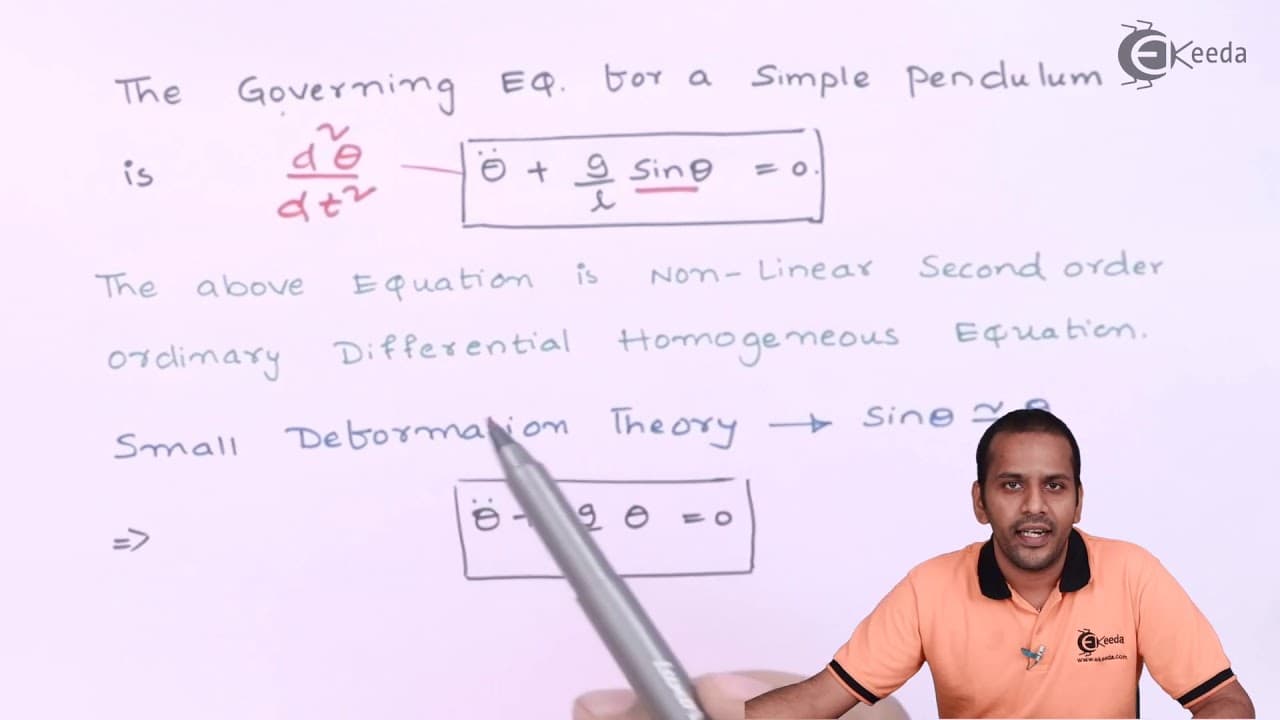
- 🛩️ The governing equation for the simple pendulum is non-linear, but it can be simplified by assuming small deformations.
- 😑 The solution for the simple pendulum equation can be expressed as a sinusoidal function with initial conditions determining the constants in the solution.
- 💆 The derived analytical solution for the simple pendulum equation can also be applied to a spring-mass system, highlighting the similarities in their governing equations.
Install to Summarize YouTube Videos and Get Transcripts
Explore YouTube Video Summarizer or Get YouTube Transcript Extractor
Questions & Answers
Q: What are the assumptions made when deriving the analytical model for the simple pendulum?
The assumptions include negligible friction and drag forces, swinging in a perfect plane, and the pendulum arm being rigid and massless.
Q: What conservation principles are used in deriving the governing equation for the simple pendulum?
The conservation of angular momentum and Newton's second law for rotation are used to derive the governing equation.
Q: Why is the governing equation for the simple pendulum considered a non-linear equation?
The equation is non-linear because of the term involving the sine of the angle theta, which makes it a second-order non-linear homogeneous ordinary differential equation.
Q: Can the governing equation for the simple pendulum be solved directly?
No, the non-linear nature of the equation makes it difficult to solve directly. However, by making the assumption of small deformations, the equation can be approximated as a second-order linear homogeneous differential equation, which has a known analytical solution.
Summary & Key Takeaways
-
The video revisits the derivation of analytical models previously covered in courses on solid mechanics, dynamics, and heat transfer.
-
The focus is on deriving the differential equation for the motion of a simple pendulum, representing the motion of a pendulum with no external forces or friction.
-
Assumptions are made about the pendulum, such as negligible friction, swinging in a perfect plane, and the pendulum arm being massless.
Read in Other Languages (beta)
Share This Summary 📚
Summarize YouTube Videos and Get Video Transcripts with 1-Click
Try YouTube Summary with ChatGPT & Claude or YouTube Transcript Generator
Explore More Summaries from Ekeeda 📚




Summarize YouTube Videos and Get Video Transcripts with 1-Click
Try YouTube Summary with ChatGPT & Claude or YouTube Transcript Generator