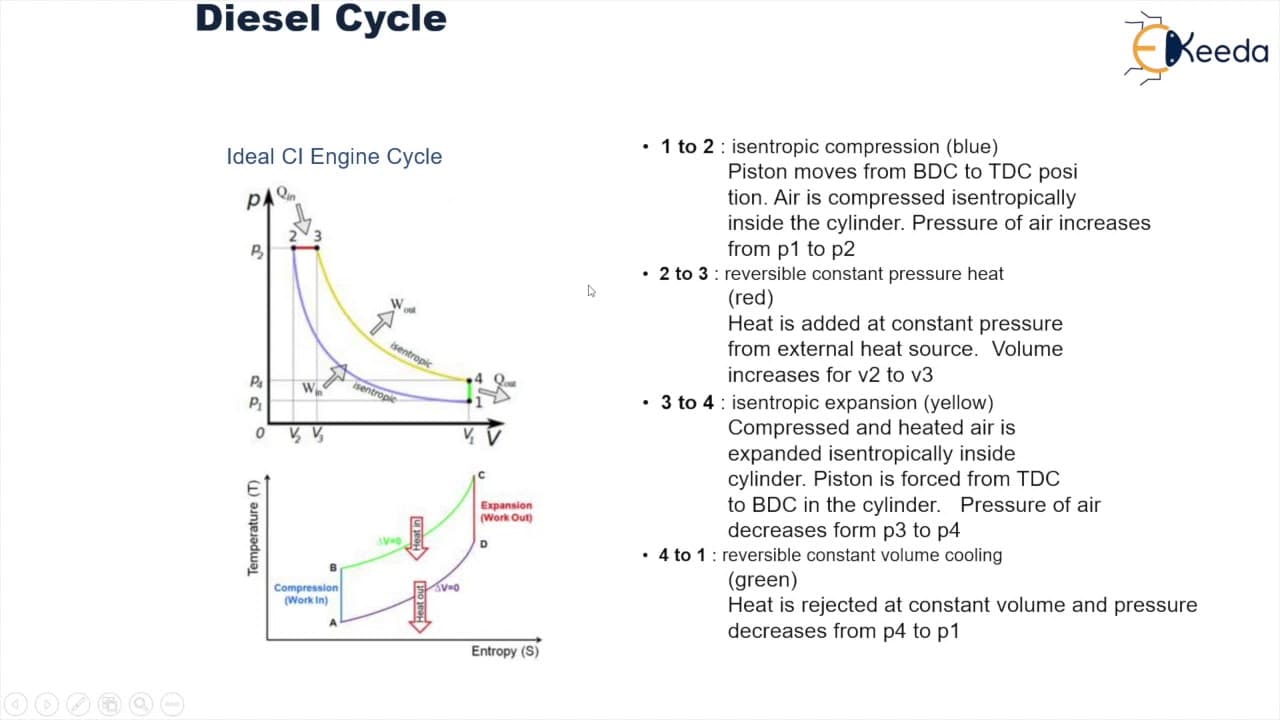
Fuel Air Actual Working Cycle
TL;DR
This analysis discusses the fuel/air cycles in internal combustion engines, including the assumptions and processes involved in each cycle.
Transcript
hello everyone today in this lecture we are going to see some of the fuel/air cycles on which the internal combustion engines they operate there is the reason why in these cycles are called as you air cycle even is that with any internal combustion engine fuel and they combine and combustion takes place the mass stable material is assumed for anyth... Read More
Key Insights
- 👱 The fuel/air cycles in internal combustion engines are named after the combination of fuel and atmospheric air required for combustion.
- 💦 The analysis simplifies the process by assuming the working fluid to be only air and constant specific heat of the working fluid.
- 🥵 The cycles involve processes such as compression, combustion, expansion, and heat rejection.
Install to Summarize YouTube Videos and Get Transcripts
Explore YouTube Video Summarizer or Get YouTube Transcript Extractor
Questions & Answers
Q: Why are fuel/air cycles called as such in internal combustion engines?
Fuel/air cycles are named because they involve the combination of fuel and atmospheric air for combustion in internal combustion engines.
Q: Why is the assumption made that the working fluid is only air during the analysis?
The assumption is made to simplify the analysis process, as different fuels would require separate analyses, making it tedious and complicated.
Q: What happens during combustion in the fuel/air cycle?
During combustion, there is a chemical change in the fuel and air, with some chemical bonds being broken and new ones formed.
Q: How are the expansion and compression processes considered in the analysis?
The expansion and compression processes are assumed to be frictionless and adiabatic, with no heat transfer between the gases.
Summary & Key Takeaways
-
Fuel/air cycles are named after the combination of fuel and atmospheric air that is required for combustion in internal combustion engines.
-
The analysis assumes the working fluid to be only air to simplify the analysis process.
-
Before combustion, there is no chemical change in the fuel or air, and after combustion, changes occur in chemical equilibria.
Read in Other Languages (beta)
Share This Summary 📚
Summarize YouTube Videos and Get Video Transcripts with 1-Click
Try YouTube Summary with ChatGPT & Claude or YouTube Transcript Generator
Explore More Summaries from Ekeeda 📚
Summarize YouTube Videos and Get Video Transcripts with 1-Click
Try YouTube Summary with ChatGPT & Claude or YouTube Transcript Generator