What Is Lisa Max and How Will It Change Gravitational Wave Detection?
TL;DR
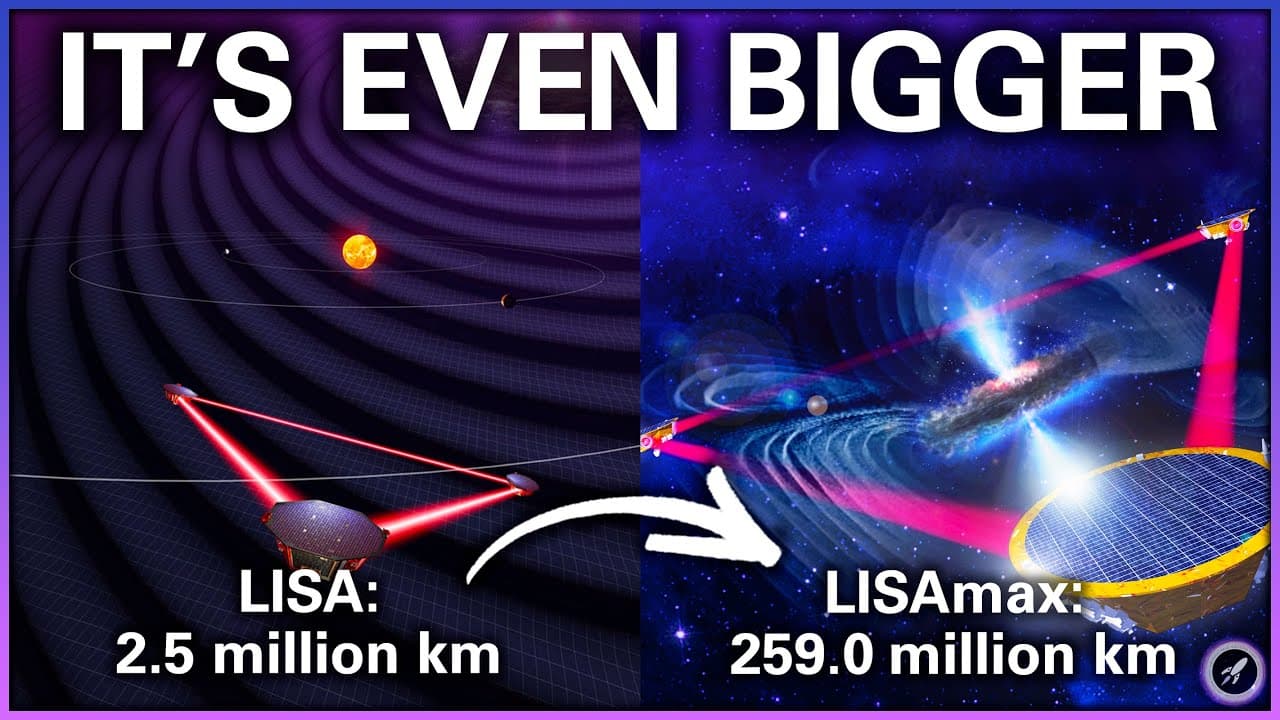
Lisa Max is a proposed extension of the Lisa gravitational wave detector that aims to observe lower frequency gravitational waves by utilizing arms extending from Earth-Sun Lagrange points. This setup could detect signals from colliding supermassive black holes and potentially capture primordial gravitational waves from the Big Bang, although it faces challenges in source localization compared to Lisa.
Transcript
gravitational waves are pretty exciting we've got this new way to observe the universe in an entirely new Spectrum it's like before we could see the universe and now we can hear the universe thanks to gravitational waves and we've got the ground-based observatories like ligo and Virgo and kagra but there's a new space-based Observatory under develo... Read More
Key Insights
- 😫 Lisa, a space-based gravitational wave detector, is set to launch in 2035.
- 🔺 Dr. Walimer Martins is proposing a version of Lisa called Lisa Max, which would have arms extending from Earth-Sun Lagrange points to create a massive equilateral triangle.
- 👋 Lisa Max aims to detect lower frequency gravitational waves and could potentially observe colliding supermassive black holes and primordial gravitational waves from the Big Bang.
- 👋 Lisa Max could provide valuable insights into the background gravitational wave signal from the early universe.
- 🥃 One challenge for Lisa Max is the ability to localize sources in the sky compared to Lisa.
Install to Summarize YouTube Videos and Get Transcripts
Explore YouTube Video Summarizer or Get YouTube Transcript Extractor
Questions & Answers
Q: What is Lisa and how does it differ from ground-based gravitational wave detectors?
Lisa is a space-based gravitational wave detector that measures ripples in the fabric of space-time. Unlike ground-based detectors like Ligo, Lisa has much larger arms and can detect lower frequency gravitational waves.
Q: What is the purpose of Lisa Max and how does it differ from Lisa?
Lisa Max is a proposed extension of Lisa that aims to detect even lower frequency gravitational waves. It would have arms extending from Earth-Sun Lagrange points, creating a massive equilateral triangle. Lisa Max could observe colliding supermassive black holes and primordial gravitational waves from the Big Bang.
Q: Can Lisa Max help us understand the background gravitational wave signal from the early universe?
It's possible that Lisa Max could provide valuable insights into the background gravitational wave signal from the early universe. By detecting signals from supermassive black hole inspirals much earlier, it could help us measure parameters more precisely and contribute to our understanding of the early universe.
Q: What challenges does Lisa Max face and how does it compare to Lisa?
One challenge for Lisa Max is the ability to localize sources in the sky. While Lisa has the ability to observe one source over time and measure its signature, Lisa Max's configuration does not allow for the same level of localization. Additionally, Lisa Max is more sensitive to lower frequencies but less sensitive to higher frequencies compared to Lisa.
Summary & Key Takeaways
-
Lisa, a space-based gravitational wave detector, is currently under development and set to launch in 2035.
-
Lisa Max is a proposed extension of Lisa that would have arms extending from Earth-Sun L3, L4, and L5 Lagrange points, creating a massive equilateral triangle.
-
Lisa Max aims to detect lower frequency gravitational waves and could potentially observe colliding supermassive black holes and primordial gravitational waves from the Big Bang.
Read in Other Languages (beta)
Share This Summary 📚
Summarize YouTube Videos and Get Video Transcripts with 1-Click
Try YouTube Summary with ChatGPT & Claude or YouTube Transcript Generator
Explore More Summaries from Fraser Cain / Universe Today Podcast 📚



Summarize YouTube Videos and Get Video Transcripts with 1-Click
Try YouTube Summary with ChatGPT & Claude or YouTube Transcript Generator