Contract Law 23 II Lefkowitz v Great MN Surplus Store (ambiguous offer)
TL;DR
A court case explores whether advertisements constitute offers and how they form binding contracts.
Transcript
our next case comes from the Supreme Court of Minnesota in 1957 and deals with the role of advertising and forming a contract on Friday April 6 1956 the great Minneapolis surplus store published an advertisement in the newspaper very much like the one you see here it advertised Saturday 9:00 a.m. sharp three brand new fur coats worth two one thousa... Read More
Key Insights
- 🫠 Advertisements are generally treated as solicitations for offers, but in certain cases, clear and explicit ads can be considered binding offers.
- 🛄 Courts aim to protect consumers and encourage careful drafting by being reluctant to enforce indefinite contracts.
- 🖐️ Timing plays a crucial role, as any modifications or revocations of an offer must occur before acceptance.
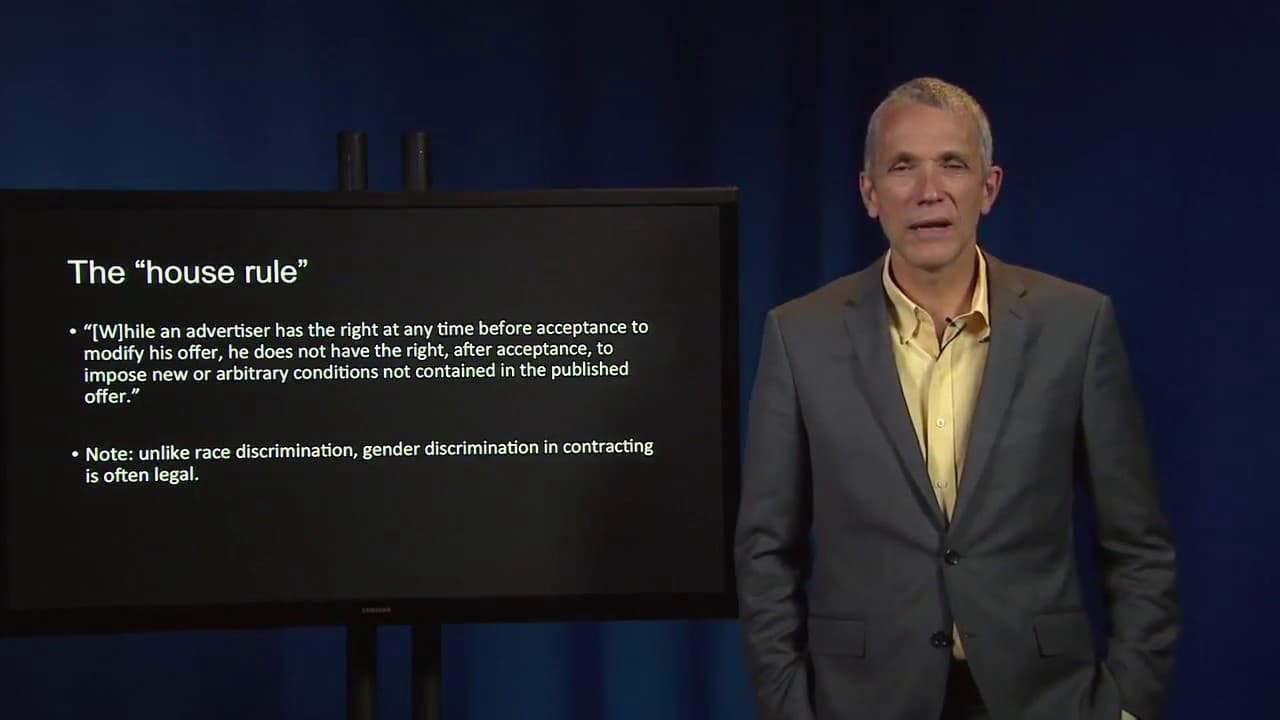
- 👶 Imposing new conditions after acceptance, like gender restrictions, is generally not permitted.
Install to Summarize YouTube Videos and Get Transcripts
Explore YouTube Video Summarizer or Get YouTube Transcript Extractor
Questions & Answers
Q: Did Morris Lefkowitz have a valid argument for claiming that the advertisements constituted offers?
Yes, Morris Lefkowitz argued that the advertisements were offers which he accepted by showing up at the store ready to pay, and the court agreed that clear and explicit advertisements can be considered offers.
Q: What is the significance of the court's ruling regarding indefinite contracts?
The court's reluctance to enforce indefinite contracts, as seen in this case, aims to encourage parties to draft more carefully and avoid ambiguities. However, it may lead businesses to make advertisements indefinite to protect themselves from legal enforcement.
Q: What was the court's stance on the house rule of the surplus store?
The court ruled that the store couldn't impose a new condition, such as gender restriction, after the offer was accepted, as it was not a part of the original advertisement.
Q: Is gender discrimination in contracting legal?
In most states, gender discrimination in contracting is legal, except in California and a few other states. California's Unruh Civil Rights Act bans gender discrimination in contracting, along with discrimination based on other characteristics.
Summary & Key Takeaways
-
In 1957, a Minnesota court case involved the great Minneapolis surplus store refusing to sell fur coats and a stole to a customer who arrived promptly for advertised deals.
-
The court had to determine if the advertisements were offers or mere solicitations, ultimately ruling that clear, definite, and explicit ads can be considered offers.
-
The court found that the second advertisement for the stole met the requirements, resulting in the plaintiff receiving expectation damages.
Read in Other Languages (beta)
Share This Summary 📚
Summarize YouTube Videos and Get Video Transcripts with 1-Click
Try YouTube Summary with ChatGPT & Claude or YouTube Transcript Generator
Explore More Summaries from YaleCourses 📚





Summarize YouTube Videos and Get Video Transcripts with 1-Click
Try YouTube Summary with ChatGPT & Claude or YouTube Transcript Generator