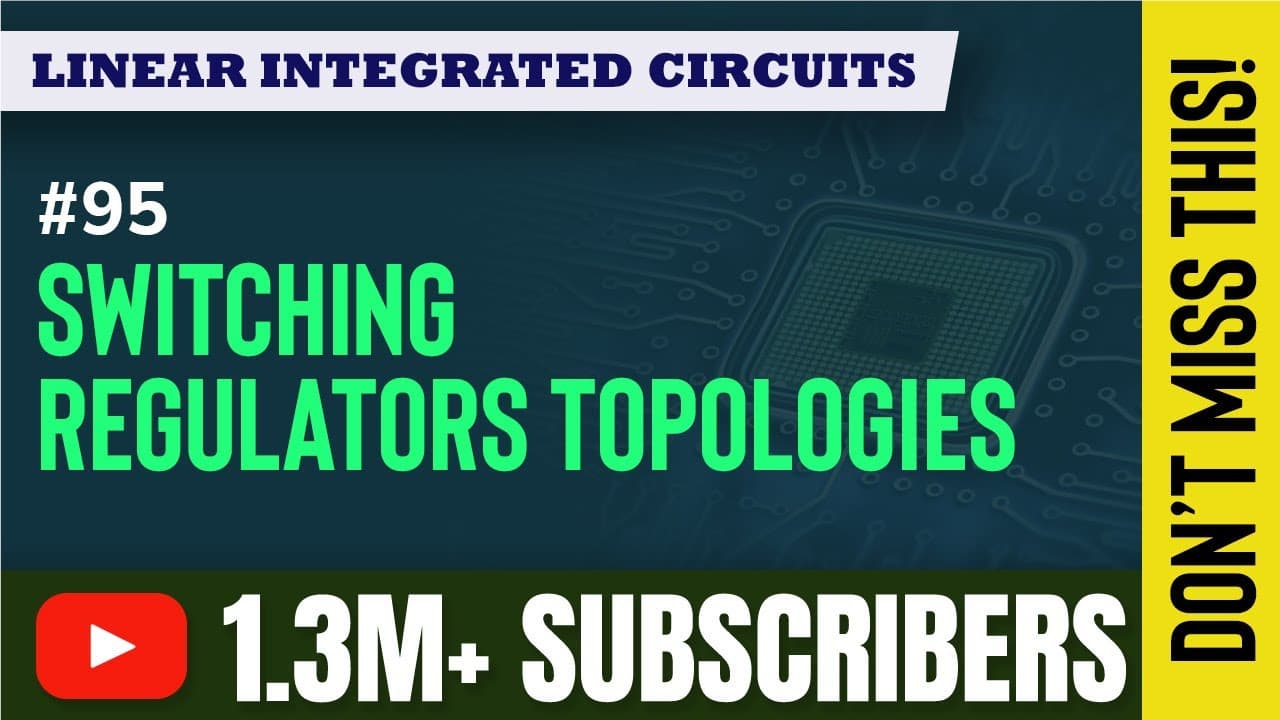
Switching Regulators Topologies | Voltage Regulators in LIC | Linear Integrated Circuits in EXTC
TL;DR
This video explains the three basic switching regulator topologies: step-down (buck), step-up (boost), and buck-boost.
Transcript
hello friends in this video we are going to see the different switching regulator topologies or we can say the different types of switching regulators so let's begin with the topic the three basic switching regulators available are step down or buck switching regulator step up or boost switching regulator and third one is switching buck boost regul... Read More
Key Insights
- 🪣 There are three basic switching regulator topologies: step-down (buck), step-up (boost), and buck-boost.
- 🛂 Step-down regulators control output voltage by using rectangular pulses applied to a power transistor and a low-pass filter.
- ⚡ Step-up regulators interrupt current flow through an inductor to induce a higher output voltage.
- ⚡ Buck-boost regulators operate in three modes and can produce negative output voltages higher than the input voltage.
- 🏍️ The disadvantage of buck converters is their inability to provide dual polarity voltage and their sensitivity to changes in duty cycle.
- ✋ Boost converters have the disadvantage of high power dissipation and sensitivity to changes in duty cycle.
- 🔊 Buck-boost regulators have discontinuous input current and high peak current through the transistor.
Install to Summarize YouTube Videos and Get Transcripts
Explore YouTube Video Summarizer or Get YouTube Transcript Extractor
Questions & Answers
Q: How does a step-down switching regulator work?
A step-down regulator uses rectangular pulses applied to a power transistor to control the output voltage. The transistor turns on and off, allowing energy to flow through an inductor and capacitor to create a low-pass filter. The duty cycle of the pulses determines the output voltage.
Q: What is the advantage of a step-up switching regulator?
A step-up regulator, also known as a boost converter, can produce an output voltage higher than the input voltage. It achieves this by interrupting the current flowing through an inductor, causing the energy stored in the inductor to be added to the input voltage.
Q: What are the disadvantages of a buck switching regulator?
Buck converters, or step-down regulators, do not provide a voltage with dual polarity, and the load current is unidirectional. They also require a continuous duty cycle change to vary the output voltage, and the output is sensitive to changes in duty cycle.
Q: How does a buck-boost switching regulator work?
A buck-boost regulator operates in three modes: when the transistor is on, when the transistor turns off and the diode is forward biased, and when all devices are off. It can produce a negative output voltage higher than the input voltage but has the disadvantage of discontinuous input current and high peak current through the transistor.
Summary & Key Takeaways
-
There are three basic switching regulator topologies: step-down or buck, step-up or boost, and buck-boost.
-
The step-down regulator uses rectangular pulses applied to a power transistor to control the output voltage.
-
The step-up regulator interrupts the current flowing through an inductor to induce a higher output voltage.
Read in Other Languages (beta)
Share This Summary 📚
Summarize YouTube Videos and Get Video Transcripts with 1-Click
Try YouTube Summary with ChatGPT & Claude or YouTube Transcript Generator
Explore More Summaries from Ekeeda 📚

Summarize YouTube Videos and Get Video Transcripts with 1-Click
Try YouTube Summary with ChatGPT & Claude or YouTube Transcript Generator