Contract Law 47 III Ferguson v Countrywide Credit Industries
TL;DR
The analysis discusses a court case involving the enforceability of an arbitration clause in an employment contract, highlighting the concept of unconscionability.
Transcript
our next case continues our discussion of unconscionability looking closely at one common type of contractual provision arbitration clauses the facts of this case are relatively straightforward miss T Ferguson was an employee of countrywide when she began working there she signed a contract which included a provision mandating that certain types of... Read More
Key Insights
- ❓ Unconscionability is a crucial concept in determining the enforceability of an arbitration clause in contracts.
- 🫢 Procedural unconscionability focuses on fairness in the contracting process, while substantive unconscionability assesses the one-sidedness and shock value of terms.
- 🛀 California has shown hostility towards arbitration clauses, distorting unconscionability doctrines to limit their enforceability.
- 👮 The analysis highlights the tension between state contract laws and the Federal Arbitration Act in determining the enforceability of arbitration agreements.
- 🇺🇸 Recent United States Supreme Court decisions have affirmed the validity of arbitration clauses and overturned California's interpretations of unconscionability.
- 🤨 The analysis raises questions about the fairness and bias in the arbitration process, particularly in employment contracts.
Install to Summarize YouTube Videos and Get Transcripts
Explore YouTube Video Summarizer or Get YouTube Transcript Extractor
Questions & Answers
Q: How does arbitration work as an alternative to lawsuits?
Arbitration involves a neutral third party, the arbitrator, who reviews evidence and arguments from both parties and issues a binding decision. The process is determined by the contractual agreement, and the decision generally cannot be appealed to a court.
Q: What factors are considered in determining procedural unconscionability?
Procedural unconscionability is assessed based on two factors. Firstly, whether there was inequality in bargaining power and meaningful negotiation between the parties. Secondly, whether the arbitration clause was hidden or presented as a take-it-or-leave-it proposition.
Q: How did the court assess substantive unconscionability in this case?
The court found the arbitration clause to be substantively unconscionable due to three reasons. Firstly, it only applied to certain claims against Countrywide, allowing them to go to court for their claims. Secondly, it imposed a significant portion of the arbitration costs on Ferguson, making it financially burdensome. Lastly, certain provisions limiting discovery disproportionately disadvantaged Ferguson.
Q: Has the United States Supreme Court ruled on the issue of unconscionability in arbitration clauses?
Yes, the Supreme Court has overturned California law in two cases, emphasizing the validity and enforceability of arbitration clauses. These cases focused on provisions preventing class arbitration, reflecting the ongoing struggle between federal and state laws regarding arbitration enforcement.
Summary & Key Takeaways
-
The case involves an employee, Miss T Ferguson, who filed a lawsuit for sexual harassment against her employer, Countrywide, and her manager. Countrywide attempted to enforce an arbitration clause in Ferguson's employment contract.
-
The court refused to enforce the arbitration clause, deeming it unconscionable under California law, which requires both procedural and substantive unconscionability to be present.
-
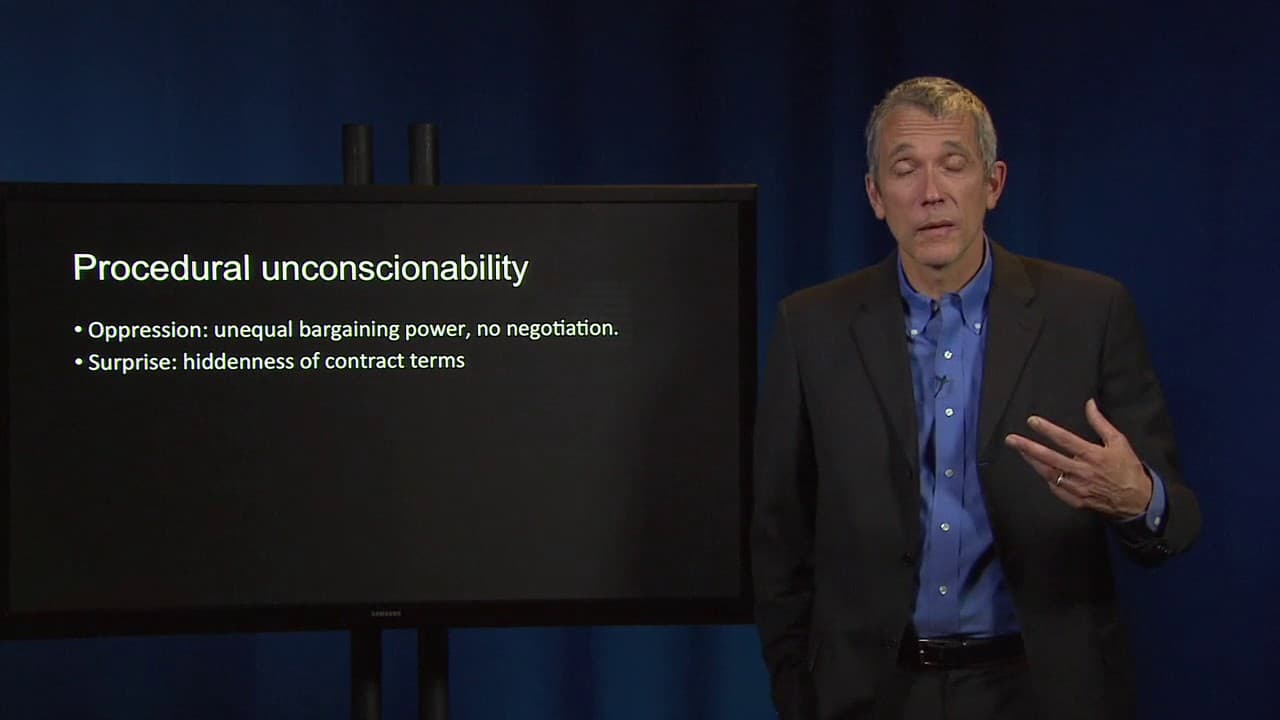
Procedural unconscionability refers to the fairness of the contracting process, including unequal bargaining power and surprise elements. Substantive unconscionability focuses on terms that are heavily one-sided and shock the conscience.
-
The court found the arbitration clause to be substantively unconscionable based on unequal applicability, higher arbitration costs for Ferguson, and limitations on discovery.
Read in Other Languages (beta)
Share This Summary 📚
Summarize YouTube Videos and Get Video Transcripts with 1-Click
Try YouTube Summary with ChatGPT & Claude or YouTube Transcript Generator
Explore More Summaries from YaleCourses 📚

Summarize YouTube Videos and Get Video Transcripts with 1-Click
Try YouTube Summary with ChatGPT & Claude or YouTube Transcript Generator