Supernova. Difference Between Type 1 and Type 2
TL;DR
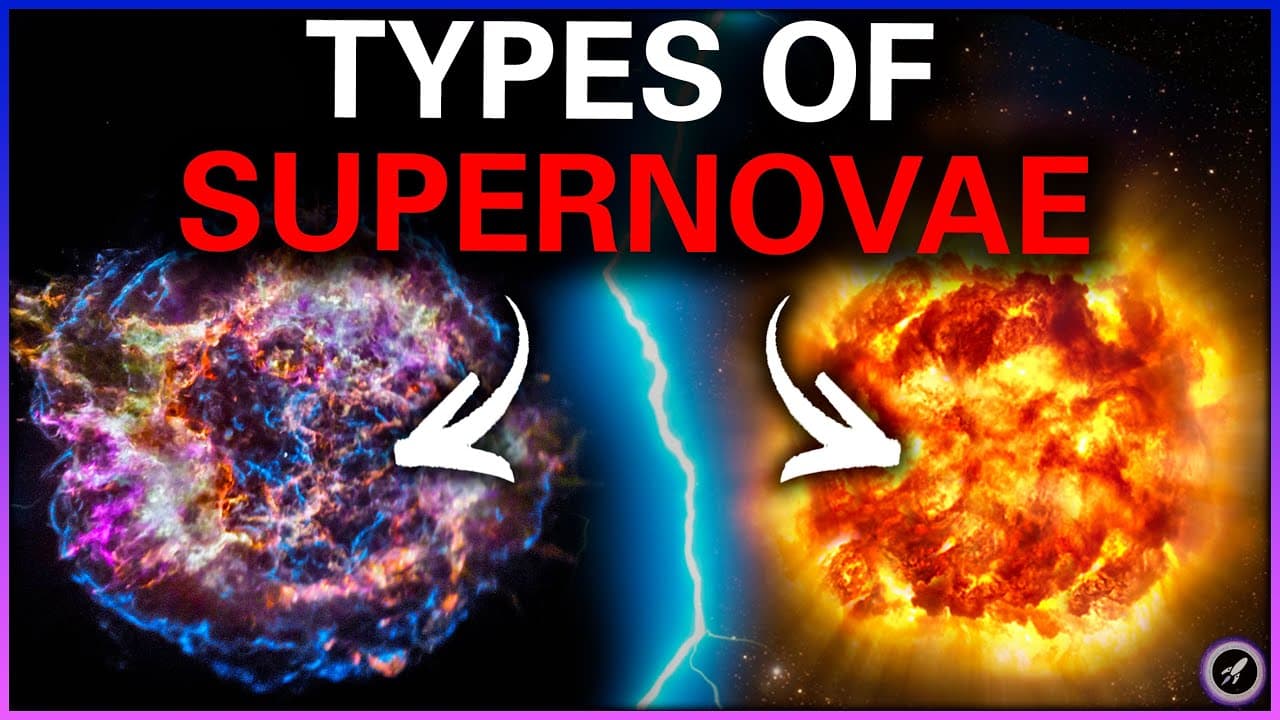
Supernovae are extreme events in which massive stars collapse, creating black holes or neutron stars and exploding with immense energy. There are two main types: Type I and Type II.
Transcript
there are few places in the universe that defy comprehension and Supernova have got to be the most extreme places you can imagine now we're talking about a star with potentially dozens of times the size and mass of our own Sun that violently dies in a fraction of a second faster than it takes me to say the word Supernova a complete star collapses i... Read More
Key Insights
- ✴️ Supernovae are among the most extreme events in the universe, where massive stars violently collapse and explode, creating black holes or neutron stars.
- 🅰️ There are two main types of supernovae: Type I and Type II, each with different progenitor stars and explosion mechanisms.
- 🤩 Type II supernovae result from the core collapse of massive stars, while Type I supernovae occur in binary star systems where a white dwarf accretes matter until it reaches a critical mass.
- 🛟 Type I supernovae, particularly Type Ia, serve as standard candles for cosmic distance measurements.
- ❣️ Supernovae are responsible for the creation of elements heavier than iron on the periodic table through nuclear fusion processes.
- 💥 Hypernovae and gamma-ray bursts are even more powerful events that can occur through stellar collisions, releasing enormous amounts of energy.
Install to Summarize YouTube Videos and Get Transcripts
Explore YouTube Video Summarizer or Get YouTube Transcript Extractor
Questions & Answers
Q: What causes a Type II supernova?
Type II supernovae occur when a massive star with 8 to 25 times the mass of the Sun runs out of elements to fuse in its core, resulting in the collapse of its outer layers, followed by a detonation.
Q: How do Type I supernovae serve as standard candles?
Type I supernovae, specifically Type Ia, have a well-defined energy output, allowing astronomers to measure their distance based on the amount of energy released. This helps in determining cosmic distances.
Q: Can supernovae create elements heavier than iron?
Yes, supernovae are responsible for creating elements heavier than iron on the periodic table, including ununseptium and antirium. These elements are produced during the extreme conditions of a supernova explosion.
Q: Are there even more powerful events than supernovae?
Yes, hypernovae and gamma-ray bursts are even more energetic events that can occur through collisions between stars, white dwarfs, and neutron stars. These events release an immense amount of energy.
Summary & Key Takeaways
-
Supernovae occur when massive stars die, with Type II supernovae resulting from the collapse of stars with 8 to 25 times the mass of the Sun, forming neutron stars or black holes.
-
Type I supernovae happen in binary star systems, where a white dwarf steals matter from its companion star until it explodes, serving as a standard candle for measuring cosmic distances.
-
There are also rare events like hypernovae and gamma-ray bursts that involve collisions between stars, white dwarfs, and neutron stars.
Read in Other Languages (beta)
Share This Summary 📚
Summarize YouTube Videos and Get Video Transcripts with 1-Click
Try YouTube Summary with ChatGPT & Claude or YouTube Transcript Generator
Explore More Summaries from Fraser Cain 📚




Summarize YouTube Videos and Get Video Transcripts with 1-Click
Try YouTube Summary with ChatGPT & Claude or YouTube Transcript Generator