Neutron Stars: The Most Extreme Objects in the Universe
TL;DR
Explore the extreme and unique states of matter inside neutron stars.
Transcript
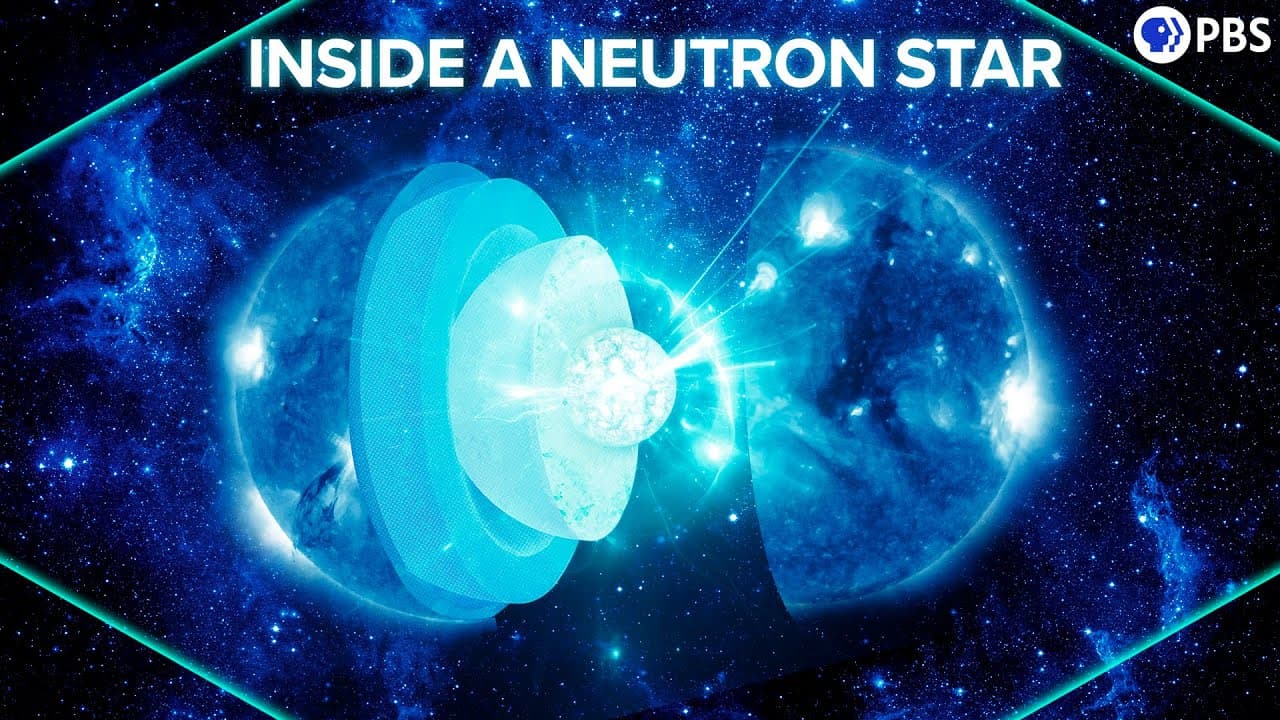
We’ve traveled to lots of weird places on this show - from the interiors of black holes to the time before the big bang. But today I want to take you on a journey that has got to be the weirdest place in the modern universe - a place where matter exists in states that I bet you’ve never heard of. Today we take a journey to the center of the neutro... Read More
Key Insights
- Neutron stars are remnants of massive stars and possess extreme conditions unlike any other place in the universe.
- The magnetosphere of a neutron star is the strongest magnetic field, with electron and positron currents creating pulsars.
- The neutron star's atmosphere is a thin plasma layer, vastly different from Earth's, with extreme gravitational forces.
- The surface of a neutron star consists of a frozen plasma crystalline material, primarily iron, formed during the star's supernova phase.
- As we delve deeper, neutron-rich nuclei form in a process called electron capture, creating exotic elements unique to neutron stars.
- The 'neutron drip' phenomenon occurs, where neutrons leak into spaces between nuclei, forming a neutron gas.
- Nuclear pasta, a unique state of matter, forms deep within neutron stars, potentially being the strongest material in the universe.
- The core of a neutron star may contain a superfluid of neutrons and a superconductor of protons, possibly transforming into a quark-gluon plasma.
Install to Summarize YouTube Videos and Get Transcripts
Explore YouTube Video Summarizer or Get YouTube Transcript Extractor
Questions & Answers
Q: What makes neutron stars' magnetosphere unique?
The magnetosphere of a neutron star is the strongest magnetic field in the universe, with even the weakest fields being a billion times stronger than those of Earth or the Sun. It acts as a particle accelerator, creating electron and positron currents that result in the radiation observed as pulsars.
Q: How does the atmosphere of a neutron star differ from Earth's?
The atmosphere of a neutron star is a thin plasma layer, unlike Earth's oxygen and nitrogen-rich atmosphere. It is composed of ionized nuclei, primarily hydrogen and helium, due to extreme heat. The atmosphere is barely a meter thick, with intense gravitational forces confining the plasma close to the star's surface.
Q: What is the composition of a neutron star's surface?
The surface of a neutron star consists of a frozen plasma crystalline material, primarily iron, which was the last element forged in the core before the star's supernova. This material is a regular lattice of nuclei, locked together by their mutual repulsion, despite being completely ionized.
Q: What is the 'neutron drip' phenomenon?
The 'neutron drip' phenomenon occurs when neutron-rich nuclei become so dense that neutrons begin to leak into the spaces between them, forming a neutron gas. This process occurs at extreme densities, far beyond what can be replicated on Earth, and is a key feature of the inner crust of neutron stars.
Q: What is nuclear pasta and why is it significant?
Nuclear pasta is a unique state of matter found deep within neutron stars, where nuclei rearrange into exotic shapes like spaghetti and lasagna due to extreme forces. It is potentially the strongest material in the universe, resisting intense gravitational forces and contributing to the star's structural support.
Q: What happens in the core of a neutron star?
In the core of a neutron star, extreme conditions lead to the formation of Cooper pairs, turning some fermions into bosons. Neutrons form a superfluid, while protons create a superconducting state, possibly transforming into a quark-gluon plasma, reflecting conditions similar to the early universe.
Q: How do neutron stars create gravitational waves?
Neutron stars create gravitational waves through the rotation of buried 'mountain ranges' of nuclear pasta. These waves are much weaker than those from merging neutron stars or black holes, creating a continuous hum at twice the rotation frequency of the neutron star, which astronomers are actively searching for.
Q: What might happen if a neutron star accretes too much mass?
If a neutron star accretes too much mass from a binary partner, it may reach a point where it forms an inescapable event horizon, becoming a black hole. This process involves extreme gravitational forces and changes in the star's structure, potentially trapping anything within its vicinity.
Summary & Key Takeaways
-
Neutron stars are the remnants of massive stars, exhibiting extreme conditions and unique states of matter. Their magnetosphere is the strongest in the universe, creating pulsars through electron and positron currents. The atmosphere is a thin plasma, vastly different from Earth's, with intense gravitational forces.
-
The surface of a neutron star is a frozen plasma crystalline material, primarily iron, formed during the star's supernova phase. As we delve deeper, electron capture creates neutron-rich nuclei, leading to unique elements only found in neutron stars, and the 'neutron drip' phenomenon.
-
Nuclear pasta, a unique state of matter, forms deep within neutron stars, potentially being the strongest material in the universe. The core may contain a superfluid of neutrons and a superconductor of protons, possibly transforming into a quark-gluon plasma, reflecting conditions similar to the early universe.
Read in Other Languages (beta)
Share This Summary 📚
Summarize YouTube Videos and Get Video Transcripts with 1-Click
Try YouTube Summary with ChatGPT & Claude or YouTube Transcript Generator
Explore More Summaries from PBS Space Time 📚



Summarize YouTube Videos and Get Video Transcripts with 1-Click
Try YouTube Summary with ChatGPT & Claude or YouTube Transcript Generator