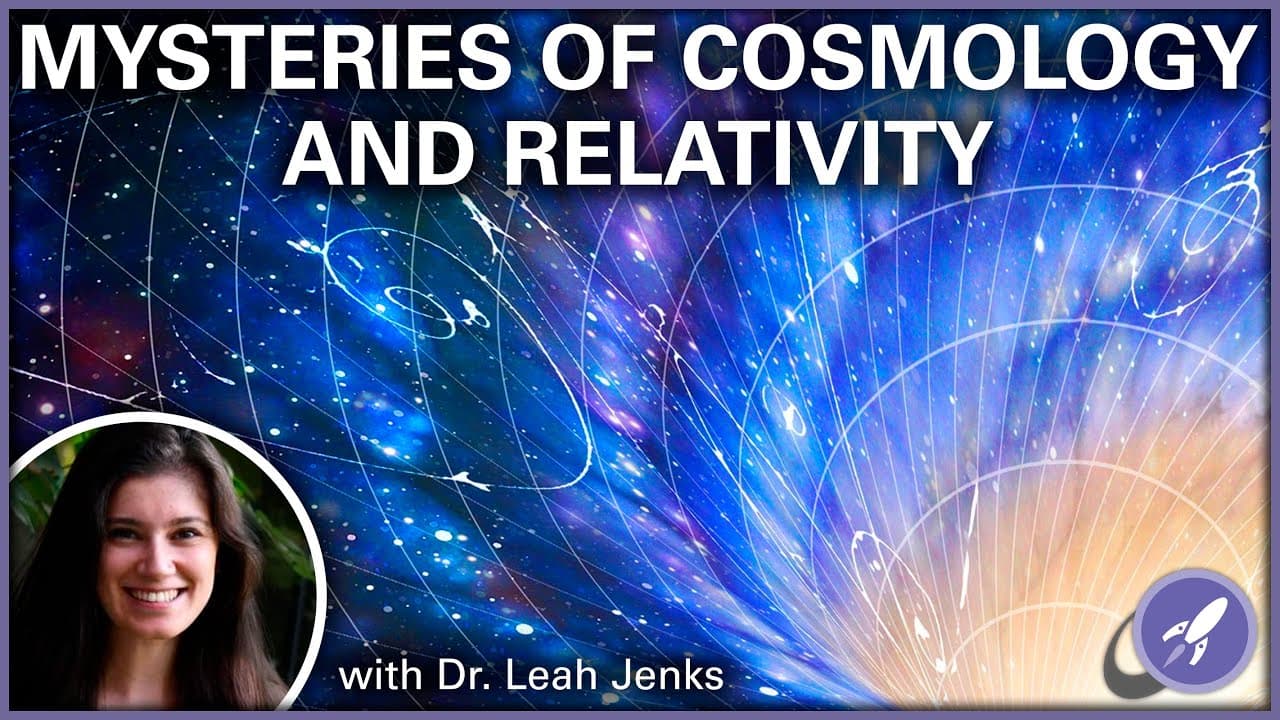
Cosmology and Relativity with Dr. Leah Jenks
TL;DR
Dr. Leah Jenks, a newly minted PhD physicist, discusses her research on relativity, cosmology, and the quest to understand dark matter.
Transcript
Fraser Cain: Hi, everyone, I'm Fraser Cain. I'm the publisher of Universe Today I've been a space and astronomy journalist for over 20 years. Today, I am joined by Dr. Leah Jenks, one of our journalists with weekly Space Hangout and a newly minted PhD physicist who is going to blow our minds today talking about relativity, cosmology and many other ... Read More
Key Insights
- 🥹 Gravitational waves and coincident electromagnetic events hold promise for testing and validating modified theories of gravity.
- 🖤 The study of black holes, particularly their behavior and properties under modified theories of gravity, can provide unique signatures for understanding fundamental physics.
- 🕶️ Theorists and experimentalists in the field of dark matter research are actively exploring various candidates, such as axions, and developing experiments to directly detect dark matter particles.
Install to Summarize YouTube Videos and Get Transcripts
Explore YouTube Video Summarizer or Get YouTube Transcript Extractor
Questions & Answers
Q: What is the difference between higher spin particles and modified theories of gravity?
Higher spin particles are particles with spins greater than 1, and Dr. Jenks' research focuses on their applications in cosmology, particularly in understanding dark matter. Modified theories of gravity refer to theories that make modifications to Einstein's general theory of relativity, exploring deviations from the standard model.
Q: How are gravitational waves being used to search for physics beyond general relativity?
Gravitational waves, observed through collaborations like LIGO, have confirmed general relativity with high precision. However, the search for physics beyond general relativity lies in studying coincident events of gravitational waves and electromagnetic events, such as neutron star collisions. By analyzing the behavior and properties of these events, scientists can constrain or validate modified gravity theories.
Q: What is the concept of a gravitational wave background, and how could it help in understanding quantum gravity?
The gravitational wave background is a low-frequency background signal, similar to cosmic microwave background radiation, but caused by gravitational waves throughout the Universe. Detecting and studying this background could provide insights into quantum gravity, the theory that describes gravity at extremely high energy scales or in the very early universe.
Q: What are some of the key experiments or technologies being used in the search for dark matter, particularly the axion hypothesis?
While Dr. Jenks did not mention specific experiments, she highlighted the potential for the Event Horizon Telescope to detect axion clouds around black holes as a signature of dark matter. Other experiments, yet to be mentioned, are likely exploring direct detection methods to search for axions.
Summary & Key Takeaways
-
Dr. Leah Jenks recently obtained her PhD in physics, focusing on two main areas: higher spin particles and their applications to cosmology, specifically dark matter, and modified theories of gravity.
-
The field of modified gravity is currently exploring gravitational waves and electromagnetic events to search for physics beyond Einstein's theory of general relativity.
-
Dr. Jenks discusses the potential of observing black holes to find unique signatures of modified gravity, such as the presence of axion clouds.
Read in Other Languages (beta)
Share This Summary 📚
Summarize YouTube Videos and Get Video Transcripts with 1-Click
Try YouTube Summary with ChatGPT & Claude or YouTube Transcript Generator
Explore More Summaries from Fraser Cain 📚

Summarize YouTube Videos and Get Video Transcripts with 1-Click
Try YouTube Summary with ChatGPT & Claude or YouTube Transcript Generator