What Are Angle Brackets in Programming Notation?
TL;DR
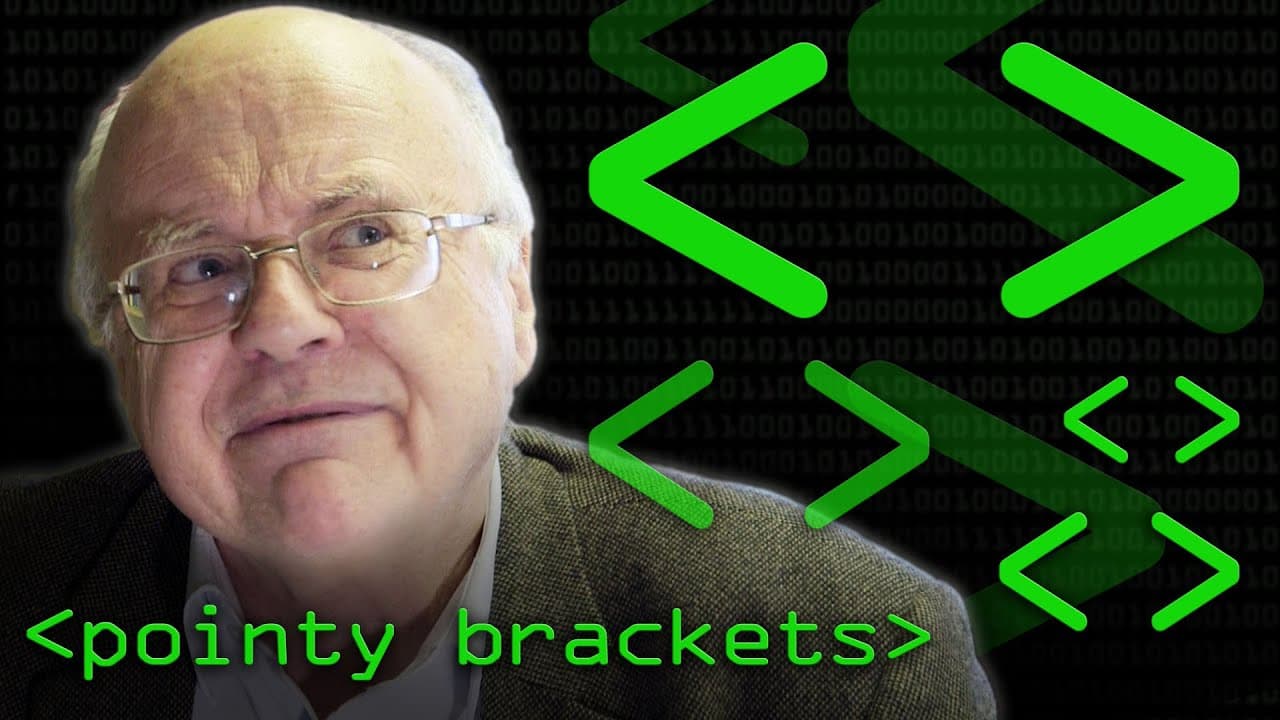
Angle brackets are used in programming notation to define identifiers clearly. Backus-Naur Form (BNF) introduced this self-explanatory approach, enhancing readability and understanding of programming languages. This notation laid the groundwork for XML, which incorporates similar structures within documents, defining clear boundaries for elements.
Transcript
Sean: We've looked at Chomsky and we've looked at Finite State Automata, and you've given me a sneak preview about what might be next, and my first thought was "What do all these notation marks mean, and where do they come from?" >> DFB: Chomsky instinctively went for a notation that appeals to mathematical logicians or theoretical computer sci... Read More
Key Insights
- 🤳 Chomsky's notation for programming languages treated everything as a sentence, while Backus-Naur Form (BNF) introduced a self-explanatory notation specifically for defining identifiers.
- 💨 BNF notation provides a clear and readable way to define programming languages, making it easier for individuals to understand and comply with language rules.
- 👻 XML, derived from BNF, allows for the inclusion of programming-like notations within actual documents, providing clear boundaries and structure.
- 🛟 BNF and XML serve as blueprints for legal programs, offering a framework for defining and understanding programming languages.
- ❤️🩹 XML's inclusion of start and end tags makes it suitable for representing structured data within documents, such as HTML.
- 😒 The use of BNF and XML in programming relates to the need for clear and concise language definitions and the desire for self-explanatory notations.
- 👻 XML's inclusion in web development allows for structured representation of elements and facilitates clear boundaries and structure in documents.
Install to Summarize YouTube Videos and Get Transcripts
Explore YouTube Video Summarizer or Get YouTube Transcript Extractor
Questions & Answers
Q: Why did Chomsky and Backus-Naur create different notations for defining programming languages?
Chomsky's notation appeals to mathematicians and computer scientists, using 'S' to represent sentences. Backus and Naur aimed for a more self-explanatory notation, using pointy brackets and '.' to define identifiers.
Q: What advantages does Backus-Naur Form (BNF) notation offer for language definitions?
BNF notation provides readable and understandable definitions for programming languages, making it easier to define and adhere to language rules. It avoids confusion and offers a blueprint for legal programs.
Q: How does XML relate to Backus-Naur Form (BNF) notation and programming languages?
XML evolved from BNF notation and serves as a way to represent structured data within actual documents. It allows for clear delineation of elements and boundaries, making it suitable for programming language-like notations in documents.
Q: How is XML used practically in web development?
XML is used in web development to define structured data within documents, such as HTML. It allows for clear representation of elements, such as paragraphs or break lines, with the use of start and end tags.
Summary & Key Takeaways
-
Chomsky's notation treats everything as a sentence, using the letter 'S' to represent all elements. In contrast, Backus and Naur introduced a more self-explanatory notation using pointy brackets to define identifiers.
-
Backus-Naur Form (BNF) notation allows for readable and intuitive definitions of programming languages, making it easier for non-technical individuals to understand and adhere to language rules.
-
XML, derived from the earlier SGML, builds on BNF and allows for the inclusion of programming language-like notations within actual documents, facilitating clear boundaries and structure.
Read in Other Languages (beta)
Share This Summary 📚
Summarize YouTube Videos and Get Video Transcripts with 1-Click
Try YouTube Summary with ChatGPT & Claude or YouTube Transcript Generator
Explore More Summaries from Computerphile 📚

Summarize YouTube Videos and Get Video Transcripts with 1-Click
Try YouTube Summary with ChatGPT & Claude or YouTube Transcript Generator