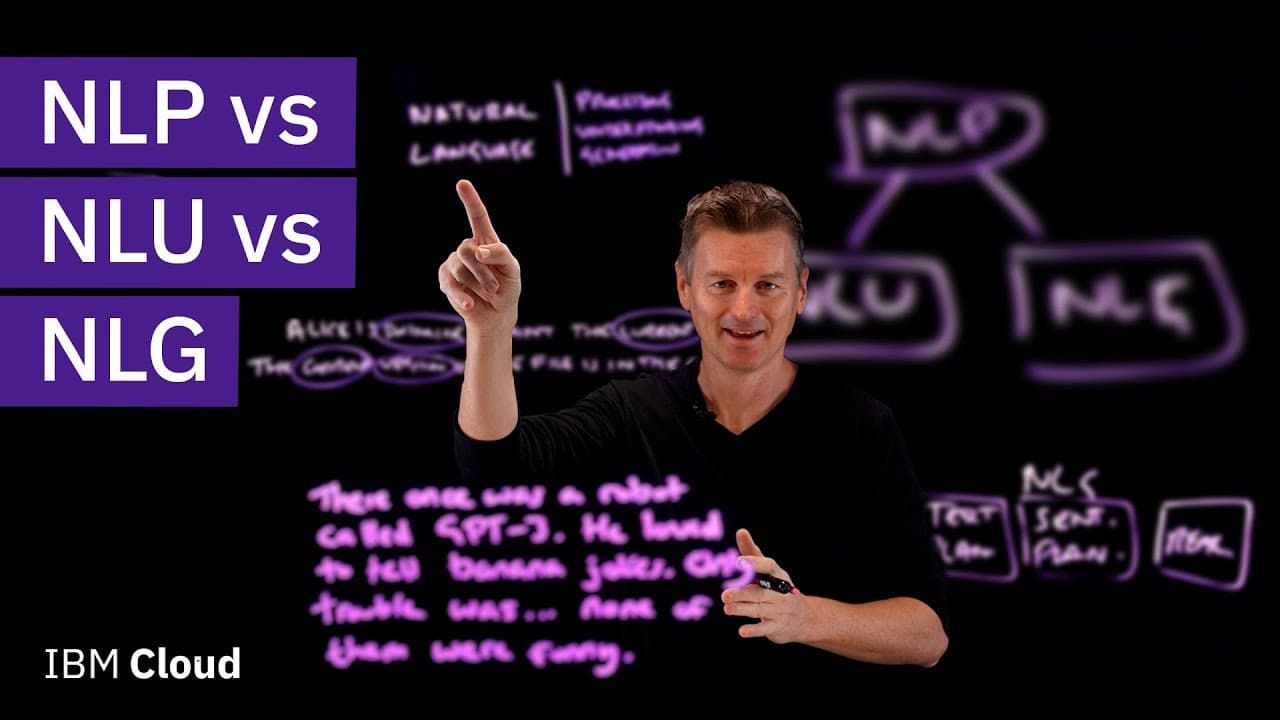
NLP vs NLU vs NLG
TL;DR
NLP, NLU, and NLG are interrelated but distinct technologies.
Transcript
Read and summarize the transcript of this video on Glasp Reader (beta).
Key Insights
- Natural Language Processing (NLP) encompasses both Natural Language Understanding (NLU) and Natural Language Generation (NLG), forming the basis for computers to process human language.
- NLU focuses on syntactic and semantic analysis to determine the meaning of sentences, accounting for the nuances of unstructured human language.
- NLG involves producing human-like text responses based on data input, requiring consideration of language rules like syntax and semantics.
- NLP applications include language translation and chatbots, leveraging deep learning techniques for understanding and generating language.
- Named Entity Recognition and tokenization are key methods in NLP for identifying word patterns and entities within text.
- NLU helps computers understand context and relationships between words, crucial for interpreting sentences with ambiguous meanings.
- NLG consists of three stages: text planning, sentence planning, and realization, each vital for generating grammatically correct and coherent text.
- Machine learning models like hidden Markov chains and transformers enable the functionalities of NLG and NLP applications.
Install to Summarize YouTube Videos and Get Transcripts
Explore YouTube Video Summarizer or Get YouTube Transcript Extractor
Questions & Answers
Q: What is the relationship between NLP, NLU, and NLG?
NLP, or Natural Language Processing, is the overarching technology that includes both NLU (Natural Language Understanding) and NLG (Natural Language Generation). NLU is concerned with interpreting and understanding human language, while NLG focuses on generating human-like text. Together, they enable computers to process and interact with human language efficiently.
Q: How does NLU handle ambiguous words like 'current'?
NLU handles ambiguous words by analyzing the context and relationships between words in a sentence. For example, the word 'current' can mean the flow of water or the latest version of a file. NLU uses syntactic and semantic analysis to determine the intended meaning based on surrounding words and sentence structure, allowing for accurate interpretation.
Q: What are the stages involved in NLG?
NLG involves three main stages: text planning, sentence planning, and realization. Text planning organizes the content logically, sentence planning focuses on punctuation and text flow, and realization ensures grammatical correctness. These stages enable the generation of coherent and human-like text responses based on input data, following language rules and structure.
Q: What role do machine learning models play in NLG?
Machine learning models are crucial for enabling NLG functionalities. They help in understanding and generating language by learning patterns and structures from data. Models like hidden Markov chains, recurrent neural networks, and transformers are used to perform tasks such as text generation, ensuring that the output is coherent and grammatically correct.
Q: What are some practical applications of NLP?
NLP has numerous practical applications, including language translation, chatbots, and customer service automation. It is used in healthcare for diagnosis and in online platforms for enhancing user interaction. By enabling computers to understand and generate human language, NLP improves communication and efficiency across various industries.
Q: How does NLU improve a computer's reading comprehension?
NLU improves a computer's reading comprehension by using syntactic and semantic analysis to interpret the meaning of sentences. It accounts for the nuances and complexities of human language, allowing computers to understand context, relationships, and intended meanings. This enhances their ability to process and respond to human language accurately.
Q: Why is realization important in NLG?
Realization is important in NLG because it ensures that the generated text adheres to grammatical rules and is coherent. It involves applying language rules to produce text that is not only correct but also natural and understandable to humans. This stage is crucial for maintaining the quality and accuracy of the generated language.
Q: How do named entity recognition and tokenization contribute to NLP?
Named entity recognition and tokenization are key methods in NLP that help identify word patterns and entities within text. Named entity recognition involves detecting and classifying key elements like names and dates, while tokenization breaks down text into manageable units. These processes are essential for understanding and processing language effectively in various NLP applications.
Summary & Key Takeaways
-
Natural Language Processing (NLP) integrates Natural Language Understanding (NLU) and Natural Language Generation (NLG) to enable computers to process human language. NLU interprets the meaning of sentences, while NLG generates text responses. Both are crucial for technologies like language translation and chatbots.
-
NLU uses syntactic and semantic analysis to comprehend sentence meanings, handling the complexities of unstructured human language. It helps in understanding context, as illustrated by varying meanings of words like 'current' in different sentences.
-
NLG focuses on creating coherent and grammatically correct text responses based on data input. It involves stages like text planning, sentence planning, and realization, utilizing machine learning models such as hidden Markov chains and transformers for effective text generation.
Read in Other Languages (beta)
Share This Summary 📚
Summarize YouTube Videos and Get Video Transcripts with 1-Click
Try YouTube Summary with ChatGPT & Claude or YouTube Transcript Generator
Explore More Summaries from IBM Technology 📚



Summarize YouTube Videos and Get Video Transcripts with 1-Click
Try YouTube Summary with ChatGPT & Claude or YouTube Transcript Generator