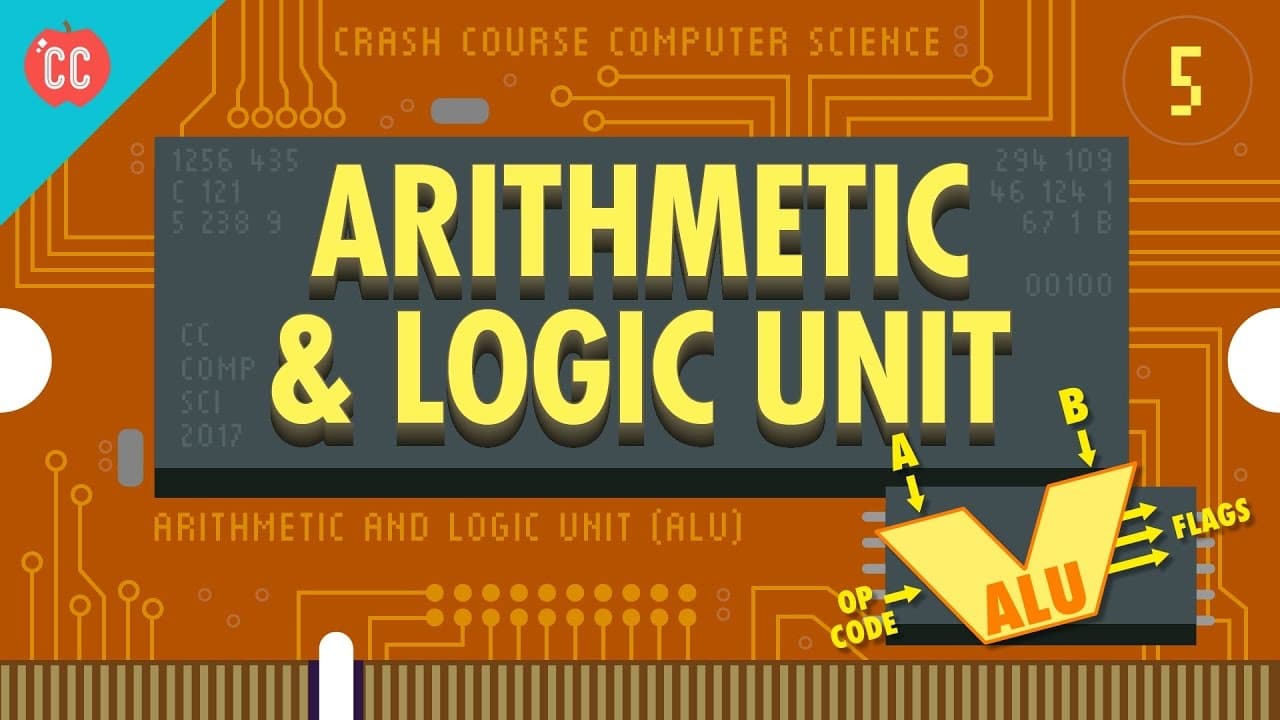
How Computers Calculate - the ALU: Crash Course Computer Science #5
TL;DR
The Arithmetic and Logic Unit (ALU) is the computer’s mathematical brain, performing numerical and logical operations through circuits built from Boolean logic gates. The lesson constructs half adders, full adders, and an 8-bit ripple carry adder, then explains how an overflow occurs when a result cannot fit within the available bits. Read on to see how these components turn binary inputs into useful computations.
Transcript
Hi, I’m Carrie Ann and this is Crash Course Computer Science. So last episode, we talked about how numbers can be represented in binary. Representing Like, 00101010 is 42 in decimal. Representing and storing numbers is an important function of a computer, but the real goal is computation, or manipulating numbers in a structured and purposeful way,... Read More
Key Insights
- 📟 The ALU, or Arithmetic and Logic Unit, is the mathematical brain of a computer and is responsible for performing numerical operations and logical operations.
- 💡 The Intel 74181 was the first complete ALU to fit entirely inside a single chip when it was released in 1970, which was a significant engineering achievement at the time.
- 🔌 Building an ALU circuit involves using logic gates, such as AND, OR, NOT, and XOR gates, to perform functions like addition and subtraction.
- 🧩 The half adder circuit is used to add two binary digits together, while the full adder circuit adds three binary digits and carries any overflow to subsequent adders.
- 💥 Overflows occur when the result of an addition is too large to be represented by the number of bits being used, causing errors and glitches.
- 🔁 An 8-bit ripple carry adder is a circuit that can add two 8-bit numbers together, propagating any carry bits to subsequent adders.
- ⚖️ The ALU's Logic Unit performs logical operations, such as AND, OR, and NOT, as well as numerical tests like checking if a number is zero or negative.
- 🏭 The ALU has multiple outputs, including the result of the operation on the inputs, as well as flags such as the Zero Flag, Negative Flag, and Overflow Flag, which indicate specific states and statuses.
Install to Summarize YouTube Videos and Get Transcripts
Explore YouTube Video Summarizer or Get YouTube Transcript Extractor
Questions & Answers
Q: What does the Arithmetic and Logic Unit (ALU) do in a computer?
The ALU performs a computer’s numerical and logical operations. It contains an arithmetic unit for operations such as addition and subtraction and a logic unit for operations such as AND, OR, and NOT.
Q: How can an ALU be built from logic gates?
An ALU can be assembled from AND, OR, NOT, and XOR gates. These gates are combined into components such as half adders and full adders, which can then be chained to process multi-bit numbers.
Q: How does a half adder add two binary digits?
A half adder accepts two single-bit inputs, A and B, and produces sum and carry outputs. An XOR gate calculates the sum, while an AND gate produces a carry when both inputs are 1.
Q: Why does binary addition need a carry bit?
Adding 1 and 1 produces 10 in binary, so the sum bit is 0 and the 1 moves to the next column. The carry output records that extra bit because a single output bit cannot represent the value 2.
Q: What is the difference between a half adder and a full adder?
A half adder adds two input bits, while a full adder accepts three inputs: A, B, and an incoming carry C. A full adder can be built with two half adders and an OR gate, producing both a sum and a carry output.
Q: How does an 8-bit ripple carry adder work?
The first pair of bits is added with a half adder because no incoming carry exists. Each later pair uses a full adder, and every carry output feeds the next adder until all 8 bits have been processed.
Q: What causes overflow in an 8-bit adder?
Overflow occurs when an addition result is too large to be represented by the number of available bits. In an 8-bit ripple carry adder, a carry into the 9th bit shows that the result does not fit within 8 bits.
Q: Why is the Intel 74181 significant?
The Intel 74181 is described as perhaps the most famous ALU. Released in 1970, it was the first complete ALU to fit entirely inside a single chip, which the lesson characterizes as a huge engineering feat at the time.
Summary & Key Takeaways
-
The ALU is the mathematical brain of a computer and handles numerical operations and logical operations.
-
The ALU can be built using logic gates, such as AND, OR, NOT, and XOR gates.
-
The ALU's arithmetic unit performs addition, subtraction, and other math operations, while the logic unit performs logical operations like AND, OR, and NOT.
Questions:
-
What is the function of the Arithmetic and Logic Unit (ALU) in a computer?
-
How is the ALU designed and built using logic gates?
-
What mathematical operations can the ALU perform?
-
Are multiply and divide operations supported by the ALU?
-
How does the ALU handle logical operations?
-
What are the flags output by the ALU, and how are they used?
-
How does the ALU's design impact the performance of modern computers?
-
What is the significance of the Intel 74181 ALU in computer history?
Answer:
Q: What is the function of the Arithmetic and Logic Unit (ALU) in a computer?
The ALU in a computer is responsible for performing numerical operations, such as addition and subtraction, and logical operations, such as AND, OR, and NOT.
Read in Other Languages (beta)
Share This Summary 📚
Summarize YouTube Videos and Get Video Transcripts with 1-Click
Try YouTube Summary with ChatGPT & Claude or YouTube Transcript Generator
Explore More Summaries from CrashCourse 📚






Summarize YouTube Videos and Get Video Transcripts with 1-Click
Try YouTube Summary with ChatGPT & Claude or YouTube Transcript Generator