Mechanical Brakes
TL;DR
This video provides an introduction to drum brakes and disc brakes, explaining how they work and their key components.
Transcript
hello friends in previous lectures we have learned about the types of brake systems mechanical bags they had two types of mechanical brakes drum brakes and disc brakes now we see here the brake brake show diagram drum brake has metal brake drum that encloses the brake assembly at each wheel to curve brake shoes here to cow brake shoes are there exp... Read More
Key Insights
- 🚗 Brake systems in automobiles can be categorized into drum brakes and disc brakes.
- 🛢️ Drum brakes have brake shoes pressing against a metal brake drum, while disc brakes have brake pads squeezing a rotor.
- 😒 Both types of brakes use different mechanisms and operate either mechanically or hydraulically.
- 🧘 Adjuster mechanisms in drum brakes help maintain proper shoe position.
- 😒 Disc brakes use hydraulic force to transmit the braking action.
- 😨 Modern cars often have a combination of drum brakes and disc brakes for improved safety.
- 🚨 Emergency brake systems provide backup braking in case of failures.
Install to Summarize YouTube Videos and Get Transcripts
Explore YouTube Video Summarizer or Get YouTube Transcript Extractor
Questions & Answers
Q: What is the purpose of the adjuster mechanism in drum brakes?
The adjuster mechanism is responsible for returning the brake shoes to their original position after they have pressed against the drum. It ensures that the shoes do not get too far away, which would require more brake fluid and result in a sinking brake pedal.
Q: How do disc brakes transmit force to stop the wheel?
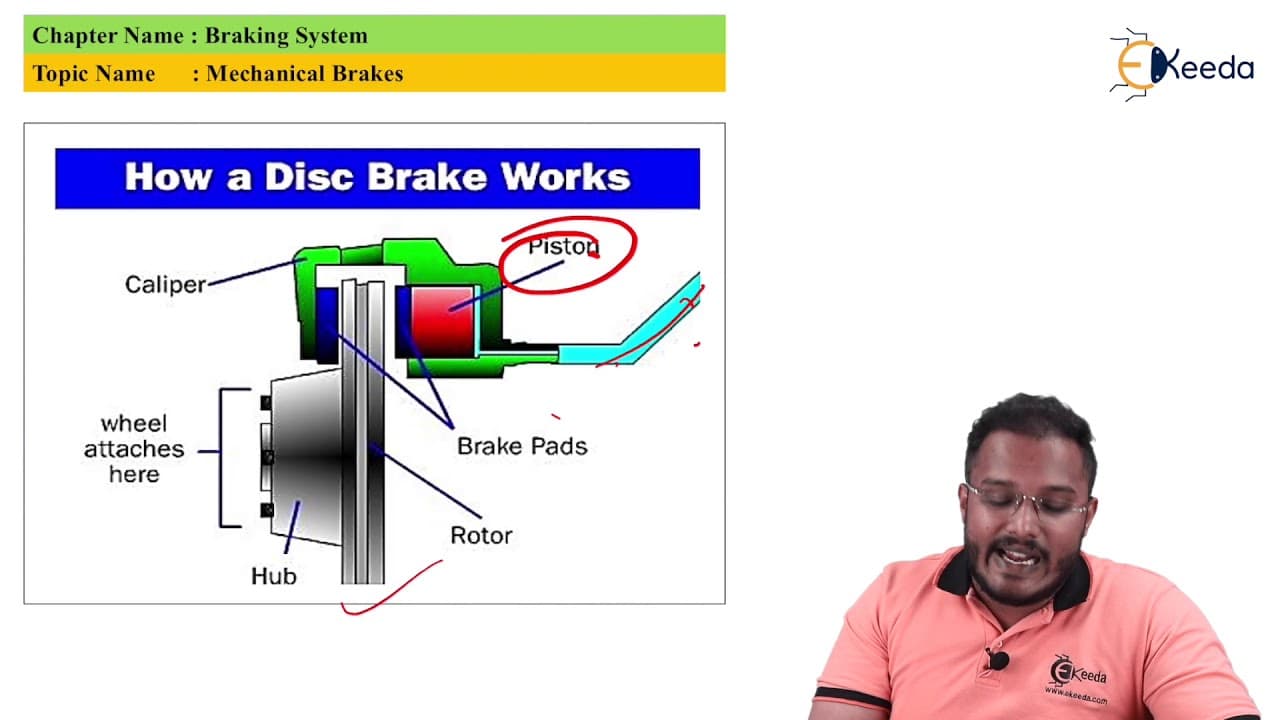
In disc brakes, when the hydraulic fluid is pressurized by the master cylinder, it moves the piston in the caliper. The piston, in turn, squeezes the brake pads against the rotor. This action slows down or completely stops the wheel attached to the rotor.
Q: What is the main difference between drum brakes and disc brakes?
The main difference is that drum brakes have brake shoes pressing against a drum, while disc brakes have brake pads squeezing a rotor. Drum brakes use mechanical force, while disc brakes use hydraulic force.
Q: Why do modern vehicles use both mechanical and hydraulic braking systems?
Modern vehicles use both systems as a safety measure. If one circuit fails or there is a brake fluid leak, the second circuit can balance the braking action to ensure the vehicle can still stop. This setup is known as an emergency braking system.
Summary & Key Takeaways
-
Drum brakes consist of a metal brake drum, brake shoes, an adjuster mechanism, and springs. When the brake shoes press against the drum, the wheel slows down or stops.
-
Disc brakes use brake pads, a rotor, a caliper, and hydraulic fluid. When the brake pedal is pressed, the fluid pressurizes the caliper, squeezing the pads against the rotor and stopping the wheel.
-
Modern cars often have disc brakes on the front wheels and drum brakes on the rear wheels, with an emergency brake system and two separate braking circuits for safety.
Read in Other Languages (beta)
Share This Summary 📚
Summarize YouTube Videos and Get Video Transcripts with 1-Click
Try YouTube Summary with ChatGPT & Claude or YouTube Transcript Generator
Explore More Summaries from Ekeeda 📚






Summarize YouTube Videos and Get Video Transcripts with 1-Click
Try YouTube Summary with ChatGPT & Claude or YouTube Transcript Generator