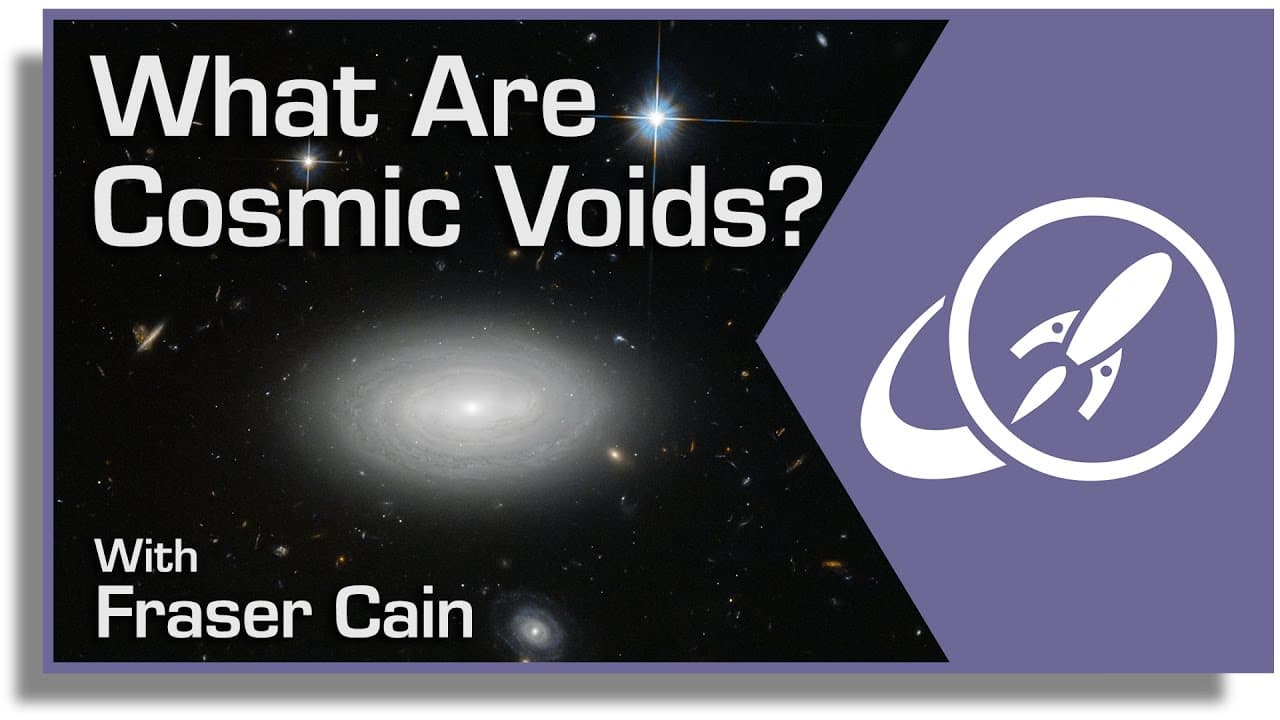
What Are Cosmic Voids? The Biggest Nothings in the Universe
TL;DR
The Universe is not just filled with galaxies, but also vast cosmic voids that are expanding and merging, leaving behind gravitational bound galaxy clusters.
Transcript
Clearly I need to learn to be more specific when I do these episodes. Everything time I open my mouth, I need to prepare for the collective imagination of the viewers. We did a whole video about the biggest things in the Universe, and identified superclusters of galaxies as the best candidate. Well, the part of superclusters actually gravitationall... Read More
Key Insights
- 🌥️ The Universe's structure consists of filaments, walls, and voids, with voids being large gaps between galaxy clusters.
- 💁 Cosmic voids were formed due to variations in density during the expansion of the Universe after the Big Bang.
- 🍁 Astronomers have created accurate 3-dimensional maps of the Universe's large-scale structure using surveys like the Sloan Digital Sky Survey.
- 🙂 The largest void known is the Giant Void, located about 1.5 billion light-years away, with a diameter of 1 to 1.3 billion light-years.
- 😘 Cosmic voids are not completely empty but have a lower density of matter compared to regions with galaxies.
- 🍃 As the Universe continues to expand, the voids will merge, leaving behind only gravitationally bound galaxy clusters.
- 🥺 The structure of cosmic voids suggests that there doesn't seem to be any larger structure beyond them, leading astronomers to refer to it as "the End of Greatness."
Install to Summarize YouTube Videos and Get Transcripts
Explore YouTube Video Summarizer or Get YouTube Transcript Extractor
Questions & Answers
Q: How are cosmic voids formed in the Universe?
Cosmic voids are formed due to slight variations in density during the expansion of the Universe, which magnified over time, creating gaps between galaxy clusters.
Q: What tools do astronomers use to map out the large-scale structure of the Universe?
Astronomers use tools like the Sloan Digital Sky Survey and the upcoming Large Synoptic Survey Telescope to create accurate 3-dimensional maps of the Universe's structure.
Q: Are cosmic voids completely empty?
No, cosmic voids have a tenth of the density of matter compared to regions with galaxies, meaning they still contain gas, dust, dark matter, and even stars and galaxies to a lesser extent.
Q: Will the cosmic voids continue to expand and merge?
Yes, as the Universe's expansion continues, the voids will expand further and merge with each other, leaving behind only gravitationally bound galaxy clusters.
Summary & Key Takeaways
-
The Universe is structured with filaments, walls, and voids, which are large gaps between galaxy clusters.
-
The voids were formed due to variations in density during the expansion of the Universe after the Big Bang.
-
Astronomers have mapped out the Universe's large-scale structure using advanced surveys and discovered the Giant Void, which is around 1.5 billion light-years away.
Read in Other Languages (beta)
Share This Summary 📚
Summarize YouTube Videos and Get Video Transcripts with 1-Click
Try YouTube Summary with ChatGPT & Claude or YouTube Transcript Generator
Explore More Summaries from Fraser Cain 📚
Summarize YouTube Videos and Get Video Transcripts with 1-Click
Try YouTube Summary with ChatGPT & Claude or YouTube Transcript Generator