Nobel Lecture: James Allison, Nobel Prize in Physiology or Medicine 2018
TL;DR
Blocking CTLA-4 can release an immune-system brake, allowing activated T cells to continue attacking tumors and potentially eliminate them. The strategy targets the immune response rather than a particular tumor mutation, so it may apply across cancer types and can potentially work with treatments that kill tumor cells and support antigen cross-priming.
Transcript
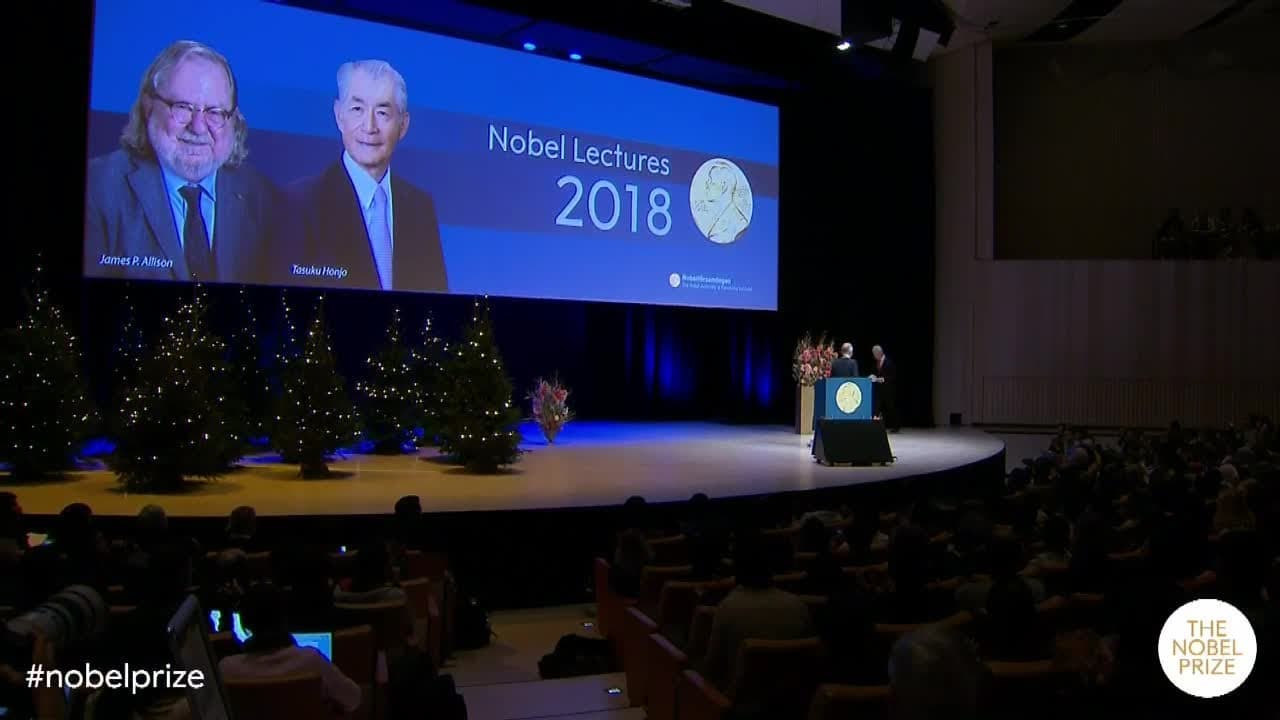
[Applause] [Applause] so thank you this year's laureate Jim Allison was born in the small South Texas town of Alice in 1948 from an early age he was drawn to science he played with his chemistry Sept and was fascinated by dissecting frogs his father was a doctor in the town Jim Allison sometimes accompanied him on house calls but when doing that he... Read More
Key Insights
- Cancer is genetically diverse and unstable, so targeting a single causative mutation with a small molecule can produce a response followed by relapse when an existing resistant mechanism is selected and enables the tumor to bypass treatment.
- T cells are specific because they recognize peptides displayed by MHC molecules on cell surfaces, giving the immune system information about intracellular activity. In tumors, T cells can focus on mutation products whether or not those mutations originally caused the cancer.
- T-cell immunity is potentially polyvalent because the immune system can recognize many tumor mutations rather than only one selected driver. This distinction separates immune-based treatment from therapies designed against a single causative genetic alteration.
- Immune memory is sustained by slowly renewing T cells that can remain for the rest of a person's life. These cells may be reawakened when necessary, providing a mechanism for renewed attacks against a returning tumor.
- The immune system is adaptable because approximately 50 to 70 million different T cells circulate, while new ones continue to be generated. This diversity allows immune recognition to adjust spontaneously as a genetically unstable tumor changes.
- Full T-cell activation requires both a signal through the T-cell receptor and a co-stimulatory signal through CD28. Together, these signals initiate programs that rapidly expand a small number of relevant cells into the much larger population needed for an attack.
- CTLA-4 is an inhibitory checkpoint induced after T-cell activation. As CTLA-4 accumulates, it can turn T cells off, creating a race between the growing tumor and the expanding immune response that is attempting to control it.
- CTLA-4 blockade targets the immune system rather than the tumor cell. In Allison's mouse experiment, transplanted tumors initially grew but were then rejected after antibody treatment, showing that disabling this single inhibitory mechanism could permit complete tumor elimination.
Install to Summarize YouTube Videos and Get Transcripts
Explore YouTube Video Summarizer or Get YouTube Transcript Extractor
Questions & Answers
Q: How does CTLA-4 checkpoint blockade treat cancer?
CTLA-4 checkpoint blockade treats cancer by interfering with an inhibitory mechanism that normally turns activated T cells off. An antibody against CTLA-4 keeps this brake from stopping the response, allowing T cells to continue expanding and attacking tumor cells. In Allison's early mouse experiment, transplanted tumors grew initially and were then completely rejected after the animals received antibodies blocking CTLA-4.
Q: Why can T cells target genetically diverse cancers?
T cells recognize peptides presented on cell surfaces by MHC molecules. In cancer, their targets can include products from many mutations, not only the mutations that caused the tumor. Because the immune system does not need to distinguish between causative and non-causative mutations, it can mount a polyvalent response against numerous tumor abnormalities and adapt as the cancer changes.
Q: Why do drugs targeting one cancer mutation often lead to relapse?
A tumor can contain many mutations by the time treatment begins, and this genetic diversity creates routes around a drug aimed at one causative mutation. A targeted small molecule may initially produce a response, but a resistant mechanism can already be present. Treatment then selects for cells using that mechanism, enabling the tumor to bypass the targeted pathway and relapse.
Q: What signals are required for full T-cell activation?
Full T-cell activation requires a signal through the T-cell antigen receptor and an additional co-stimulatory signal. Allison's work identified CD28 as the receptor that receives co-stimulation, with B7 molecules serving as ligands. Together, the two signals launch programs associated with cell proliferation, allowing a small number of antigen-specific T cells to expand rapidly into a much larger attacking population.
Q: Why can tumors remain invisible despite having antigens?
Tumor cells can contain many antigens but still fail to initiate a productive immune response because they do not provide the required second, co-stimulatory signal. Experiments showed that mouse tumor cells were rejected after B7 molecules were introduced into them. Their usual invisibility therefore reflected insufficient co-stimulation rather than an absence of antigens that T cells could recognize.
Q: How does cross-priming start an immune response against tumors?
Cross-priming begins when tumor cells die and specialized dendritic cells collect fragments from them. The dendritic cells then redisplay tumor antigens on their surfaces together with B7, supplying the context needed to activate T cells. This process initiates an immune response against tumor cells that could not directly provide the co-stimulatory signal required for full T-cell activation.
Q: Why might checkpoint blockade work with other cancer treatments?
Checkpoint blockade may work with chemotherapy, radiation, hormone therapy, or other treatments that kill some tumor cells because cell death can support cross-priming. Dendritic cells can collect material from dying tumors, present their antigens with B7, and initiate a T-cell response. Blocking CTLA-4 can then prevent the resulting response from being shut down prematurely by the inhibitory checkpoint.
Q: What did Allison's early mouse experiment show?
The experiment used transplantable tumors growing in the backs of mice. Untreated tumors continued growing, and blocking CD28 made them grow faster. When antibodies against CTLA-4 were injected, the tumors grew for a period and then were rejected. Allison had expected slower growth, but blocking this single inhibitory molecule was sufficient to produce complete tumor elimination in the treated mice.
Summary
This video discusses the work of Jim Allison, this year's Nobel laureate in medicine, who has made significant contributions to the field of immunotherapy for cancer treatment. He has been instrumental in the development of immune checkpoint blockade, which has shown promising results in treating various types of cancer. Allison's research has focused on understanding the role of T cells in the immune system and how they can be harnessed to target and eliminate cancer cells. Through his work, he has demonstrated the potential of immunotherapy to revolutionize cancer treatment.
Questions & Answers
Q: What were Jim Allison's early experiences with science?
From a young age, Jim Allison was drawn to science and played with his chemistry set. He was fascinated by dissecting frogs and developed an interest in biology and genetics. He accompanied his father, who was a doctor, on house calls, which led him to realize that he wanted to pursue a career in science rather than follow in his father's footsteps.
Q: How did Jim Allison's experience in high school shape his career path?
In high school, Jim Allison encountered a teacher who refused to teach evolution. Allison, who believed that biology without Darwin was like physics without Newton, refused to take the class. This put him at risk of failing high school. However, a compromise was reached, and he fulfilled the biology requirements by taking college-level biology courses through correspondence with the University of Texas.
Q: What were Jim Allison's groundbreaking discoveries in immunology?
Jim Allison's fundamental discoveries in immunology include defining the structure of the T-cell antigen receptor, demonstrating the co-stimulatory role of cd28 in T-cell activation, and discovering the inhibitory checkpoint molecule ctla4. These discoveries were made through basic research and laid the foundation for the development of immune checkpoint blockade as a potential cancer treatment.
Q: What is immune checkpoint blockade and how does it work?
Immune checkpoint blockade is a strategy that involves blocking the inhibitory signals that prevent T cells from attacking cancer cells. This is achieved by using antibodies to block molecules such as ctla4 and pd1, which are responsible for inhibitory signaling. By blocking these checkpoints, the immune system's response to cancer cells can be enhanced, leading to tumor regression and improved patient outcomes.
Q: What is the significance of immune checkpoint blockade as a cancer treatment strategy?
Immune checkpoint blockade has shown remarkable efficacy in treating various types of cancer, including metastatic melanoma. Prior to the approval of immune checkpoint inhibitors, the prognosis for metastatic melanoma was poor, with a median life expectancy of only 11 months. However, with the introduction of checkpoint inhibitors, patients have achieved durable responses and, in some cases, have experienced long-term remission. This breakthrough treatment approach represents a significant advancement in cancer therapy.
Q: What are the challenges associated with immune checkpoint blockade and cancer treatment?
While immune checkpoint blockade has yielded promising results in many patients, not all patients respond to therapy, and some tumors develop resistance over time. Additionally, immune-related adverse events can occur as a result of treatment, although they are generally manageable. Understanding the mechanisms of resistance and improving patient selection are ongoing challenges in the field of immunotherapy.
Q: How does combination therapy improve the efficacy of immune checkpoint blockade?
Combination therapy involves using multiple checkpoint inhibitors in conjunction with other cancer treatments such as chemotherapy or radiation therapy. This approach has shown improved response rates and overall survival compared to monotherapy. The rationale behind combination therapy is that different checkpoints operate at different stages of T-cell development, allowing for a more comprehensive and durable immune response against the tumor.
Q: What is the immunotherapy platform developed by Jim Allison and his colleagues?
The immunotherapy platform developed by Jim Allison and his colleagues aims to study the cellular mechanisms of immune responses in cancer patients who are being treated with immunotherapy. This platform involves collecting tissue and blood samples from patients and analyzing them using various techniques. The goal is to gain insights into the mechanisms of response and resistance to immunotherapy, as well as to identify potential biomarkers for patient selection and personalized treatment approaches.
Q: What have researchers learned about the cellular mechanisms of response to immune checkpoint blockade?
Through the use of high-dimensional assays such as mass cytometry, researchers have identified distinct subsets of T cells that are associated with response to immune checkpoint blockade. For example, in melanoma patients, CD4+ T cells that express the Icos marker and CD8+ T cells that express high levels of PD1 are both associated with tumor regression. These findings highlight the importance of understanding T cell subsets and their functional characteristics in order to optimize immunotherapy approaches.
Q: What is the potential role of co-stimulation in T cell differentiation and response to immune checkpoint blockade?
Co-stimulation, particularly through the ICOS pathway, appears to play a crucial role in promoting the expansion and activation of tumor-reactive T cells. By removing inhibitory signals and providing co-stimulatory signals, such as ICOS, it is possible to enhance the anti-tumor immune response. Moreover, the absence of co-stimulation can influence the differentiation of T cells towards different functional subsets. Understanding the intricate interplay between co-stimulation and inhibition could pave the way for the development of more effective immunotherapies.
Takeaways
Jim Allison's groundbreaking work in immune checkpoint blockade has revolutionized cancer treatment. Through his research, he has shown that targeting the immune system rather than the tumor itself can lead to durable responses and even complete remission in patients with metastatic melanoma. Immune checkpoint inhibitors, such as antibodies targeting ctla4 and pd1, have received approval for the treatment of various types of cancer and have demonstrated remarkable efficacy in clinical trials. Combination therapy, which involves multiple checkpoint inhibitors and other treatments, has further improved response rates and overall survival. The development of an immunotherapy platform has allowed for a deeper understanding of the cellular mechanisms underlying immune responses and resistance to therapy. By studying the different subsets of T cells and their functional characteristics, researchers can identify potential biomarkers and develop personalized treatment approaches. Co-stimulation, particularly through the ICOS pathway, has emerged as a key factor in T cell differentiation and response to immunotherapy. Further research in this field holds great promise for improving cancer treatment outcomes.
Summary & Key Takeaways
-
Cancer accumulates diverse mutations and can evade drugs aimed at single causative mutations because resistant mechanisms are often already present. T cells offer a different strategy: they recognize mutation-derived peptides displayed by MHC molecules, can target multiple abnormalities, form long-lived memory populations, and adapt as a tumor changes over time.
-
Full T-cell activation requires two signals: antigen recognition through the T-cell receptor and co-stimulation through CD28. Activation launches programs for rapid proliferation, but it also induces CTLA-4, which eventually inhibits the response. Allison reasoned that blocking CTLA-4 could prevent this braking mechanism from stopping an antitumor response too early.
-
Tumor cells can contain recognizable antigens while remaining immunologically invisible because they cannot provide the required co-stimulatory signal. When tumor cells die, dendritic cells can collect their material and present tumor antigens with B7, initiating cross-priming. In mice, an antibody blocking CTLA-4 allowed growing transplanted tumors to be completely rejected.
Read in Other Languages (beta)
Share This Summary 📚
Summarize YouTube Videos and Get Video Transcripts with 1-Click
Try YouTube Summary with ChatGPT & Claude or YouTube Transcript Generator
Explore More Summaries from Nobel Prize 📚





Summarize YouTube Videos and Get Video Transcripts with 1-Click
Try YouTube Summary with ChatGPT & Claude or YouTube Transcript Generator