Products
Features
YouTube Video Summarizer
Summarize YouTube videos
Web & PDF Highlighter
Highlight web pages & PDFs
Chat with PDF
Ask any PDF questions with AI
Ask AI Clone
Chat with your highlights & memories
Audio Transcriber
Transcribe audio files to text
Glasp Reader
Read and highlight articles
Kindle Highlight Export
Export your Kindle highlights
Idea Hatch
Hatch ideas from your highlights
Integrations
Obsidian Plugin
Notion Integration
Pocket Integration
Instapaper Integration
Medium Integration
Readwise Integration
Snipd Integration
Hypothesis Integration
Apps & Extensions
Chrome Extension
Safari Extension
Edge Add-ons
Firefox Add-ons
iOS App
Android App
Discover
Discover
Ideas
Discover new ideas and insights
Articles
Curated articles and insights
Books
Book recommendations by great minds
Posts
Essays and notes from readers
Quotes
Inspiring quotes collection
Videos
Curated videos and summaries
Explore Glasp
Glasp Newsletter
Weekly insights and updates
Glasp Talk
Interview series with great minds
Glasp Blog
Latest news and articles
Glasp Use Cases
Learn how others use Glasp
Build & Support
Glasp API
Access Glasp's API for developers
MCP Connector
Connect Glasp to Claude & ChatGPT
Community
Glasp Reddit Community
Students
Student discount and benefits
FAQs
Frequently Asked Questions
AboutPricing
DashboardLog inSign up

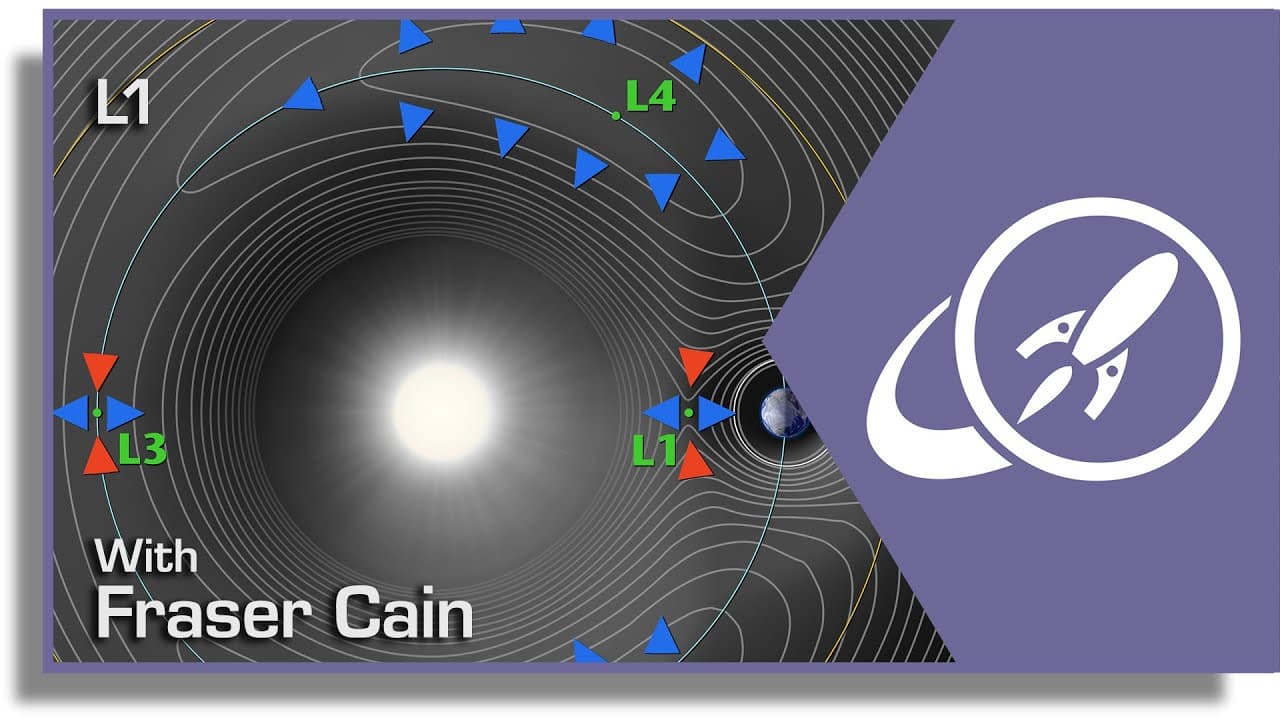
A Tour Of The Lagrange Points. Part 1 - Past And Future Missions To L1
70.8K views
•
August 30, 2019
by
Fraser Cain
YouTube video player
A Tour Of The Lagrange Points. Part 1 - Past And Future Missions To L1

TL;DR

Lagrange Points are stable regions in space that provide ideal vantage points for various spacecraft missions and potential space colonies. L1 is a Lagrange Point between the Sun and Earth, used to observe the Sun and Earth's daytime side.

Transcript

Thanks to gravity, there are places across the Solar System which are nicely balanced. They’re called Lagrange Points and they give us the perfect vantage points for a range of spacecraft missions, from observing the Sun to studying asteroids, and more. Various spacecraft have already visited Lagrange Points, used them for some or all of their miss... Read More

Key Insights

  • 😥 Lagrange Points provide stable locations for spacecraft missions, allowing for long-term observations and monitoring.
  • ❓ L1, located between the Sun and Earth, is particularly useful for solar observations and studying the Earth's daytime side.
  • 🥳 Lagrange Points require a specific mass ratio between celestial bodies to be stable, and not all celestial systems have viable Lagrange Points.
  • 👾 Future mission ideas include using Lagrange Points for asteroid observation, combating climate change, and even constructing a space elevator on the Moon.

Install to Summarize YouTube Videos and Get Transcripts

Explore YouTube Video Summarizer or Get YouTube Transcript Extractor

Questions & Answers

Q: Why are Lagrange Points important for spacecraft missions?

Lagrange Points provide stable locations in space, allowing spacecraft to observe specific objects, such as the Sun or Earth, without interference from other celestial bodies.

Q: What is the purpose of having spacecraft at L1?

L1 is an ideal location for monitoring the Sun's solar wind, observing the Earth's weather patterns, and detecting coronal mass ejections.

Q: Can Lagrange Points be used for deep space observations?

Lagrange Points offer unique vantage points for observing distant objects, such as asteroids, and can be used for future missions to study gravitational waves.

Q: How are Lagrange Points affected by gravity and mass ratios?

The stability of Lagrange Points depends on the mass ratio between the larger celestial bodies. The Sun's mass compared to Earth or Jupiter allows for the existence of stable Lagrange Points.

Summary & Key Takeaways

  • Lagrange Points are balanced regions in space that allow for stable spacecraft missions.

  • L1, between the Sun and Earth, is used to observe the Sun and Earth's daytime side.

  • Various spacecraft, such as SOHO and DSCOVR, have been stationed at L1 for solar observations and monitoring Earth.


Read in Other Languages (beta)

English

Share This Summary 📚

Summarize YouTube Videos and Get Video Transcripts with 1-Click

Download browser extensions on:

Try YouTube Summary with ChatGPT & Claude or YouTube Transcript Generator

Explore More Summaries from Fraser Cain 📚
Why Isn't the Asteroid Belt a Planet? thumbnail
Why Isn't the Asteroid Belt a Planet?
Fraser Cain
Why Did Mars Lose Its Atmosphere? And How Can We Get It Back? thumbnail
Why Did Mars Lose Its Atmosphere? And How Can We Get It Back?
Fraser Cain
What's On The Far Side Of The Moon? thumbnail
What's On The Far Side Of The Moon?
Fraser Cain
Exploring Space Lava Tubes: How To Prepare For It thumbnail
Exploring Space Lava Tubes: How To Prepare For It
Fraser Cain / Universe Today Podcast
Are We Living in a Simulation? Understanding the Simulation Hypothesis thumbnail
Are We Living in a Simulation? Understanding the Simulation Hypothesis
Fraser Cain

Summarize YouTube Videos and Get Video Transcripts with 1-Click

Download browser extensions on:

Try YouTube Summary with ChatGPT & Claude or YouTube Transcript Generator

Apps & Extensions

  • Chrome Extension
  • Safari Extension
  • Edge Add-ons
  • Firefox Add-ons
  • iOS App
  • Android App

Key Features

  • YouTube Video Summarizer
  • Web & PDF Summarizer
  • Web & PDF Highlighter
  • Chat with PDF
  • Ask AI Clone
  • Audio Transcriber
  • Glasp Reader
  • Kindle Highlight Export
  • Idea Hatch

Integrations

  • Obsidian Plugin
  • Notion Integration
  • Pocket Integration
  • Instapaper Integration
  • Medium Integration
  • Readwise Integration
  • Snipd Integration
  • Hypothesis Integration

More Features

  • APIs
  • MCP Connector
  • Blog & Post
  • Embed Links
  • Image Highlight
  • Personality Test
  • Quote Shots

Company

  • About us
  • Blog
  • Community
  • FAQs
  • Job Board
  • Newsletter
  • Pricing
Terms

•

Privacy

•

Guidelines

© 2026 Glasp Inc. All rights reserved.