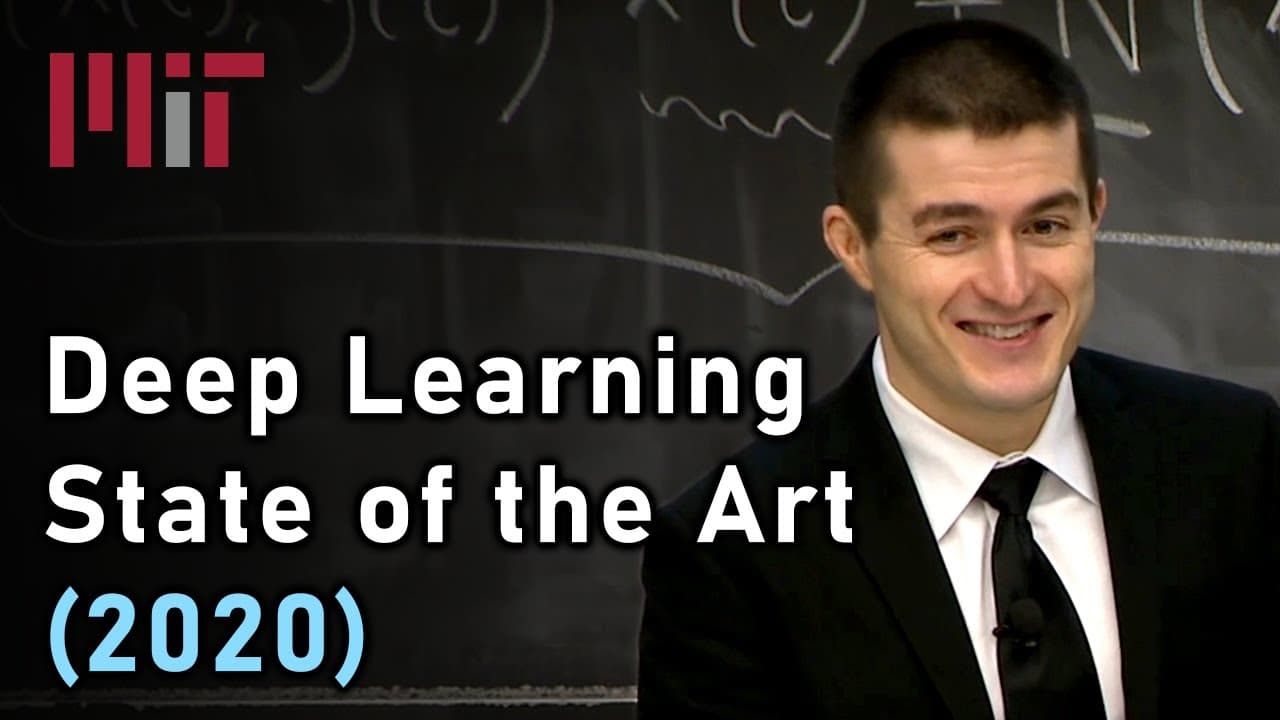
Deep Learning State of the Art (2020)
TL;DR
Deep learning has seen remarkable progress in recent years, with groundbreaking advancements in neural networks, natural language processing, and reinforcement learning. This includes significant achievements such as the development of powerful models like BERT and GPT-2, as well as the recognition of deep learning's limitations and the need for ethical considerations in AI. The Turing Award highlights the critical contributions of pioneers in this transformative field.
Transcript
welcome to 2020 and welcome to the deep learning lecture series let's start it off today to take a quick whirlwind tour of all the exciting things that happened in seventeen eighteen and nineteen especially and the amazing things were going to see in this year in 2020 also as part of this series is going to be a few talks from some of the top peopl... Read More
Key Insights
- 🎉 The Turing Award was given for deep learning, marking its growth and maturity as a critical component in computing.
- 🧠 The dream of artificial intelligence is to understand and recreate the complexity of the human mind, and deep learning is bringing us closer to that goal.
- 💻 The history of deep learning dates back to the early models of neural networks in the 1940s and has since evolved through various advancements and breakthroughs.
- 📚 The field of natural language processing has seen significant progress with the development of powerful language models like BERT and GPT-2.
- 🎮 Deep learning has also made major strides in the world of games, with AI systems defeating world champions in chess, Dota 2, and Starcraft 2.
- 🤖 Autonomous vehicles are a hot topic, with companies like Waymo and Tesla leading the way in developing advanced AI systems for self-driving cars.
- 📈 The frameworks for deep learning have matured and converged, making it easier for researchers and practitioners to work with and build upon existing tools.
- 🌍 Ethics and responsible AI practices are becoming increasingly important in the field, with discussions about the limitations and potential dangers of deep learning.
Install to Summarize YouTube Videos and Get Transcripts
Explore YouTube Video Summarizer or Get YouTube Transcript Extractor
Questions & Answers
Q: What is the significance of the Turing Award being given to deep learning experts?
The Turing Award is a prestigious honor in the field of computer science, given to individuals who have made exceptional contributions. By awarding the Turing Award to the pioneers of deep learning, the industry acknowledges the significant breakthroughs and advancements made in this area, solidifying it as a critical component of computing.
Q: What are some challenges in deep learning for natural language processing?
One of the challenges in natural language processing is common sense reasoning, which involves understanding and integrating common-sense knowledge into learning architectures. Another challenge is reasoning in open domain conversations, where systems need to transition from structured dialogue to more free-flowing and open-ended conversations.
Q: How do self-play and multi-agent learning contribute to advancements in deep reinforcement learning?
Self-play and multi-agent learning allow agents to learn from their own interactions, continually improving their strategies and performance. It enables the discovery of novel and unorthodox approaches to gameplay and can lead to the emergence of complex behaviors and strategies that humans may have not explored yet.
Q: What are some hopes and challenges in the field of autonomous vehicles?
One hope is to improve the level of autonomy in vehicles, moving towards Level 4 autonomy where AI systems are responsible for actions without a human supervisor. Challenges include addressing the difficulty of driving, perception, planning, human behavior modeling, and determining the level of human vigilance necessary for Level 2 autonomy.
Q: How can transparency and ethics be incorporated into recommender systems?
Transparency and ethics in recommender systems can be achieved through publishing more details about the algorithms used and their biases, implementing systems that allow users to have more control and visibility into recommendation processes, and ensuring diverse and unbiased representation in the algorithms' training data. These measures can help overcome the issue of controlling how people think and see the world through these systems.
Summary
This video provides an overview of the exciting developments in deep learning from 2017 to 2019, and looks ahead to what we can expect in 2020. It covers topics such as the history and growth of deep learning, the Turing award given for deep learning, the limitations and criticisms of deep learning, advancements in natural language processing, practical frameworks for deep learning, advancements in reinforcement learning and self-play, and applications of deep learning in robotics.
Questions & Answers
Q: What is the dream of artificial intelligence?
The dream of artificial intelligence is to understand and recreate the capabilities of the human mind, including thinking, reasoning, and understanding concepts. This dream is driven by the desire to engineer intelligent systems that can replicate the functionality and capabilities of the human brain.
Q: What were the key developments in deep learning from 2017 to 2019?
Some key developments in deep learning during this period include the Turing award being given for deep learning, advancements in natural language processing using transformer models, the maturing and convergence of popular deep learning frameworks such as TensorFlow and PyTorch, and the growth and advancements in reinforcement learning and self-play.
Q: What are the limitations of deep learning?
While deep learning has made significant advancements, there are still limitations to its capabilities. Deep learning struggles with tasks such as common sense reasoning, reading and understanding context from large bodies of text, and integrating symbolic reasoning with learning systems. Additionally, there is a need for more diverse data sets and ethical considerations regarding biases in data and algorithms.
Q: What were some of the advancements in natural language processing?
Some of the advancements in natural language processing include the development and popularization of transformer models, such as BERT, XLNet, and ALBERT, which achieved state-of-the-art results on various language benchmarks. There have also been tools and libraries created, such as Hugging Face's Transformers, which allow for easy use and exploration of these language models. Additionally, there has been progress in dialogue systems, open domain conversation, and reasoning in language models.
Q: What are some practical frameworks for deep learning?
TensorFlow and PyTorch are two popular deep learning frameworks that have experienced significant growth and convergence. TensorFlow has introduced eager execution as the default mode, making it easy to use and allowing for imperative programming in Python. PyTorch has focused on making deep learning accessible to beginners with its PyTorch 1.3 release and has added support for TensorFlow Processing Units (TPUs). Both frameworks are working on better support for mobile devices and deployment in the cloud.
Q: What advancements have been made in reinforcement learning and self-play?
There have been several advancements in reinforcement learning and self-play, particularly in the realm of games. OpenAI's OpenAI Five team achieved significant progress in the game Dota 2, beating world champions and using self-play to improve the AI's performance. DeepMind's AlphaStar project also made strides in playing the game StarCraft II, reaching Grandmaster level by observing and playing like human players. Additionally, there have been advancements in using reinforcement learning for robotic manipulation tasks, such as solving the Rubik's Cube.
Q: What are some applications of deep learning in robotics?
Deep learning has been applied to various robotics tasks, including robotic manipulation and autonomous vehicles. In terms of robotic manipulation, there have been advancements in using reinforcement learning to teach robot hands to manipulate objects, such as solving the Rubik's Cube. Autonomous vehicles have also seen progress, with self-driving car companies using deep learning algorithms to navigate and make decisions on the road.
Q: What is the lottery ticket hypothesis?
The lottery ticket hypothesis is the idea that within a larger neural network, there are smaller subnetworks that can achieve the same accuracy as the full network. This hypothesis was demonstrated in MIT's research, where they showed that by iteratively pruning and resetting the weights of a neural network, a smaller subnetwork could be found that achieved similar accuracy to the original network. This has implications for reducing the size and computational requirements of deep learning models.
Q: What are the hopes for deep learning in 2020?
In 2020, there are hopes to see advancements in reasoning and common-sense reasoning in natural language models, the transfer of success in transformers to visual information processing, continued application of deep reinforcement learning in robotics and robotic manipulation, and the exploration of social behaviors that emerge in self-play reinforcement learning agents. There is also a desire for framework-agnostic research and the development of greater abstractions to make machine learning more accessible to non-experts.
Q: What are some of the challenges in deep learning that remain?
Some challenges in deep learning that remain include the need for better reasoning and common-sense reasoning capabilities, expanding the context and understanding of language models to longer texts and stories, addressing limitations and biases in data and algorithms, and exploring the dynamics and emergence of social behaviors in multi-agent systems. There is also ongoing research to reduce the compute and resource requirements of deep learning models while maintaining or improving performance.
Q: What are the possibilities for reinforcement learning and self-play in the future?
In the future, there are possibilities of using reinforcement learning and self-play to study and understand human behavior, explore social behaviors that emerge in multi-agent systems, and develop novel strategies and behaviors in games. Reinforcement learning and self-play have the potential to reveal new insights into human decision-making and social dynamics, as well as inform the development of intelligent systems that can learn and adapt in complex and dynamic environments.
Takeaways
The past few years have seen significant advancements and growth in deep learning, with key developments in natural language processing, reinforcement learning, and robotics. While deep learning has made impressive strides, there are still limitations and challenges that need to be addressed. The future of deep learning holds promises for improvements in reasoning, context understanding, and the emergence of new capabilities in language models and reinforcement learning systems. Additionally, there is a need for greater collaboration, openness, and interdisciplinary efforts to drive progress in the field.
Summary & Key Takeaways
-
The content discusses the historical background and dreams behind artificial intelligence and deep learning, emphasizing the importance of understanding the human mind and recreating its functionalities.
-
It explores the growth and achievements of deep learning models and algorithms, from perceptrons and convolutional neural networks to the rise of transformers and GANs.
-
The content also delves into the recent recognition of deep learning's limitations and the importance of skepticism, as well as the celebration of the Turing Award for deep learning.
Read in Other Languages (beta)
Share This Summary 📚
Summarize YouTube Videos and Get Video Transcripts with 1-Click
Try YouTube Summary with ChatGPT & Claude or YouTube Transcript Generator
Explore More Summaries from Lex Fridman 📚
Summarize YouTube Videos and Get Video Transcripts with 1-Click
Try YouTube Summary with ChatGPT & Claude or YouTube Transcript Generator