Consciousness & Physiology I
Transcript
Read and summarize the transcript of this video on Glasp Reader (beta).
Install to Summarize YouTube Videos and Get Transcripts
Explore YouTube Video Summarizer or Get YouTube Transcript Extractor
Summary
This video discusses various aspects of consciousness and its relationship to physiology. It covers topics such as different states of consciousness, impaired states of consciousness, levels of awareness, neuronal correlates of consciousness, and the self.
Questions & Answers
Q: What is the easy problem of consciousness and why is it called easy?
The easy problem of consciousness refers to understanding the neural correlates of consciousness, or how neural activity in the brain gives rise to conscious experience. It is called easy because some progress has been made in studying this problem and scientists are able to correlate neural activity with specific conscious experiences.
Q: What is the hard problem of consciousness?
The hard problem of consciousness refers to the subjective experience of consciousness and how it arises from physical activity in the brain. It is difficult because there is currently no scientific explanation or understanding of how subjective experiences emerge from brain activity.
Q: How are neuronal correlates of consciousness studied?
Neuronal correlates of consciousness are studied using techniques such as electroencephalography (EEG), magnetoencephalography (MEG), positron emission tomography (PET), and functional magnetic resonance imaging (fMRI). These techniques allow scientists to observe and analyze neural activity in the brain in relation to conscious experiences.
Q: What areas of the brain are most related to consciousness?
Consciousness is most related to the associative areas of the cortex, which are involved in higher cognitive functions and awareness. These areas receive information from primary sensory areas and are responsible for conscious perception and experience.
Q: Can consciousness be affected by physiological factors?
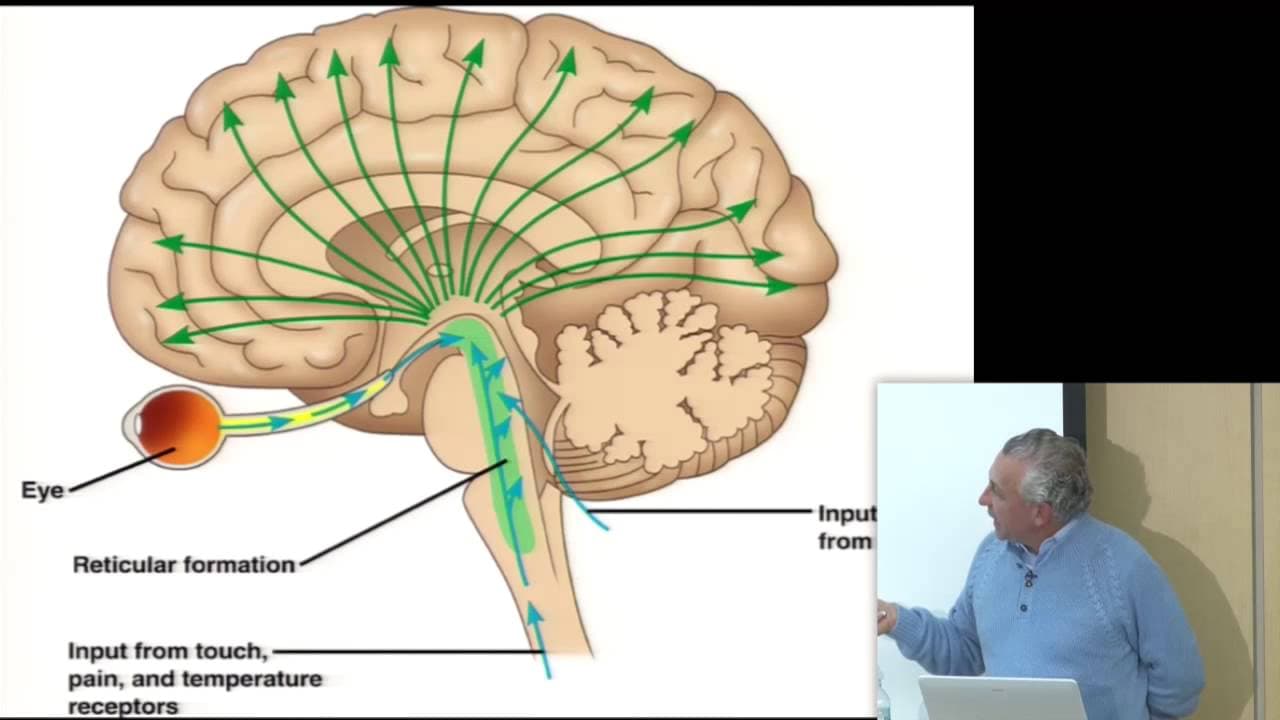
Yes, consciousness can be affected by physiological factors such as levels of arousal, attention, and awareness. For example, the reticular formation in the brain stem plays a role in regulating the level of consciousness by modulating arousal.
Q: How do subconscious processes and memory affect consciousness?
Subconscious processes and memory play a role in consciousness by storing information and automating certain actions. Once a task or action is learned, it is stored in subcortical areas of the nervous system, allowing it to be performed without conscious thinking.
Q: What is the self and how is it related to consciousness?
The self can be understood as both a physical and cognitive construct. The physical self is related to bodily functions and homeostasis, while the cognitive self encompasses higher cognitive functions such as language, speech, and self-awareness. Different areas of the brain, from the brainstem to the cortex, are involved in the various aspects of the self.
Q: Can consciousness be studied in other organisms?
The question of whether other organisms have consciousness is still a topic of debate and study. Understanding the presence and nature of consciousness in organisms such as animals is a complex question that requires further investigation.
Q: How does consciousness relate to time?
Consciousness is related to the perception and experience of time. It allows us to be aware of the passage of time and to have a sense of past, present, and future. However, the exact mechanisms of how consciousness relates to time are still not fully understood.
Q: What are some examples of altered states of consciousness?
Altered states of consciousness can be induced by various factors such as chemicals, hallucinogens, hypnosis, lucid dreaming, and sleepwalking. These states involve changes in perception, awareness, and physiological activity.
Takeaways
Consciousness is a complex and multidimensional concept that is intimately related to physiology. Scientists have made progress in understanding some aspects of consciousness, such as the neural correlates of consciousness, but the hard problem of consciousness, which relates to the subjective experience of consciousness, remains a challenging and unresolved issue. Further research is needed to fully understand the nature and origins of consciousness.
Read in Other Languages (beta)
Share This Summary 📚
Summarize YouTube Videos and Get Video Transcripts with 1-Click
Try YouTube Summary with ChatGPT & Claude or YouTube Transcript Generator
Explore More Summaries from Stanford 📚




Summarize YouTube Videos and Get Video Transcripts with 1-Click
Try YouTube Summary with ChatGPT & Claude or YouTube Transcript Generator